
03 October 2024
How to protect soils from the impact of machinery
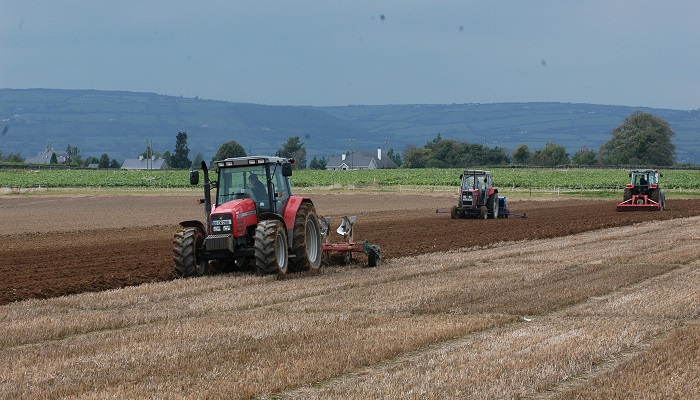
Modern tillage farming practices make soils more vulnerable to the impact of heavy machinery and traffic volumes, but tillage land can still function well if handled with care.
In this article, first published in the September/October edition of Today’s Farm, Dermot Forristal of the Teagasc Crops, Environment and Land Use Programme, digs deeper into the factors impacting soil compaction.
Until the 1970s, virtually all tillage happened on mixed farms. Typically fields were in grass for seven to ten years followed by three years’ annual crops, before returning to grass. This resulted in resilient soils with high organic matter levels. Today, as result of specialisation, most tillage fields are cropped for 40 to 50 years. This leads to lower soil organic matter levels and greater vulnerability to soil structural damage. Soils can still function with low organic carbon levels; but they must be managed with great care. In particular, we need to bear in mind:
- Soil moisture at the time of working.
- Machine weight and axle load.
- Tyre size, type, inflation pressure and ground pressure.
- Traffic management in-field and on headlands.
- Crop choice: cultivation requirement and timing of machinery operations.
Soil moisture
Soil moisture is the most critical factor. Very dry soils resist damage to their structure. But as they get wetter, soils become weaker and are more easily compacted. Machinery, or animal, traffic can cause compaction. Within the soil profile, compaction is what happens when the aggregates are forced together – shrinking the empty pore spaces between them. Even more serious structural damage occurs where the aggregates themselves are broken down.
So when is it safe to work on soil? This is not a straightforward question. Growers usually judge conditions by gauging how ‘sticky’ the soil is on a spade, a boot, or in the hand; with the soil’s texture (sand, silt and clay content) influencing the result.
Often, however, moisture in surface layers may not be a good indication of moisture levels down the profile. Heavy axles can have their greatest impact on wet soil layers well below the surface.
In autumn, the soil can be drier underneath. A plough and one-pass sowing system can often work well in these circumstances. As soils wet-up over the normal autumn sowing period, however, there are challenges for all tillage systems.
In spring after a wet period, the drying top soil can often mask wetter conditions below. In this situation, which was common in 2024, it would be better to wait – but for how long? Most growers will work the ground when they gauge the tillage tools won’t damage the soil.
While this is good practice, we cannot ignore the further impact of machinery weight, through the tyres, both in the field, and particularly on headlands. This type of soil damage must be prevented as remediation by further tillage e.g. subsoiling, can leave the soil vulnerable to serious damage from subsequent traffic.
Headlands
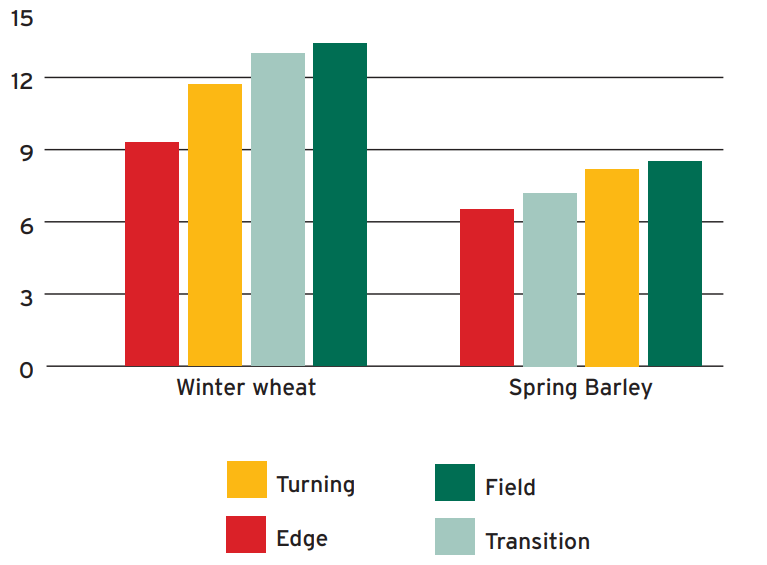
Field headlands are a particular cause for concern. They experience greater traffic with machines turning for the next field pass. Axle loads are greatly increased where mounted implements are raised for turning. A 120kW tractor could typically have four tonnes on its rear axle in the field. This could increase to eight tonnes on the headland. In a Teagasc Oak Park research study carried out over 40 growers’ fields, Mark Ward found that parts of the headland had yield reductions of 44% in winter wheat and 31% in spring barley (Figure 1) .
Figure 1: Crop yield in three headland areas (edge, turning, transition) compared to in-field area in winter wheat and spring barley fields
Source: Today’s Farm
While this was not all caused by compaction, the loss caused by compaction alone was about 15%. Survey work at the same period found headland axle loads varied from six to more than 16 tonnes depending on the establishment machinery being used.
Field headlands can amount to a sizeable part of our fields’ total area. For example with an approximately square field of 5ha, two of the headlands at 24m wide will have most traffic and account for 1.1ha or 22% of the field. The third (side) headland will have some additional turning depending on the field shape adding another 11%. In total, one-third of the area could be impacted by headland traffic to some extent. It is imperative that we try to minimise damage to headlands by carefully managing traffic there.
Reducing machinery ground pressure
The ground pressure exerted by a wheel can be reduced by decreasing the load or weight on the wheel, or by increasing the tyre size or contact area between the tyre and the ground.
Loads can be decreased by reducing machine size and this should be carefully considered when selecting machines. We sometimes seem to be pursuing scale to reduce labour at all costs. This may not always make sense with our field sizes and distances between fields and land blocks.
While the manoeuvrability of mounted equipment is a benefit in smaller fields, the use of trailed equipment can greatly reduce axle loads. Unfortunately, much of the trailed equipment available is not designed for manoeuvrability in small fields or trafficability in wetter conditions.
Larger tyres, lower pressures, less soil stress
Big tyres are expensive, but they are essential with our heavier machines. They can carry loads at lower inflation pressure. Consequently they will exert a lower ground pressure, reducing the stress on the soil.
Tyre size is relative. A 600/65R38 would have been considered large when fitted to an 80kw (105hp) tractor 25 years ago, but is totally inadequate on a 135 kW tractor (185hp) today.
We can use the required inflation pressure of a tyre as a guide to ground pressure. So how do we select tyres? An example of a 120kW tractor and a five furrow mounted plough is given in Table 1.
Table 1: Tyre options and pressures; 120KW tractor and 5F plough, 8t axle load, 30kmh
| Tyre options | Inflation pressure bar |
|---|---|
| 520/85R38 | 1.6 |
| 650/65R38 | 1.2 |
| 800/65R32 | 1.0 |
| VF 650/65R38 | 0.9 |
The target ground pressure/inflation pressure depends on the condition of the soil when working but for ploughing it may be 1.0 bar pressure. It would be less (0.8 bar) for sowing and drilling. With a rear axle load on the headland of 8t, four tyre options are considered.
The first 520/85R 38 requires 1.6 bar pressure to carry that load, resulting in considerable soil stress. A change to wider 650/65R 38 tyres reduces the pressure to 1.2bar which is still too high. Selecting an 800/65R32 tyre would allow the 1.0bar target to be achieved, but this would be a very wide tyre for ploughing. The last option is a VF 650/65R38 tyre which allows a pressure of 0.9bar to be achieved meeting our target. But what is a VF rated tyre?
New Tyre technology: VF and IF tyres
A tyre’s contact area is determined by its width and diameter, and the inflation pressure within the tyre. The inflation pressure is determined by how much sidewall deflection that is allowed.
In the past, all manufacturers used similar inflation pressure guidelines for specific tyre and load combinations. But 20 years ago, more flexible carcasses capable of running at lower pressures without damage, were developed by Michelin, and designated IF or VF. Today most major manufacturers have VF or IF tyre options available.
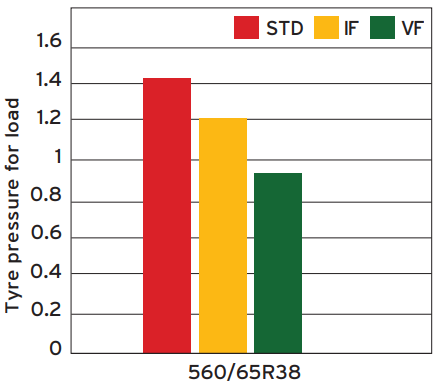
These allow lower pressures and larger (longer) contact patches. The reduction in ground pressure is up to 40% with VF tyres and 25% with IF tyres. In Figure 2, the pressure reduction for IF and VF tyres of the one size is illustrated for an 8t axle load at 40kmh speed. While currently expensive, this technology will help dissipate some of the extra load imposed on the soil.
Figure 2: Standard, VF and IF tyre pressure for 8t axle load (650/65r38 at 40kmh)
Source: Today’s Farm
Traffic management
In addition to avoiding working and driving on the soil in wet conditions, further traffic management options are possible. These include:
- Cultivating and sowing headlands last. This allows machines to turn on uncultivated soil.
- Switching the headland to the other sides of the field, or setting up a turning headland inside an existing headland, to allow damaged headlands to repair, possibly following loosening.
- Controlling traffic paths using auto-steer and accurate GPS, restricting compaction to tightly controlled zones/paths and having more gentle turns by skipping passes when turning.
Crop choice
Finally, crop choice can also play a role. Oilseed rape for example is sown in August and harvested in July, ensuring that the main machinery operations are carried out when the soil is likely to have good carrying capacity.
Conversely, vegetable crops requiring excessively cultivated seedbeds, compounded by destoning, and with contract-determined harvesting dates (e.g. carrots), should only be considered on light textured soils on free-draining sites, with good field access, to reduce the risk of damage. As we look out at seemingly incessant showers it seems we will never be short of water. Whether we continue to have six inches of well-structure topsoil is in your hands.
The above article first appeared in the September/October edition of Today’s Farm. Find out more about Today’s Farm here.