
08 March 2024
How best to use organic manures this spring
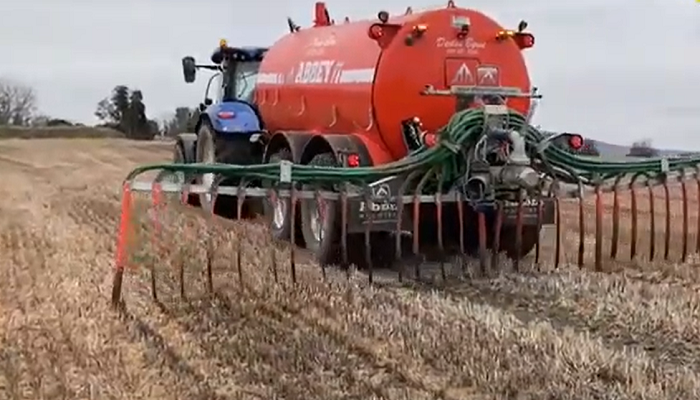
Michael Hennessy discusses the importance of planning the application of organic manures to tillage fields, considering nutrient allowances and the impact on chemical fertilizer needs.
The longer days and drying winds in March should hasten the dry out time needed for land to allow progress in fields. There is a lot of work to be completed in a short space of time. One of these tasks is applying organic manures to tillage ground.
Before you start applying slurries, FYM, poultry manures, spent mushroom compost or sludge’s, ask yourself a two key questions;
- Do I have sufficient allowance to apply the organic manure? i.e. sufficient phosphate allowance
- How can I get the most from the organic manure?
The days of applying an organic manure and largely ignoring the nutrient content have come to an end with the introduction of the Department of Agricultural National Fertiliser Database. This is because the DAFM will have a clear view of all chemical fertilisers purchased by all farmer each year.
For every tonne or 1,000 gallons of organic manure applied to the farm this mean the allowance for chemical fertilisers must be reduced. Phosphate will generally be the limiting nutrient for most tillage farms.
To give a simple example, we will take a 40 ha (100 acre) block on a farm, with up to date soil samples, all showing P index 3, and the area is planted to spring barley. This farm will have standard allowance of 25 kg P/ha or 1,000 kg P for the block. Where the farmer chooses to use 13:6:20 compound (which contains 60 kg of P in every 1,000 kg of product) the total tonnes which can be bought is 16.6 tonnes (416 kg/ha or 3.36 x 50 kg bags/ac) based on P as the limiting element.
If the farmer imported 22 m3/ha (2,000 gal/ac) of cattle slurry to half (20 ha) the block (a total of 440 m3 of slurry) this would apply a total of 220 kg of P (1m3 of cattle slurry contains 0.5 kg P). The farmer incorporated the slurry within 2 hours of application to stubbles to ensure N loses are minimised.
Before the farmer can buy chemical fertiliser, the P in slurry (220 kg P) must be deducted from the total allowance (1,000 kg P), leaving 780 kg P remaining to be applied to the block.
If the farmer was to stick to purchasing 13:6:20 now the farmer can only purchase 13 tonnes.
However, as 1m3 of slurry also contains 3.5 kg of K (potash), therefore the slurry will apply almost all of the crops K requirements. The farmer can now switch to applying straight P (4.8t of super phosphate) and balance the nitrogen with straight CAN or Urea.
Where you are unsure about the calculations be sure to consult your farm advisor.
Find your local Teagasc office here