
03 February 2024
Converting to organic tillage
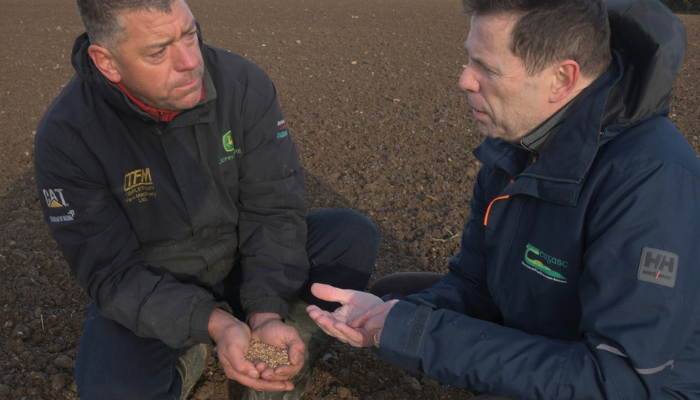
Martin Bourke, Teagasc organic tillage advisor, speaks with Liam O’Toole about his experience, one year in.
It was a no brainer to switch,” says Liam O’Toole who farms near Avoca, Co Wicklow. For the last 25 years, he had been conventionally farming winter and spring cereals, along with oilseed rape and spring beans as break crops. This all changed one year ago, when he took the decision to convert part of his farm to organic tillage. Martin Bourke, organic tillage specialist, paid him a visit to see how he fared during his first season.
Why did Liam go organic?
Liam said that the price of fertiliser and the crop protection costs of growing a conventional crop were ‘gone too high’. He had examined the figures carefully, and it made perfect sense to switch.
“Also, my gut feeling was that too much chemistry is being used in tillage production,” says Liam. “Un- less the price of conventional grain is above €300/tonne, I see very little future in conventional tillage production.”
The partial conversion option
“In my opinion, the biggest hurdle for any tillage farmer considering organic production is to be able to challenge the conventional mind-set and the fear of failure,” says Liam. “You can’t be concerned about what the neighbours might think.”
Liam says that partial conversion, which means not having to put all of the farm into organic at once, gave him the confidence to give it a try.
Partial conversion does involve some restrictions. Liam is not al- lowed to grow the same species or variety of crop on the conventional part of his farm and the organic part of his farm in any given growing season. He must also ensure his seed drill and combine harvester are thoroughly cleaned before sowing, or harvesting, his organic crops.
One year on, does he have any regrets?
“I have absolutely no regrets,” says Liam. “In fact, I want to put more of the land I farm into organic production.” He says he definitely sees a future in it, adding that the workload is less than previously. This is especially important as he is a qualified mechanic and holds down a full-time job testing cars with NCT.
He was really happy with year one. “My first organic crop was 58 acres of a really nice crop of spring oats,” says Liam. “The crop stood perfectly with very few weeds, any present remained down low in the crop. I grew it with 2,000 gallons per acre of imported cattle slurry and an application of poultry manure pellets.”
It takes two years for land to become certified as fully organic, so Liam sold his oats conventionally to the local merchant. Liam also bought six acres of land from his brother which had been converted to organic production a year earlier. He grew an intercrop of peas mixed with oats on this land and it was sold to another organic farmer as second year ‘in-conversion’ feed.
Plans to expand organic area
If Liam could secure longer-term leases on the rest of his rented land, he says he would put it all into organic production. Due to competition for rented land and losing rented land to building development, Liam is finding it harder to maintain his acres. At one stage he was farming almost 500 acres, but is now back at 220 acres.
Even though the rest of his land farmed wasn’t converted to organic, Liam had decided to go down the low input route with his conventional crops. He is convinced that 2023 was a year that this approach offered better profitability than the more normal high-input approach adopted by most tillage farmers, as crops did not reach their normal yield potential.
Is organic tillage farming profitable?
Liam is convinced the figures stand up. “Your main cost is seed and paying a contractor to spread some cattle slurry or composted FYM,” he says.
“After that you close the gate. Straight organic cereal for animal feed is currently trading for about €400 per tonne, and the combination crops (mixture of legume and grain) are selling for higher.
“You don’t need to be a maths genius to work out that if what you’re selling is double the price of conventional, and that your yields are half that of conventional, well then the higher profitability comes from the significantly reduced input costs. A 10-year- old could do that calculation!”
Was there any extra paperwork?
Liam says he is quite happy that the level of paperwork and record keeping isn’t really much additional work compared to conventional farming. He believes that traceability and thorough recordkeeping is very important to protecting the highly valued organic brand.
What crops are you growing organically and who is your market?
Based on a Department of Agriculture feed survey of all organic farmers in Ireland, the demand for organic cereals and combination crops is estimated to be about 40,000 tonnes.
Currently there are just over 4,000ha of organic crops grown. So based on a yield of 4t/ha, the current organic tillage area is producing just 16,000 tonnes of cereals and combination crops – 40% of total demand.
Liam hopes to sell into this organic animal feed market. He says he would also like to secure a contract with Flahavan’s to grow oats for their expanding organic oats market. His plan is to have a sustainable, stockless rotation, of oats, protein/cereal intercrops and organic milling wheat. He says that should fields start to get a little dirty with weeds, he may sow red clover for a few years to clean them up and build soil fertility.
Niche markets
Liam is also keen to grow organic crops for some niche markets. “I have just sown a new variety of winter wheat called HE Goldkorn selected under Irish conditions from a well-established biodynamic variety used in Germany and other parts of Europe,” he says.
HE Goldkorn is a milling quality winter wheat selected and improved under Irish growing conditions over the last 15 years. Liam sourced the seed from Wilhelm Rost, a German businessman, who has been selecting and multiplying seed from this variety under extreme conditions in Gort, Co Galway.
Milling and baking have been successful with this variety in recent years, and there is currently strong demand for flour from this grain.
This article was first published in Todays Farm, read more from Today’s Farm – January/February 2024 here