
08 November 2023
Farming in a modern climate at Ballinafagh
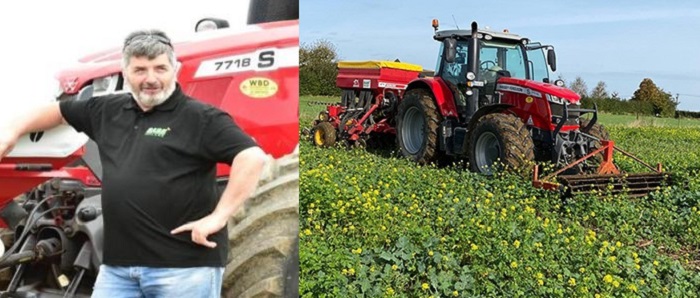
Tom Tierney, a participant in the Teagasc Signpost Programme, tells us of the happenings on his farm over the month of October. Tom farms 165ha of owned and long-term leased land in partnership with his neighbour Gordon.
Amidst an extremely difficult harvest, my attention was soon turned to dealing with ‘EU intelligence in the sky’ as the Department of Agriculture, Food and the Marine’s (DAFM’s) AgriSnap app was required to validate crops I had planted in fields by uploading field photographs.
However, the fields in question already had their crops harvested and replanted with cover crops before the queries arose, hence the confusion. Then there was the app not working properly causing endless annoyance – every single time I went to upload photos they’d bounced back.
While the DAFM helpdesk was very helpful, we soon realised it was not the fault of either the iPhone or the gifted photographer, but that of the AgriSnap app. The issue was soon confirmed by an on the ground DAFM inspection at local level. After a brisk walk to one of the fields, now cropped for harvest 2024 to winter oilseed rape, we could easily identify the winter barley volunteers, confirming the previous crop to be indeed a winter barley crop. AI nil points, IQ one point.
The hidden cost of compliance
With all the wet downtime, we assessed the new 3m Nitrates Regulation riparian buffer zone requirements and their impact on the farm going forward. For example, we have a 50ac block that was leased in five years ago and all six fields now have to have buffers increased out to 3m to comply with current rules. Having measured these field margins over the 50ac land block, we will lose 2 viable acres to buffer zones. Potentially 8 t/year at €200/t. Not forgetting to mention our landlord will hardly forgo his rental on these non-productive acres. The hidden cost of compliance!
Summer cover crops
The stubbles after winter oilseed rape were disced and air-seeded post-harvest with 4kg of mustard cover crop, while at the same time complying with the straw incorporation measure. Winter wheat straw was also chopped, disced and air-seeded with a cover crop mix of Buck wheat, Vetch and Phacelia at the same time. In fact, with all the wet weather during harvest, I decided all crops would have their straw chopped and disced in, with nutrients returned to the soil instead of exported off field in the form of straw bales. Both of these measures featured in the latest Teagasc MACC, contributing to a reduction in my GHG emissions on farm, which I am trying to achieve as part of the Signpost Programme.
Field crop rotations for autumn 2023
Break crops
I’ve more acres of winter oilseed rape this year than I normally would have. This year I’ve planted a conventional winter oilseed rape variety, sown at 8kg/ha using the 5 meter disc harrow with mounted APV air-seeder. Output at 10ac per hour in catchy weather overcame the usual workload problems of simultaneously combine harvesting and oilseed rape planting, with the higher seed rate allowing for a few losses from weather and slugs. I predict slugs will be a serious issue this year.
Also read: Why you should monitor crops for slug damage this autumn
Cereals
We started direct drilling cereals on October 8th with hybrid rye variety KWS Tayo sown at 62kg/ha into a standing green mixed cover crop. We then moved on to winter wheat (Graham) direct drilled at 200kg/ha on October 10th after winter oilseed rape, again into a standing green cover crop of mustard and volunteers.
To terminate the cover crops, the newly-planted cereals received a pre-emergence herbicide spray consisting of 2.0L/ha of 480g glyphosate plus 0.3 Lt/ha of Firebird herbicide for grass weed control, all applied within days of sowing.
No insecticides will be used. Slug traps will be used to monitor slug feeding pressure. I would prefer not to have to apply slug pellets and will only do so if necessary as part of my IPM crop protection. However, sometimes this is essential as having no crop is not an option.
Opinion
The latest EU MEP decision (October 13th) on glyphosate is disappointing and could be the end of no-till/direct drilling in our Irish maritime climate. Employing no-till practice on my farm allows me to reduce my pesticide use by up to one third compared to conventional intensive tillage. But glyphosate use is an essential part of no-till practice and is used whenever and wherever necessary. By all means ban or limit sales of glyphosate from DIY home-stores & garden centres, and outlaw its purchase or use by general public and non-professional users using unsuitable equipment – but until professional users have an alternative to glyphosate then common sense should prevail, you’d think!
Carbon capture
As part of Signpost, Teagasc was on the farm recently to install an Eddy-Covariance flux tower in one of my larger cereal fields. This tower will take real time atmospheric and soil measurements of greenhouse gas exchanges along with meteorological data. Teagasc has already completed on-farm baseline soil carbon testing. These results, together with the towers measurements, will provide data on carbon capture/sequestration on this farm and will be included in the new National Agricultural Soil Carbon Observatory (NASCO). This will be used to provide accurate, long-term information on changes in carbon within Irish agricultural systems.
Forestry
This farm also has 11ha of forestry that was established on old set-aside fields over twenty years ago. The recent launch of the Afforestation Scheme 2023 – 2027 by Senator Pippa Hackett at the National Ploughing, while overdue, was very welcome news.
Overall the initiative seems to offer more than preceding schemes. I’m particularly interested in the forthcoming details around forestry harvesting machinery incentives as my forestry is due commencement of first thinning & I’d favor sustainable on-farm tree harvesting perhaps using my own forestry machinery in a low environmental impact and sustainable way. This low impact approach would also support continuous cropping forestry which I’m aiming to achieve for my forestry.
Finally, to follow on from a previous mention. My daughter Erin has been successful in getting a placement on a Teagasc Green Cert Course.
This article first appeared in the Farming Independent. Tom Tierney is a participant in the Teagasc Signpost Programme. For more information on Tom’s farm click here.