
26 October 2023
Bringing precision to the spreading of organic manures
Although farmers try to be accurate with chemical fertiliser spreading, through the use of tray testing and fertiliser spreader calibration, bringing precision into spreading organic manures is very important.
That’s a according to Dermot Forristal, Teagasc researcher in crop mechanisation, who joined Michael Hennessy, Teagasc Head of Crops Knowledge Transfer, and Don Somers, Teagasc Signpost Programme tillage farmer, on a recent episode of the Teagasc Tillage Edge podcast.
Dermot commented: “Organic manure spreaders tend to vary width wise and spread; they tend to vary.
“Attempts need to be made to get that right – speed of the floor belt, the speed of the tractor, to try and make sure that you have the same output from the start to the end of the load.
“Technology can help that by having weighing equipment to control it but can be very expensive. But even without this, you can still make adjustments on the move to improve the precision.”
Don Somers, a tillage farmer from outside Enniscorthy, Co. Wexford, also detailed some of the precision farming technologies being used to bring as much precision and accuracy as possible to the application of organic manures on his farm.
On this, he said: “I have a Bergmann universal spreader which can apply both lime and organic manures. I can’t justify a weight cell system on it to do variable rate, but what I have done is fit a weighing system to my loader. I can weigh in lime, poultry manure or farmyard manure and know exactly what weight went into the spreader.
“Because I have GPS on the tractors, I know what areas are spread and how much they are getting. Without a major investment, I can be as accurate as possible with the equipment I have.”
Along with the above, Don also completes an analysis of organic manures to identify their nitrogen, phosphorous and potassium contents. With this information to hand, he can calculate how much N, P and K is applied and make up the difference with chemical fertiliser.
These organic manures are applied on the basis of Don’s Nutrient Management Plan, soil tests and yield maps, but Don also uses his knowledge of the farm and different fields, which sees poor yielding headlands, for example, receiving extra organic manures.
Also read: Using yield maps to make better decisions in the future
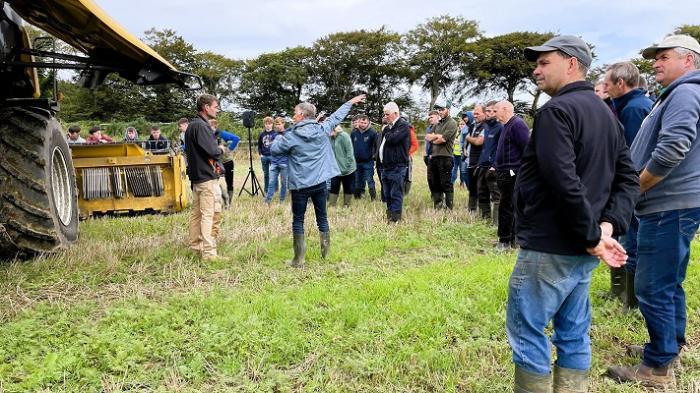
Don Somers was the host of a recent Signpost Programme tillage event, from which a number of Teagasc Tillage Edge podcasts were recorded. Listen to these podcasts below:
How this Wexford farmer is getting the best from precision machinery:
Getting the best from cover crops and organic manures on Don Somers’ farm
Soil management on Don Somers’ farm
This article has been published as part of Teagasc Signpost Sustainability Month. For more information on the activities planned, click here. To learn more about the Teagasc Signpost Programme and its ambitions, click here.