
12 October 2023
An update on winter barley and winter wheat plantings
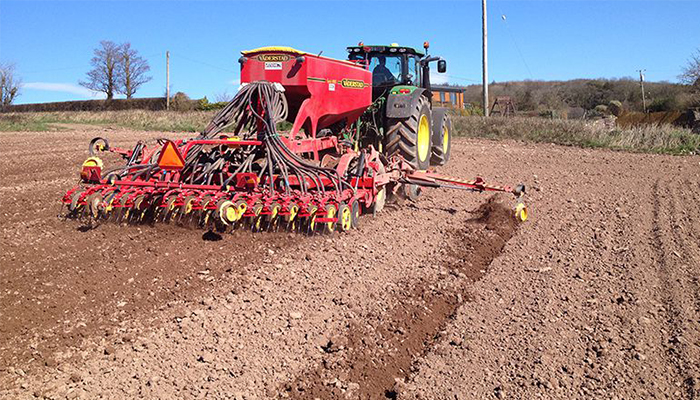
Shay Phelan, Teagasc Crops Specialist, provides an update on winter barley and winter wheat plantings and provides some key agronomic advice on the management of these crops and winter oilseed rape.
Winter Barley
Winter barley planting is reported to be well back on 2022 when just over 53,000 ha were planted but it remains to be seen what next week brings in terms of weather, which could allow more to be planted. Later planted crops will need higher seed rates as establishment rates will drop with the poorer seedbeds, the losses with slugs and birds will also be higher at this time of year. Depending on the thousand grain weight of the seed conventional varieties will need to be drilled at about 200kg/ha (12.7 stone/acre) while 6 row hybrids will be around 100 kg/ha (7 stone/acre).
Visit the Teagasc seed rate calculator for more details
Rolling will not now be possible on most crops as the underlying conditions are very wet, even though on sunny days the top of the ground may dry off, conditions underneath by enlarge are not suitable. This also makes it important to keep seed rates high.
If possible prioritise pre-emergence herbicides on winter barley as the post emergence options for grass weed control are poor products containing flufenacet (Firebird etc.) prosulfocarb (Defy etc.) or pendimethalin (Flight, Stomp etc.) will work better at controlling grass weeds. The addition of DFF (Diflanil) will broaden the weed spectrum or increase the effectiveness of the mixture. Avadex Factor will give good control of grass weeds when used in a programme with flufenacet.
Early drilled barley has now emerged so keep an eye out for pests such as slugs and aphids. Where you think there is a risk of slugs lay down some traps and count the slugs under them after 24-48 hours, if you see 4 or more per trap consider treatment. Early drilled barley is more at risk of BYDV unless one of the tolerant varieties, Joyau or Molly have been drilled. For conventional varieties the advice is still to apply an insecticide at the two to three leaf stage and a second application on these early sown varieties may be warranted later in the season especially in risky areas along the coasts.
Winter wheat
Again many growers are struggling to get drilling completed due to the poor weather and poor ground conditions. With the forecast set to improve next week consider waiting a day or two to let ground soak out before starting to drill. This will help to improve seed beds and increase establishment rates.
Ideally all wheat should be drilled around the 15th of October as trials in Oak Park have previously shown that that is, on average, the optimum timing for drilling wheat. Many growers will drill later into the month and into November but again this will depend on the seedbed conditions, while wheat can tolerate poorer conditions than barley, they still won’t tolerate waterlogging.
Similar to barley pre-emergence control of weeds works better than post emergence although there are more options in wheat where grass weeds are a concern. Where blackgrass is an issue, use Avadex Factor plus flufenacet at full label rates, pre-emergence, this can be followed up with a post emergence application of flufenacet and or Pacifica Plus or Monolith, assuming there is no resistance.
Winter oilseed rape
Crops are growing well in the last few weeks and the higher than normal temperatures have helped crops to catch up despite the later drilling. Phoma is evident in many crops and treatment with Proline 0.4l/ha will be needed if it continues to spread. Many crops will also get a graminicide as volunteers and grass weeds are competing with the crop at the moment. Many crops have not yet received a herbicide with many growers intending to use Kerb or Astrokerb when temperatures drop later in the season, remember grass weeds will be competing with the crop and should be treated as soon as possible, even though Astrokerb will also control grass weeds. Based on last years’ experience, when these products became very scarce order your requirements as soon as possible.
Tillage edge podcast
Over the last few weeks Michael Hennessy has been talking to Don Somers one of the Teagasc tillage Signpost farmers about different aspects of his farm all which are aimed at farming as sustainably as he can. As this week is Teagasc Farm Sustainability Week it is a good time to hear how Don is changing his practices to become more sustainable.
Listen to the Tillage Edge podcast