
05 October 2023
Nutrient management planning has never been as important on tillage farms
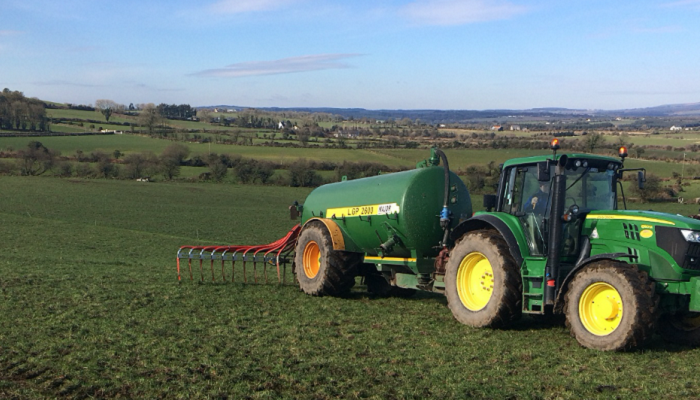
At the moment, there is a lot of talk in the media and within farming circles about the reductions of nitrogen as part of the nitrates delegation for intensive livestock farmers. Michael Hennessy tells us why the option of exporting slurry off these farms should explored.
Almost all tillage farmers would welcome organic manure to their farms as it adds add extra N, P and K, boost soil carbon and will add resilience to the soil.
There are a number of reasons why tillage farmers should be careful when importing organic manure for the coming year.
All Tillage farms should have a nutrient management plan
Every tillage farm needs to have a valid soil test in order to apply phosphate to any field. If a field does not, then it is assumed that soil is at P index 4 therefore no P is allowed to be applied (chemical or organic) .
Tillage farmers are aware how well nutrients are utilised on farm. The National Farm Survey data shows Tillage farm nitrogen use efficiency of 70% or over and phosphorus use efficiency of well above 80%. Therefore there is little wriggle room for reducing or miscalculating the nutrients available to the growing crop or yields will quickly be compromised.
From soil test results nationally there are 23% of soils which are at soil P index 4. There is no allowance to import and apply organic manures to these soils.
The Fertiliser Database
All tillage farmers need to register with the Department of Agriculture Food and Marine (DAFM) on the new Fertiliser Database. Failure to register will mean the farmer cannot purchase chemical fertilisers. At the point of sale the merchant or co-op will register the exact quantity of purchased chemical fertilisers to the farmers herd number. The merchant or co-op will communicate these purchases monthly to the DAFM. Up until now the DAFM could not tract such fertiliser movements. If your farm is inspection next year the DAFM will have a record of all chemical fertiliser purchases and also organic manures imported onto your farm.
Organic manure movements
Over the coming weeks and months many tillage farmers will be asked if they would take some slurry or other organic manures onto their farm. There are deals to be done with intensive livestock farmers who will be under pressure to move organic manures. However the tillage farmers must ensure that any organic manure transferred to them through the Department of Agriculture manure exports system, arrives on the farm with a good nutrient status.
Cattle or dairy slurry can either be very liquidly or quite thick. The difference in dry matter between these slurries has a huge bearing on the nutrient content of the slurry. See the extract from the Teagasc Green Book of Major and Micro Nutrient Advice for Productive Agriculture for differences in nutrient status between slurries of high and low dry matter.
Dry Matter N, P and K levels in cattle slurry samples from Irish farms
| Cattle slurry | DM % | N kg/t | NH4-N kg/t | P kg/t | K kg/t |
|---|---|---|---|---|---|
| Average values | 6.3 | 2.4 | 1.4 | 0.5 | 3.5 |
| Fange in values | 0.4-11.9 | 0.2-5.2 | 0.2-3.4 | 0.1-1.1 | 0.5-7.7 |
Surveys of cattle slurry (dairy and beef farms) conducted by Barry et al., 2013
1 tonne slurry = 1000 litres = 1m3. 1000 gallons = 4.5 tonnes. 1000 gallons/acre = 11 tonnes/ha
Transport of slurries is expensive but this becomes even more expensive when the slurry has a low dry matter content. Rough calculations suggest, balancing the nutrient value in cattle slurry (4% dry matter) with the costs of transport and spreading, slurry will struggle to be economic if transported over 10 Km.
The importing (tillage) farmer needs to bear in mind that regardless of the actual nutrient content in the slurry a standard figure is applied to the imported slurry by the DAFM. At inspection the DAFM will add these nutrients to the chemical purchases on the fertiliser data base to calculate to overall use of nutrients on the farm. This is compared to the actual allowance on the farm based on soil samples, crops planted, etc. If the farmer has applied more than was allowed a penalty is applied.
Utilisation of the nitrogen in organic manures
Organic manures, especially high N organic manures, applied to the soils in late summer or the autumn are prone to nitrate loss. Losses of 10-15% have been recorded from these manures and this adds to the normal nitrate losses from free draining tillage soils. Planting a crop with a high demand for nitrogen like oilseed rape is recommended in these circumstances. Nitrogen recovery by winter cereals is small and will not mop up excess nitrates from organic manure application.
The loss of these nutrients is not only harmful to the environment but will also reduce the farmers ability to purchase chemical nitrogen the following spring.
Apply all organic manures ahead of a growth period in the spring to achieve a high utilisation of nitrogen.
Make a plan!
If you intend to import organic manures you need to get a plan in place quickly. Firstly, ensure your soil samples are up to date. If not take these immediately. Secondly, book an appointment with your advisor in the coming few weeks to get a specific nutrient management plan for your farm. Don’t expect an advisor to complete this in March or April when they will be flat out completing your and your neighbours BISS applications.
Don’t put this on the long finger. Set a plan in motion this week!
Tillage edge podcast – Grazing cover crops with store lambs
The practice of fattening store lambs on cover crops is becoming more popular. Michael Gottstein, Head of Sheep Production in Teagasc, joined the podcast to discuss how to get the most from the cover crops while maximising animal performance.
Michael said that lambs will take a little time to get used to the taste of the new crop. A gradual introduction over a week will help. Once the lambs are used to it their intake will rise and will thrive on the crop. Michael said lambs will happily graze a mixed species of cover crops and in general they should preform well on these crops.
Listen to the tillage edge podcast