
10 September 2023
Don’t get itchy feet with planting winter cereals
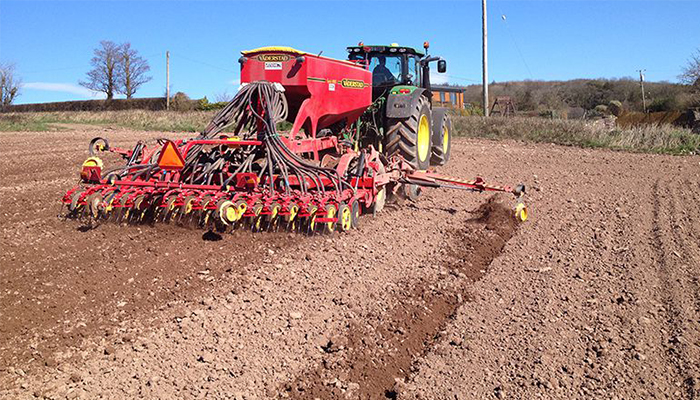
It is always tempting to avail of good weather in September to plant winter cereals, but early planting carries risks.
Planting winter wheat and barley early (in mid to late September – later further south) generally ensures good seedbeds and favourable temperatures during germination, leading to higher establishment rates. However, there is an increased threat from take-all, foliar diseases, lodging, grass weeds and aphids (barley yellow dwarf virus (BYDV)).
BYDV
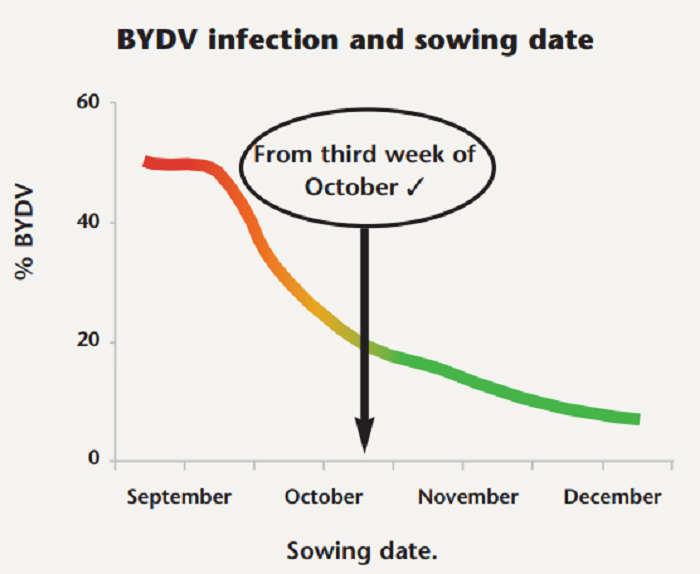
Early-sown crops are at the highest risk from BYDV (Figure 1) and yield reductions of 3.7t/ha have been recorded in Teagasc winter barley experiments. Risk increases when early sowing is combined with a coastal location and a mild autumn/winter, as the aphid migration period and overwintering risk both increase. Planting cereals in October significantly reduces the risk of BYDV over September planting.
Figure 1: BYDV risk increases with early sowing – Tom Kennedy, Teagasc national tillage conference 2014
Grass weeds
Avoiding the key germination period is a key integrated pest management (IPM) technique. The key germination period for sterile brome and blackgrass is September and tapers off as sowing moves into October. Winter barley should be avoided, as there are no reliable chemical control options.
Soil sampling
Under the new Nitrates Directive, all tillage farmers are required to take soil tests. In the absence of an up-to-date soil test result, phosphorus (P) is assumed to be index 4 (no P allowance). Now is the ideal time to identify fields on the farm that require fresh soil samples. Ensure soil samples are taken correctly and take one every 4ha or 5ha where soil type and cropping of lands were similar during the previous five years. This will provide the basis for lime, P, potassium (K) and magnesium (Mg) applications for the next four to five years.
Lime
Soil test results will provide recommended rates of lime to correct soil pH to the optimum pH 6.5 for a cereal crop rotation. Where crops such as oilseeds, beans or beet are part of the rotation, target pH 6.8.
Aim to apply lime over the coming weeks and months to correct soil pH for either winter or spring crops. Lime is a soil conditioner and delivers many benefits at least cost, from soil pH correction to improving soil structure.
For winter crops, where possible, apply lime to ploughed/pressed soils. Optimising soil pH will provide the right conditions for the establishment of winter cereals and ensure such nutrients as P and K are readily available for rapid establishment.
Contact your local advisor today to take soil samples over the coming weeks and request an S4 soil test for tillage soils (pH, lime requirement (LR), P, K, Mg, manganese (Mn), copper (Cu) and zinc (Zn)).
Cereal crop P and K requirements
Winter cereals have a demand for P and K, which ensures that crops are well established in terms of rooting and tiller development entering the winter period. Index 3 soils will have a good supply of P and K for crop establishment; therefore, omit P and K applications until spring. For index 1 or 2 soils, apply nutrients as shown in Table 1. A fertiliser product such as 0-10-20 or 0-7-30 will supply the correct balance of P and K at this stage. Apply at sowing and incorporate into the seedbed. Complete fertiliser P applications by October 31st.
Where organic manures are available they should be considered as a source of P and K for winter cereals. For example, farmyard manure (FYM)/cattle slurry/mushroom compost are all suitable organic manures as they are low in nitrogen (N) and will supply good levels of organic matter.
Table 1: Table 1: Autumn P and K requirements for winter cereals (build-up)
| Soil index | P (kg/ha) | K (kg/ha) | Suggested fertiliser product and rate (kg/ha) |
|---|---|---|---|
| 1 | 20 | 30 | 200kg 0-10-20 |
| 2 | 10 | 15 | 100kg 0-10-20 |
This article first appeared in the Teagasc Tillage Advisor newsletter for September, which was edited by Teagasc Crops Specialist. To access the full newsletter, click here.
Also read: The role of catch crops in nitrogen uptake
Also read: Stubble cultivation and its role in controlling problem grass weeds