
02 June 2023
Importance of sulphur for grass and crop production
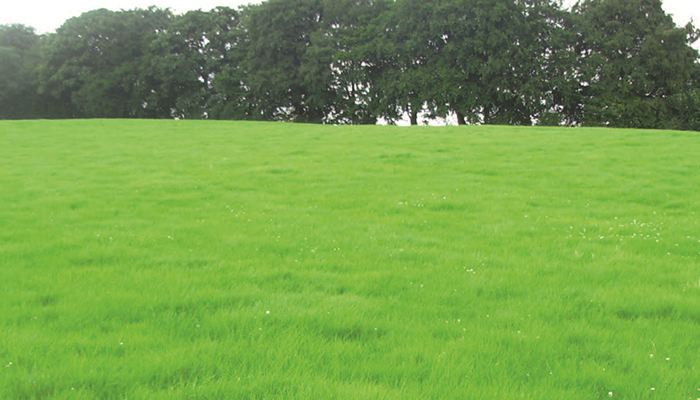
Sulphur and the soil’s sulphur supply depend on soil type and soil organic matter levels.
Sulphur and soils
Soil sulphur (S) supply depends on soil type and soil organic matter (SOM) levels. For example, light soils with low SOM will have a low S supply, while heavier soils will have higher SOM levels will have a higher supply. This will be one of the main drivers to a response to S application. Sulphur loss occurs through leaching. Soil testing is a poor indicator of soil supply.
Sulphur role and function
Sulphur is part of every living cell and is a major constituent of two of the 20 plant amino acids which form protein. S plays a major role in nitrogen (N) fixation in legume plants such as clovers, peas and beans. At high nitrogen rates, S plays an important role in plant N efficiency and utilisation in producing higher grass/crop yields.
Sulphur deficiency
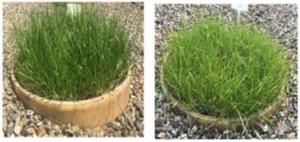
A sulphur deficiency is quite similar to an N deficiency, as plants show a pale yellow color. For S deficiency, the youngest leaves are affected first. This is due to the poor mobility of S in the plant.
Fig 1: Grass showing S sufficiency (left) & S deficiency (right). Source P. Forrestal & Claire Aspel, Teagasc, Johnstown Castle.
Sulphur and crop yield responses
Response to S application is mainly found on light soils, intensively-managed grassland or continuous tillage soils. Cereals grown on light, sandy soils with low SOM can show up to 2.5t/ha yield response (Michael Conry, Teagasc, Oak Park). Research shows that clover is more responsive to S than ryegrass and adequate S will increases the percentage of clover in the sward. Research from Teagasc Johnstown Castle show a wide range of yield responses to S; some soils give no significant yield response to S, while others have been observed to give responses of up to 43%, indicating that S isn’t a ‘one size fits all’ soils situation (Figure 2).
Figure 2: 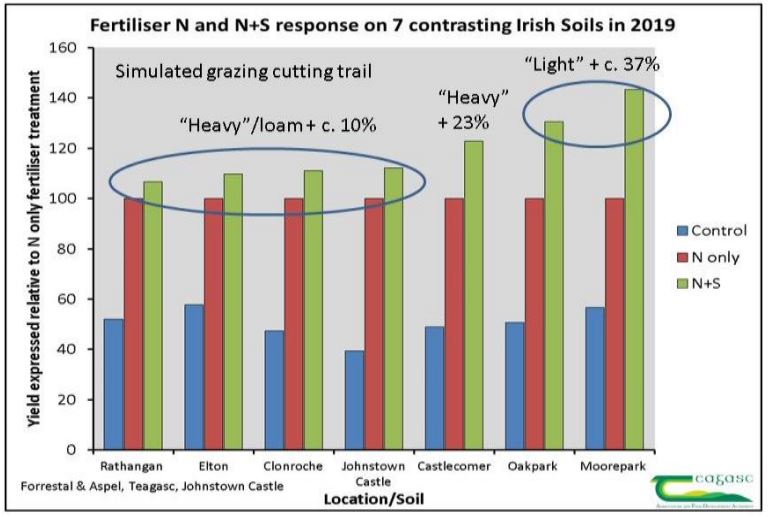 (Teagasc, Johnstown Castle).
Sulphur advice
| Crop type | Sulphur rate |
|---|---|
| Grass – Grazing | 20 kg/ha/year |
| Grass – Silage | 20 kg/ha/cut |
| Cereal Crops | 20 kg/ha |
| Oilseeds / Legumes / Brassicas | 15–30 kg/ha |
Sulphur and timing of application
Apply S as part of a fertiliser grazing programme, starting in early spring, and apply S in 2 to 3 applications between March to May. For crops of grass silage, apply prior to closing for each cut. For cereals, apply S requirements with main N splits during March to May.
Sulphur and fertilisers
Sulphur is available in a range of fertilisers from straight Ns to blends. For example ASN contains 26% N and 14% S and is very suitable for such crops as oilseed rape, where there is a high S requirement. While fertiliser blends such as 10-10-20 / 18-6-12 +S etc. or CAN +S or Urea +S contain between 2% and 8% S and are very suitable for grazing / silage / cereal production.
Sulphur and organic manures
Organic fertilisers such as cattle/pig slurry contain low levels of total S (0.3 to 0.4 kg/m3), while poultry manures contain high S levels (layer manure 2.5 kg/t). Sulphur and trace elements over supply of S can depress the uptake of Se and reduce absorption of Cu by animals.
Mark Plunkett, Claire Aspel & Patrick Forrestal, Johnstown Castle, Research Center