
24 April 2023
Growing peas and beans in combination can reduce risk and increase yields
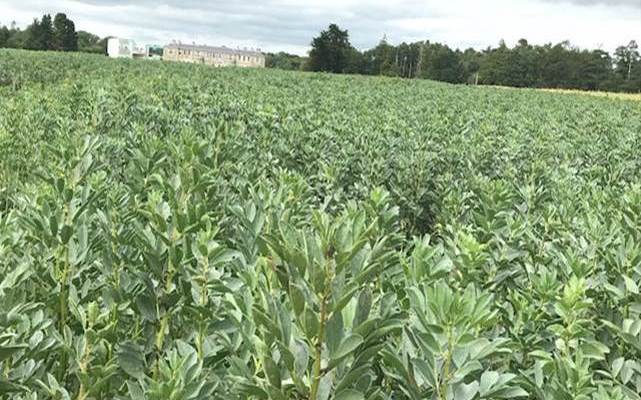
Teagasc researchers have found that growing peas and beans in combination can reduce risk and increase yields. Sheila Alves and Ewen Mullins tell us more.
Faba beans and peas are re- nowned as excellent sources of in-demand plant protein. They are effective break crops in cereal rotations, interrupting the cycle of diseases such as take-all and fixing atmospheric nitrogen (N), reducing N requirements in the following cereal. So, where’s the catch? Like all crops, Faba beans and peas each have their own weaknesses. Peas are prone to lodging and spring sown faba beans can struggle in dry summers. However, growing them together in mixed stands means the crops can complement each other, decreasing risk in unfavourable seasons.
Potential of intercropping
The potential of mixed stands to assist a crop prone to lodging has long been recognised, specifically in barley-pea and oat-pea mixes. The legumes latch on to the stiff culms of the cereal with their tendrils. The legume benefits, but the weight of the legume can interfere with the growth of the cereal.
We are investigating the potential to mix two legumes – for example, peas with faba beans – with each supporting the other to deliver more consistent yields. Importantly, such diversification also increases in-crop biodiversity and enhances soil structure and health.
Based on four field trials over two years, Teagasc research shows that the mechanical support provided by faba beans to the field pea in mixed plots effectively prevented the peas from lodging in all experiments, compared to plots where peas were the sole crop (Figure 1).
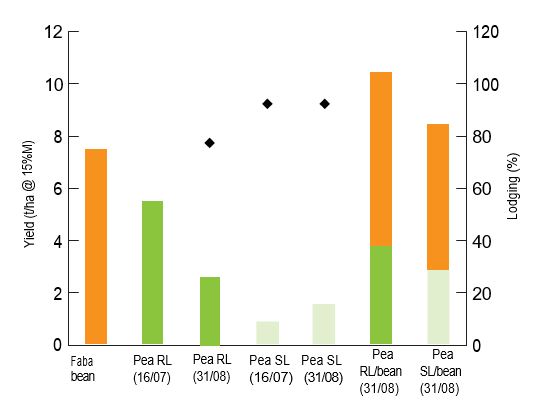
Figure 1. Mean yield (t/ha) of winter field peas (green columns) and faba bean (orange column) and lodging in intercropping trials. The total seed rate of mix stands and sole pea plots was 80 seeds/m2. In the mix plots, t seed rate of faba beans and peas was 24 and 56 seeds/m2, respectively. The seed rate in sole bean plots was 30 seeds/m2. Two varieties of field peas were used, one susceptible (SL, light green column) and another mo resistant (RL, dark green column) to lodging. Sole field pea plots were harvested in two different dates: 16/07/2020 and 31/08/2020. Sole faba bean and mix stand plots were harvested on the 31/08/2020.
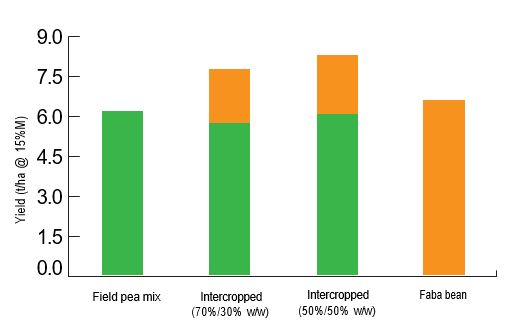
Figure 2. Mean yield (t/ha) of spring field pea mixture (green column) and faba bean (orange column) in intercropping trials. The total sowing rate of mix stands and sole plots of faba beans and field peas was 190 kg/ha.
The presence of both crops increased productivity per m2, regardless of the presence of lodging (Figure 1 and 2). Further trials are needed and are underway to tailor intercropping agronomy to the available pea and bean varieties. Also, the market for a mixed crop needs to be established so that post-harvest separation and processing can deliver added value for the grower. If used as a mixture, the proportion of each crop will have to be deter- mined and adjusted to requirements.
The research is being continued as part of VALPRO Path, an EU-funded research project tasked with increasing the added value potential of plant protein crops.