
14 April 2023
Don’t delay! Fertilise silage swards today
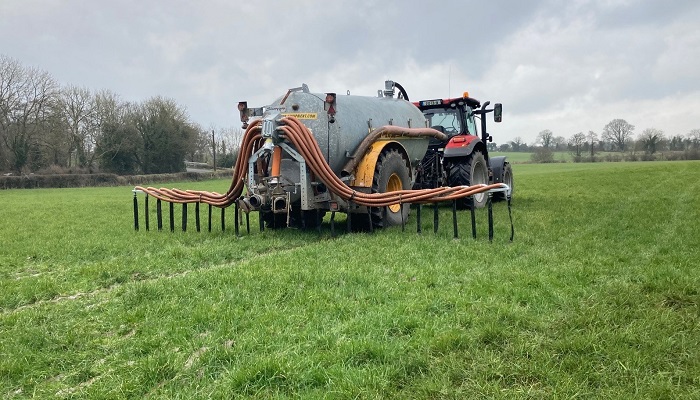
Weather conditions over the last number of weeks have resulted in delayed applications of fertiliser to silage fields. In addition, livestock have been housed for longer than normal, eating into farm silage stocks.
Fertilising silage fields, once field conditions allow, will be critical in order to grow sufficient grass to replenish silage reserves for the coming winter. Teagasc’s Mark Plunkett and David Wall explain. Targets for silage harvest still apply to maintain silage quality, with harvesting during the last week in May up to the 1st week in June.
April and May grow most grass
April and May is the most responsive time of the year to apply N fertiliser due to longer days, high levels of sunshine and warm soils. For example, a yield response of 25 to 30 kg grass dry matter per kilo of N applied during this window.
Nitrogen (N)
Is the key driver of grass yield. Grass swards with high levels of perennial rye grass will use N more efficiently than older swards. Recently reseeded swards (0-3 years) will have 25% higher N demand, especially when reseeded after a tillage rotation. A crop of grass silage (5t/ha of DM) will require 125 kg N/ha (100 units/acre). Grass silage will take up on average 2.5kg/ha/day of N (2units/day), therefore apply N at least 50 days before cutting to ensure full N utilisation by the crop. Nitrogen rates may have to be adjusted to reduce the risk of high nitrate concentration in the grass at time of harvesting. Make adjustment for fertiliser or slurry N applied for early grazing, for example assume ~25% of N applied will be available for the silage crop. For example where 40 units/ac of N was applied for grazing reduce N applied by 10units/ac for grass silage crop.
Phosphorus (P) & Potassium (K)
Are essential to maximise grass yields therefore adequate supply of these nutrients in the soil is critical. Consult the most recent (3 to 5 years) soil test reports to determine the P and K requirements (applied as organic manure and fertiliser) for silage fields. A crop of grass silage will remove approximately 4kg P and 25kg K /tonne of grass DM. In the current year silage fields may have received cattle slurry in February, for example, 3,000 gals/ac of good quality slurry will supply the majority of P & K required on a soil at Index 3. In the current year, fertilise silage crops to the target grass yield as shown in table 1 below. If you are accessing the table from mobile devices, change to landscape to view the recommendations for both slurry and without cattle slurry.
Table 1: 1st Cut silage N, P, K & S req. based on grass yield with & without cattle slurry
| Grass Yield(t DM/ha)3,4 | N kg/ha (units/ac) | P kg/ha (units/ac) | K kg/ha (units/ac) | S kg/ha (units/ac) | Fertiliser Options1 – No Slurry1 | Fertiliser Options1 – Cattle slurry1,6 |
|---|---|---|---|---|---|---|
| 5 (10t/ac fresh grass) 1,5 | 125 (100) | 20 (16) | 125 (100) | 20 (16) | 3.0 bags/ac 13-6-20. 1.6 bags/acProUrea+S | 3,000gals/ac. 1.9bags/ac ProUrea+S |
| 6(12t/ac fresh grass)1,5 | 150 (120) | 24 (20) | 150 (120) | 24 (20) | 3.0 bags/ac 13-6-20. 1.6 bags/acProUrea+S | 3,000gals/ac. 1.9bags/ac ProUrea+S |
1 Protected Urea + S (Urea 38% + 7% + NBPT). 2 Apply 25kg N, 4kg P & 25kg K per tonne of grass dry matter (DM). 3 N, P & K advice for crop off takes based on grass DM yield at harvest time. 4Apply additional P & K for soil fertility build on Index 1 & 2 soils up after grass harvest refer to Teagasc Green Book for specific rates. 5Fresh grass @ 20% DM. 6 Slurry applied with low emission technology (LESS).
Sulphur (S)
Is essential to maximise grass yield therefore adequate soil supply is essential. A recent study from Johnstown Castle on a free draining sandy loam soil highlights the major role S has to play in increasing N use efficiency (+25%), grass N uptake (+38kg/ha), grass yield (+2.6t/ha) while reducing N leaching (-22kg/ha). For silage, fields apply 15 to 20kg S/ha/cut. Cattle slurry contains ~0.6 units S/1,000gals available; therefore apply fertiliser S where slurry is applied.
Rules of thumb for N, P, K & S
- Allow 2 units N /ac per day for example 40 days grass growth requires 80 units N/ac
- Adjust fertiliser N rates where cattle slurry N was applied
- Apply a maximum of 70 units K/ac at silage closing time. This will reduce the risk of milk fever / grass tetany issues when the silage is fed to livestock in spring.
- Apply 12 to 16 units S/ac