
16 May 2025
Making quality silage – be brilliant at the basics
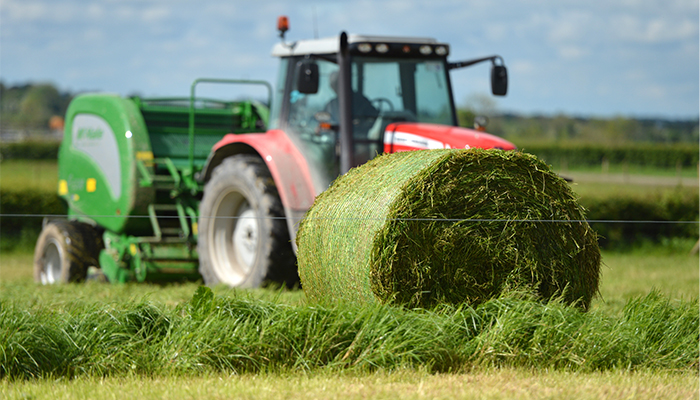
Being brilliant at the basics is key to producing quality silage. Teagasc Advisor in Tinahely, Co. Wicklow, Tom Deane reminds us of the importance of quality targets, cutting date, wilting and handling.
Silage crops across the region have developed well in 2025 courtesy of the much-needed rainfall that fell in mid-April coupled with recent longer sunny days and minimal cloud cover.
Silage is the base upon which animal diets are formulated – be it for growing, lactating or finishing animals with concentrate levels being adjusted according to the quality of it. Producing poor-quality silage will result in either sub-optimal animal performance and/or higher concentrate requirements to achieve the same performance in the winter period.
Like a lot of things, it’s all about being brilliant at the basics, all of which have been well documented over the years.
Quality targets
Silage quality should be targeted at 72-75% Dry Matter Digestibility (DMD) from first cut and can be used for feeding priority livestock, such as autumn-calving dairy cows, lactating sucklers, in-lamb and lactating ewes and finishing cattle etc.
Recently reseeded swards produce the best quality in terms of crude protein and DMD, as these grass varieties are bred with desirable agronomic characteristics in mind. Recently reseeded fields also use nutrients very efficiently and head out at similar times which results in an even, consistent crop.
Cutting date
A key determinant in reaching silage quality targets is the cutting date of the crop. This is ideally carried out when the grass is at the leafy stage. Digestibility of grass ensiled decreases by 2-3% per week from the second half of May, hence why mid-May is the target for many farmers.
Choosing the right time to cut involves several factors such as adequate levels of sugar (over 3%) and appropriate nitrates levels, both of which can be assessed in your local Teagasc office prior to harvesting.
A crop which has received 85 units of nitrogen per acre would be expected to be close to cutting after 45-50 days. Careful monitoring of the crop close to harvest date is very important as a lot of growth occurs in the final few days before harvesting.
Of course, the weather is the final important factor to minimise field damage and provide the best conditions for preservation.
Wilting
With regard to wilting, the aim is to achieve a crop with 30% dry matter as soon as possible after mowing. Too much wilting can lead to loss of silage quality and mould at the pit face and too little can lead to effluent losses, so the correct balance must be struck.
Handling
Once wilted, the crop should be rowed and ensiled as soon as possible. Great care should be taken when transporting and storing wrapped bales as the nutrient value of the silage will be compromised following air ingress. Likewise, grass in the pit should be consolidated well and covered as soon as possible. The aim is for a rapid pH drop within the clamp to ensure aerobic bacteria cannot spoil the silage.
For more information on making quality silage, contact your local Teagasc office.
More from Teagasc Daily: The time for high performing silage is now
More from Teagasc Daily: Dealing with surplus grass this May
More from Teagasc Daily: 7 tips for better quality silage on beef farms