
17 April 2025
Unlocking the full potential of grassland
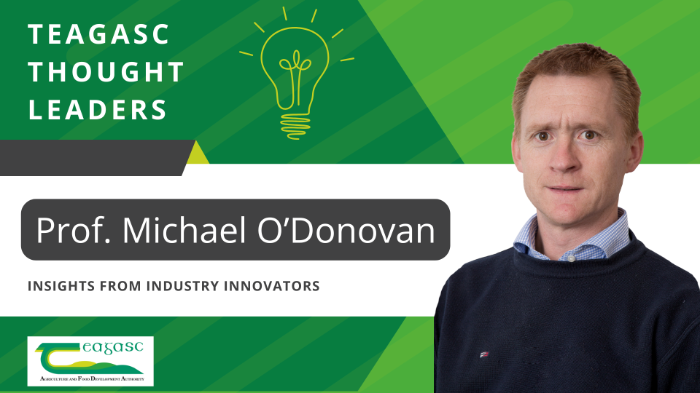
As part of our Teagasc Thought Leaders series, Catriona Boyle spoke with Michael O’Donovan, Head of the Grassland Science Department in Teagasc, recently about getting the most out of our grasslands.
Professor Michael O’Donovan is Head of the Grassland Science Department in Teagasc, based at the Animal & Grassland Research Centre in Moorepark, Fermoy, Co Cork.
A University College Dublin graduate with a master’s and PhD in Agricultural Science, Michael has over 30 years of experience leading research on grassland science, agronomy, animal performance, new measurement techniques, decision support systems, and on-farm grassland research.
His research in grassland has led to the concept of grassland measurement being adopted nationally in Ireland. PastureBase Ireland and the Pasture Profit Index have been key national developments in his research career to date. He continues to pursue science-based solutions to increase grassland sustainability for Irish grassland farmers. He is an adjunct Professor in University College Cork.
You can find out more in the video below
Video credit: Declan Mc Ardle and Charlie Smith
How are climate change pressures shaping the future of grasslands, and what solutions are emerging?
In grassland, we are always adapting to the climate and its challenges. In Ireland, we are fortunate that we have a temperate climate and the challenges for us are about higher and more intense seasonal rainfall and drier summers.
When facing such challenges, our primary focus is on building contingencies into grassland systems, ensuring sufficient and surplus conserved feed and appropriate farm infrastructures – such as setting up short grazing periods, productive grass/clover swards, and continuing to focus on improving grassland efficiency – inside the farm gate.
In the Grassland Science Department, we have developed PastureBase Ireland (PBI) as a key grassland decision support tool and database. Many farmers now use this technology in the decision making around grazing management. PBI has over 7,000 farmer users, which we intend growing further into the future.
What role do grasslands play in carbon sequestration and biodiversity conservation, and how can research drive better management practices?
Grassland and ruminants play a key role in the carbon cycle, which is widely overlooked. Ruminants have the ability to transform pasture into high quality foodstuffs (meat and milk products), which are important for human nutrition and global food security.
Grasslands cover over 40% of the earth’s surface and we need to preserve the high organic matter that we have in soils and continue to harness carbon sequestration effectively. Grazing has a key role in the carbon sequestration process that we need to continue to improve.
Are there any recent technological or scientific advancements that could transform grassland monitoring and restoration?
Yes, there are many examples. For instance, the MoSt grass growth model and PBI are directly linked now, which means in two years’ time we will have the capacity to predict grass growth on 2,000 Irish grassland farms.
The use of precision nitrogen management in conjunction with grass/clover swards is a new avenue of research, this is being rolled out to the industry with the Clover 150 group.
Our continued focus is to improve the level of nitrogen fixation and animal performance from grass/clover swards. Our research in grassland science across dairy, beef and sheep has shown an 8 to 10% animal performance improvement with grass/clover swards. Our objective is to increase this performance level even further.
We are now using drones in Teagasc to monitor disease resistance in perennial ryegrass varieties, trying to select the most tolerant strains, as part of our climate adaptation programme.
What collaborations or policy developments are most critical right now to ensure the sustainability of grassland ecosystems?
We participate in many grassland networks internationally. The Irish government has been very supportive in supporting grassland research and sustainability improvements. We need to continue to collaborate with organisations across the world that offer us the potential to improve grassland ecosystem sustainability.
Grassland systems are challenging – you are working with soils, swards, varied species and, of course, the grazing animal (dairy cows, beef animals and sheep). There is no single development on its own that is going to deliver, it is making sure the ‘sum of the parts’ work coherently and efficiency to deliver in grassland systems.
What are your top research priorities for grassland ecosystems in the coming year, and why?
The main objective is to continue to improve the productive capacity of perennial ryegrass/clover swards to beyond current performance levels. Nitrogen levels have reduced at farm level and there is a major challenge to improve the clover content of swards and hence productivity. This is a main priority in grassland systems, as farm nitrogen surpluses will reduce and animal performance improvement will be positive consequences of this.
Also from the Teagasc Thought Leaders series: Advancing environmental science, with Dr Karen Daly.