
23 April 2024
Tips on establishing grass/white clover swards
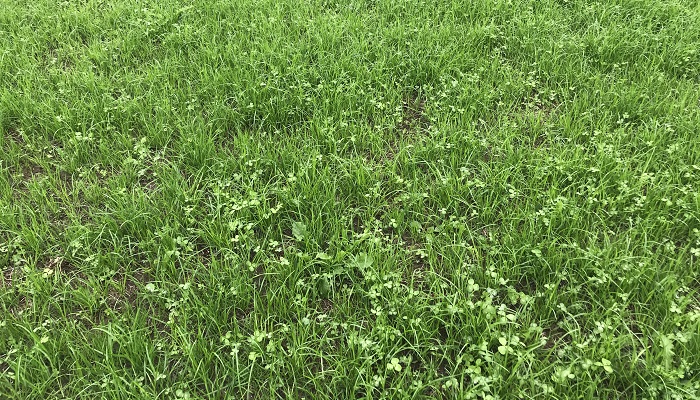
The inclusion of white clover in grassland swards brings many benefits – from nitrogen fixation and the resulting reduction in chemical nitrogen requirements, increased herbage quality and dry matter intake, and higher milk production and live weight gain.
However, establishing white clover on farm cannot happen overnight and a longer-term plan is needed to ensure sufficient levels are present within the sward to provide the abovementioned benefits. This plan should include a combination of both reseeding and over-sowing.
Incorporating white clover in a full reseed is the most reliable method of clover establishment. Over-sowing is a simple and low-cost method of introducing white clover into swards. Success is very much dependent on soil fertility, weather conditions at the time of over-sowing and post-sowing grazing management.
White clover establishment blueprint
A targeted multi-year approach should be used in establishing a white clover system, i.e. a combination of reseeding and over-sowing. An example is outlined below:
- Reseed approx. 10% per year;
- Over sow approx. 15% per year;
- Year 1- reseed 10% and over sow 15% = 25%;
- Year 2- reseed 10% and over sow 15% = 25% (50%);
- Year 3 – reseed 10% and over sow 15% = 25% (75%);
- Year 4 – reseed 10% and over sow 15% = 25% (100%);
- Year 5 + – on-going process.
Reseeding
In terms establishing white clover, a spring reseed – carried out in April/May – provides the best results. When completing a reseed, the key steps include:
- Spray off the old pasture with glyphosate;
- Prepare a fine, firm seedbed (with the most appropriate cultivation method for that paddock);
- Soil sample and apply the required lime, phosphorous (P) and potassium (K);
- Use the Irish Recommended List for grass and clover cultivar selection;
- Ensure good seed to soil contact by rolling after sowing.
Table 1: Sowing rates when reseeding
| Sowing rates | ||
|---|---|---|
| Grass | White clover | |
| Cattle | 28-30kg/ha | 4-5kg/ha |
| Sheep | 25-28kg/ha | 5-6kg/ha |
Over-sowing tips
If over-sowing is practiced, it’s best – where possible and there’s a need – to control weeds the previous year to over-sowing white clover.
- April / early May is the best time for over-sowing;
- Over-sow directly after a tight grazing;
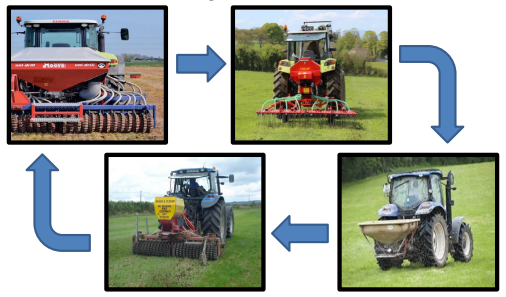
- White clover can be over sown using a number of methods (see figure 1 below);
- Ensuring seed to soil contact post over-sowing is one of the most crucial factors;
- Over-sowing methods (figure 1) are equally successful once the correct timing and post sowing management are optimal
- Broadcasting – gives more varied results:
- Mix clover seed with a compound fertiliser in the field – max of 1ha at a time.
- Stitching – can ensure a better soil to seed contact:
- In sheep swards stitching should be used.
- Sow at a rate of 5-6 kg/ha.
Figure 1: Methods of over-sowing white clover into existing swards
Post-sowing management – full reseed or over-sowing
Allowing light to reach the base of the sward is crucial in post-sowing management, as this encourages stolon development. The first grazing should be at a pre-grazing herbage mass of 600-1000kg DM/ha. The subsequent three grazings should be at a pre-grazing herbage mass <1,100kg DM and swards should be grazed to ≤4 cm (grazed tight). This will mean that paddock grazing times will be reduced in these paddocks.
Additionally, no silage should be harvested in the first 12 months after sowing and swards should be grazed later in the autumn to avoid carrying heavy covers over the winter.
In the below video, Joseph Dunphy, Grass10 Advisor, provides an overview as to what’s involved when establishing grass-white clover swards:
Weed control
Weed control in reseeded and over-sown grass-white clover swards is vital to improve sward persistence. Clover-safe herbicides should be used in establishing and established swards. All pesticide users should comply with the regulations as outlined in the Sustainable Use Directive (SUD).
Weed control in reseeds
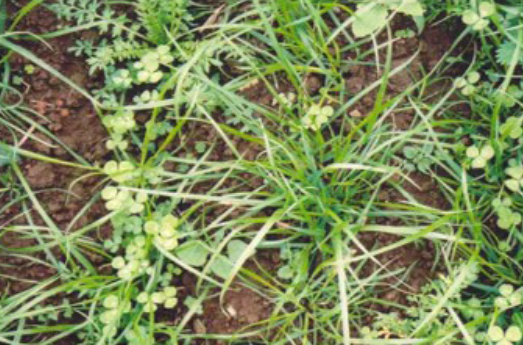
- Weeds are best controlled when the grass plant is at the three leaf stage and the clover when the trifoliate leaf has appeared (see figure 2 below for correct timing for herbicide application). White clover safe herbicide should be used;
- Pro-Clova will be the only licensed clover safe herbicide available for new reseeds;
- Eagle and Pro-Clova are both licensed for established swards.
Figure 2: Grass plant at the 3 leaf stage and white clover plant with the trifoliate leaf emerged
Weed control in over-sown swards
- Established weeds should be controlled the previous year before over-sowing;
- Consider the residue time of non-clover safe sprays (this may affect clover establishment – read product label).
This article was adapted from the ‘Management and establishment of grass-white clover swards’ handbook, written by Michael O’Donovan, Áine Murray, Philip Creighton, Peter Doyle and Brian McCarthy. The full version of the handbook can be accessed here.