
24 January 2024
Save slurry for your silage ground
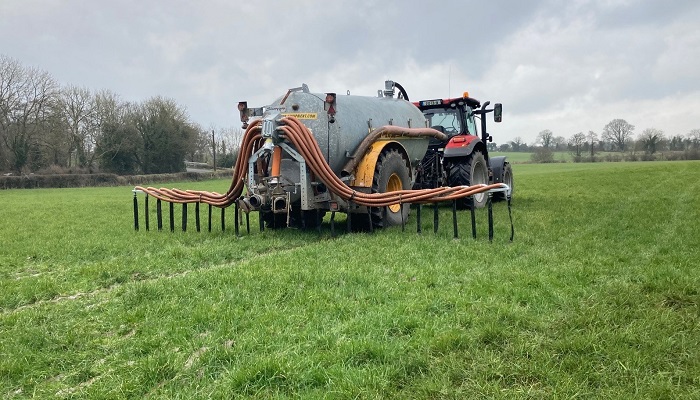
Although slurry spreading is now permitted in Zones A and B, farmers have been reminded to plan carefully and to apply slurry in the areas where it gives the best response.
Speaking as part of an ASSAP / Signpost Programme webinar targeted at farmers in the Wicklow/Carlow/Wexford region on Tuesday, January 23rd, Training and Development Specialist with the Signpost Programme, Mark Plunkett explained that due to regulation change – resulting in a lower availability of chemical nitrogen to spread on farms – farmers have to get more use of the nitrogen that’s in slurry.
“Slurry is a valuable source of fertiliser that you have on your own farm,” he explained, adding that 80% of cattle slurry’s nutrient content is in the form of phosphorous (P) and potassium (K), and 20% being in the form of nitrogen (N).
Using a typical cattle slurry as an example, Mark said that 1,000 gallons of cattle slurry is the equivalent of a 50kg bag of 9:7:32, thus giving a value of approximately €29/1,000 gallons. However, he noted that variability can exist in terms of the nutrient content of cattle slurry.
On this, he said: “We would strongly encourage you to get your slurry tested to see what is in it. The dry matter has a large influence on the nutrients that’s in the slurry. Our standard slurry values are 9 units of N, 5 units of P and 32 units of K per 1,000 gallons of cattle slurry, so you have approximately 9 units of nitrogen (available) per 1,000 gallons of cattle slurry or 1kg N/mᶾ.
“If we are to retain more of that nitrogen, we must put it out when conditions are right in terms of uptake, growth and soil temperature and when there’s a requirement there for that nutrient.”
He added: “Ideally, the cattle slurry should go back to the silage fields. That’s where your biggest demand is for P and K and also to utilise that nitrogen in the slurry.
“For example, if you take a first cut of silage, you need about 80 units of nitrogen, 16 units of P and 100 units of potassium per acre, so 3,000 gals/ac (33mᶾ/ha) of cattle slurry will supply the majority of the P and K and about 33% of the crop’s nitrogen requirement.”
Mark also noted that applying slurry during the growing season is a way of improving nitrogen use efficiency on farm and this is further aided by having a fertiliser plan, completing a soil analysis and applying slurry to the crop with the biggest demand for nutrients – typically silage ground in the majority of situations.
“We must spread slurry at the right time of the year in order to utilise that nitrogen and you’re talking of the period from mid-February to mid-March. You are putting your slurry out at the right rate when there is a demand for the nitrogen.”
By applying cattle slurry to silage fields in this period, Mark said: “We are taking it out of the risky time of year when soil temperatures are low, soils are wet and days are short, and there’s little demand, and you are putting it out in a more responsive time of the year.”
Mark also touched on a number of technologies available to farmers to maximise the nitrogen utilisation from their cattle slurry. The first – low emission slurry spreading (LESS) – can reduce ammonia losses.
“We can reduce ammonia loss by 65% using LESS and thus retaining more N from cattle slurry to grow grass. We retain about 3 units of nitrogen per 1,000 gallons by going from the splash plate to the trailing shoe. By applying in the spring time as opposed to the summer, there’s another 3 units retained, so that’s 6 units of extra nitrogen that we can recover.
“LESS is a very precise way of spreading slurry akin to fertiliser placement. You are reducing the surface area of the slurry. You are putting it exactly where it needs to go – close to the soil in the rooting zone – retaining as much nitrogen as possible. LESS technology will also allow you to spread into heavier covers of grass in better soil conditions and you have a wider window of application for your cattle slurry.”
The role of sulphur (S) in fertiliser planning was also discussed, with Mark citing research from Teagasc Johnstown Castle, which showed that the S in cattle slurry was relatively unavailable, and it is important to apply 20kg S/ha/cut to improve N use efficiency by the silage crop thus reducing crop N requirements.
“If you want to get the best response from the nitrogen in your cattle slurry, it is important that you balance it with sufficient levels of sulphur, as you can reduce nitrate leaching and retain more nitrogen to grow that crop of silage,” he said.
Also read: Transitioning to LESS
Also read: Slurry spreading advice for farmers and slurry contractors