
12 May 2025
Hedgerow Retention – what every farmer needs to know
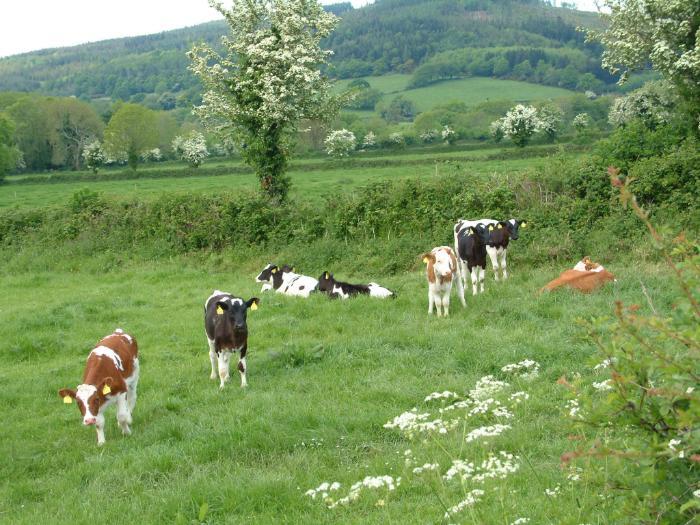
Mícheál Kelly, Scheme Support Specialist, outlines the protections afforded to hedgerows on farms as designated landscape features, and the requirements farmers must meet as part of Conditionality.
Hedgerows are vital for biodiversity, providing essential habitats and travel corridors for numerous species, while also supporting a rich array of plant and animal life, but they can often be threatened.
What is a hedge?
- A line of shrubs and/or tree species, maintained to form a barrier for controlling animals or marking land boundaries. They can vary from dense barriers to individual trees.
- A gappy hedge, where there is at least 20% of hedgerow species (including briars, gorse etc.) dispersed along the length of the hedge is considered a hedgerow.
- Briars on an earthen bank are also considered as a Landscape Feature; however earthen banks on their own are not. It is however important to note that many earthen banks are recorded national monuments in their own right, and as such are designated landscape features that are afforded the same protection as hedgerows.
- A hedge starts and ends at the nodes or intersection with another hedge.
Are hedgerows protected?
- Since 2009, hedgerows have been designated as Landscape Features and beneficiaries of CAP payments are obliged to retain them.
- Payments are linked to mandatory baseline requirements known as Conditionality (formerly Cross Compliance). Under Conditionality, GAEC 8 deals with the retention and maintenance of non-productive features and areas to improve on-farm biodiversity.
Can I remove a hedge?
Removal of landscape features is not permitted except in defined exceptional circumstances, as shown in Table 1.
Table 1. Exceptional circumstances for the removal of hedges, line of trees, ditches or drains.
|
Exceptional Circumstance |
Conditions |
|
1) Building work |
|
|
2) Road Safety issues |
|
|
3) Farm Safety issues |
|
In all circumstances above, the exemption is limited to the minimum length necessary.
Under conditionality, who is responsible for the retention of hedgerows?
Responsibility lies with the BISS applicant for the entire calendar year.
If removal is permitted under exceptional circumstances, are there conditions to carrying out the work?
- Hedgerows cannot be removed between March 1st and August 31st.
- As of January 1st, 2023, if removal is permitted, the original feature must be replaced, prior to its removal, by twice the length of the original feature to be removed, in a like-for-like manner i.e., only a hedge can replace a hedge; so if 10m of hedgerow is to be removed, 20m of hedgerow must be planted before the removal work can commence. This must be planted in the vicinity of the removal i.e., within the farm/holding where the feature was removed.
- The replacement hedgerow cannot be funded under an agri-environment measure such as ACRES or the Eco-Scheme.
- Replacement hedgerows must consist of traditional local species and cannot include amenity species (e.g., laurel, conifers).
- New hedgerows should ideally connect with existing hedgerows or woodlands.
- A hedgerow or line of trees planted in front/alongside of another hedgerow or planting a line of trees, or planting a grove of trees, is not considered fulfilling the replacement requirement. Planting within the curtilage of a dwelling house is not permitted.
If I meet the exceptional circumstances, do I have to seek approval from anyone?
In designated areas (Special Area of Conservation, Special Protection Area or National Heritage Area), prior approval from the National Parks and Wildlife Service (NPWS) is required for any removal.
Hedgerows are field boundaries and as such are protected by Environmental Impact Assessment (EIA) Agriculture regulations, which apply to all projects, even if there is no BISS application. These regulations contain thresholds, above which screening of the proposed works may be required.
Farmers must apply for screening if they wish to remove any field boundary over 500m in length, or if removal of any field boundary would result in the creation of a field over 5ha in size, whichever is the lesser.
Sub-thresholds to this are:
- Where the proposed works are to be carried out within (or may affect) a proposed NHA or a nature reserve.
- The proposed works may have a significant effect on the environment.
Thresholds refer to the cumulative total over any 5-year period.
For uncertainties regarding screening requirements, consult the Department of Agriculture, Food and the Marine (DAFM)/NPWS.
Download: Hedgerow Removal Rules and Regulations