
11 July 2024
Exciting Developments in Carbon Counting
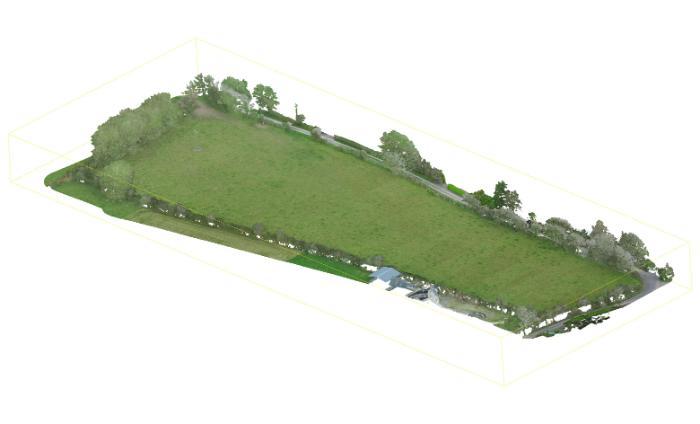
Stuart Green, Remote Sensing Specialist, Teagasc Ashtown, explains that Measurement, Reporting, and Verification (MRV) systems are crucial for tracking and validating agricultural practices that reduce greenhouse gas emissions and increase carbon sequestration.
There are many actions in the Teagasc Marginal Abatement Cost Curve that will allow us to reduce greenhouse gas emissions and / or increase carbon sequestration but importantly, we need to be able to measure, report and verify these activities so that they can be included in the National Inventory and be used for carbon farming.
Therefore, Measurement, Reporting and Verification (MRV), are tools that allow actions taken by farmers to reduce greenhouse gas (GHG) emissions and increase carbon (C) sequestration, to be turned into trusted impacts.
MRV
- Without measurement, the size of the impact will not be known,
- Without reporting, the source of the impact will be unrecognised and
- Without verification the measured, reported impact will not be trusted.
MRV can be done at a national scale improving the inventory reporting for agriculture and land use or it can be done at farm level. MRV approaches are important with respect to C stocks on the farm – how much carbon is already stored in the soil and in hedgerows, value and credit will only flow from an increase in these stocks.
There are two approaches to MRV
- If we know certain management practices increase C stocks then MRV of these actions is sufficient for reporting. This would be known as an action based approach to carbon farming, for example planting winter cover crops or increasing hedgerow cover.
- The second approach would be results based – demonstrating that a specified increase carbons stocks has been achieved. MRV for results based schemes rely on measuring or modelling of Carbon before and after the period of the scheme.
The technology behind MRV has been researched within Teagasc to ensure that changes farmers make will be recognised. The changes suggested are those options within the Teagasc Marginal Abatement Cost Curve or MACC.
Hedgerow Management
Within the Signpost Programme cutting edge laser scanning technologies are used to give accurate estimates of hedgerow volume. The FarmCarbon project created the first Irish models to convert hedgerow volume to biomass Carbon (C). The project found that hedgerows typically contain approximately 58 t carbon / ha. If allowed to grow, this can increase by 1-2 t carbon / ha / yr. New satellite technology that can see through clouds, now automatically detects hedgerow removal (nationally the area of hedgerows continues to decline annually).
Grass and Cropland Management
The TerrainAI project used satellites to map grassland management and productivity. These products act as a verification of the adoption of the grassland management MACC option. In tillage, the winter green cover option is an important measure for GHG mitigation; using the same satellites that can see through cloud, TerrainAI has developed a method to detect the planting of green cover at field scale in winter.
One of the significant MACC measures for land-based mitigation of GHG emissions is controlling the water table in agricultural peat soil. MRV to see changes in water table levels are being developed within the Teagasc D-TECT project.
Other MACC measures, such as multispecies swards and extended grazing, are close to having a remote MRV solution in place to confirm the uptake of these technologies.
Carbon Markets
MRV as a tool for the support of carbon farming and the possible development of carbon markets is quickly developing. As an example there is now a robust national hedgerow baseline and methods for measuring change at both farm scale within DAFM. Farmers can be confident that any trees planted on the farm or within hedgerow, or hedgerows removed will be accounted for.