
14 January 2024
Now is the time to get soil sampling
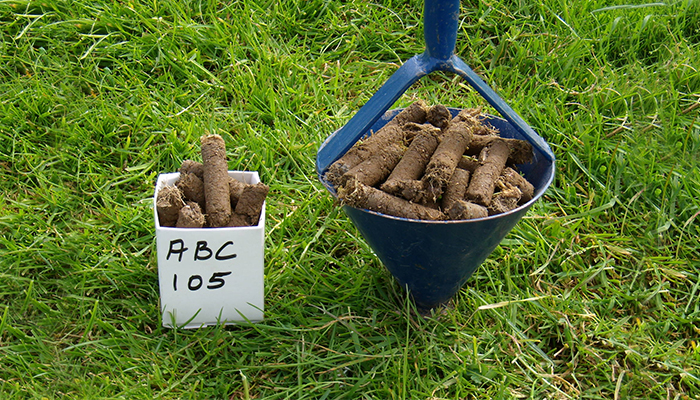
Stephen O’Callaghan, Teagasc Walsh Scholar, tells us why soil sampling and analysis are crucial for Derogation and ACRES schemes, essential for fertiliser allowances, and guide decisions on slurry, lime, and nutrient management for the next four years.
Soil sampling and analysis establishes the soils requirement for major soil nutrients such as lime, Phosphorous (P) and Potassium (K). Knowing the farm’s soil fertility allows you to recognise your fertiliser allowances and improve efficiency of application.
Soil samples are valid for 4 years, and each sample covers an area of 2-4 Ha
Why Now?
It is important to wait 3-6 months after P and K applications before taking soil samples in order to obtain an accurate result. Now is the time to take soil samples before slurry and fertiliser applications begin in the Spring
Do I need to Soil Sample?
Since 2023 all farms with a stocking rate above 130kg Organic Nitrogen/Ha must take soil samples. All arable land also requires a valid soil sample. In the absence of soil samples Index 4 for Phosphorus will be assumed. This means that all farmers in these categories need soil samples to prove that their land requires phosphorous for the coming year, otherwise they cannot spread any fertilisers containing P.
Derogation applicants must have valid soil samples for all lands farmed, so it is important to ensure previous samples have not expired for the coming year. Valid soil samples for 2024 are those taken after 15th September 2020
ACRES participants must have soil samples taken and uploaded on Agfood before the 15th May as a requirement of the scheme
The introduction of the department’s fertiliser database has increased the importance of soil sampling and analysis as farmers need to know their fertiliser allowances. A farmer may unknowingly apply too much phosphorous fertiliser in the absence of soil samples unless they have their homework done.
Benefits
Aside from regulations, Soil sampling is a valuable tool which should be utilised on all farms. It allows you to identify areas of the farm that require lime, and identify fields with high and low soil fertility. Knowing this allows you to target organic manures and fertilisers to where they are needed most. Getting overall soil fertility right will increase the efficiency of nitrogen spread on the farm.
| Table 1. Soil nutrient index, response fertilisers and soil test range for P & K (Source: to fertilisers and Teagasc, 2020) | |||||
| Soil Index | Response to fertilisers | Fertiliser strategy | P (mg/L) Grassland | P (mg/L) Tillage | K (mg/L) |
| 1 | Definite | Build – up + M | 0 – 3.0 | 0 – 3.0 | 0 50 |
| 2 | Likely | Build – up + M | 3.1 – 5.0 | 3.1 – 6.0 | 51 – 100 |
| 3 | Unlikely | Maintenance (M) | 5.1 – 8.0 | 6.1 – 10.0 | 101 – 150 |
| 4 | None | None | >8.0 | > 10.0 | > 150 |
What sort of sample analysis do I need?
Basic soil sample analysis covers lime requirement, soil pH, phosphorous (P) and potassium (K) levels. More extensive analysis is available if required.
It is important to check in with your advisor before taking samples as they can provide you with maps of the fields to sample, and also check if organic matter (OM) samples are required. OM samples are required on land classified as peat under the Teagasc-EPA Indicative soils map.
Interpretation of Results
When the sample results come back, talk with your adviser and complete a nutrient management plan for the farm.
Your soil sample results should form the basis of your decisions on where to apply slurry, FYM, lime and chemical forms of Phosphorous and Potassium for the next 4 years. They will also make you aware of your Nitrogen & Phosphorous limits; the amount which you are allowed to spread on farm.