
18 April 2025
Tree stability
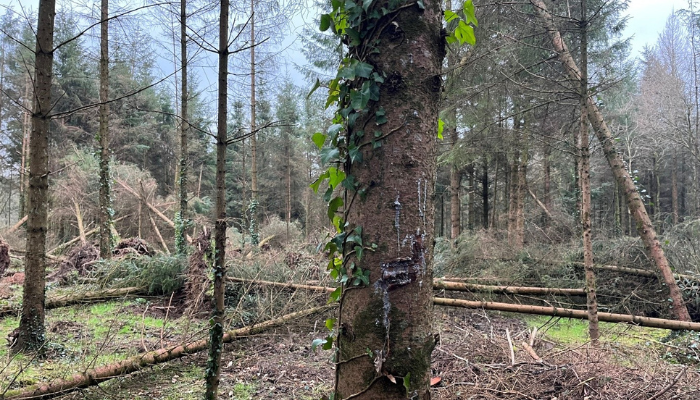
A recent paper, Unearthing Current Knowledge Gaps in Our Understanding of Tree Stability: Review and Bibliometric Analysis, was published by Teagasc Walsh Scholar Emmanuel Ekoma. Dr Niall Farrelly tells us more.
The research undertook an analysis of tree stability research, covering international literature on the subject from 1983 to 2023. The paper found that most literature on the subject originated from the USA, France, and Italy. Despite fewer publications, literature published in Scotland and England is heavily referenced and is of particular interest to Ireland, as the soil, weather, and forest types are similar.
The study indicates that tree stability is influenced by multiple factors, including root architecture, soil properties, wind speed, and forest management. These all affect the biomechanics of trees in the forest. Much of the existing literature focuses on windthrow resistance and root anchorage, examining the factors associated with increased or reduced tree stability. However, notable gaps exist in the research, particularly in understanding the role of soil type, climate change, and species-specific responses to wind. Many studies rely on small-scale experiments or simulations, which limits their real-world applicability. Furthermore, these studies often examine factors in isolation, whereas integrated approaches to understanding the combined effects on tree stability are relatively scarce.
The review emphasises the need for interdisciplinary collaboration, advanced modelling techniques, and long-term field studies to enhance predictions of tree failure. There is a lack of robust data on how different soil types and textures influence tree stability, especially in the context of soil failure during windthrow events. Existing models tend to address ‘endemic’ windthrow but lack relevance in ‘catastrophic’ storm events. The role of soil properties, the timing and nature of management interventions, and the specific wind speeds that lead to tree failure are not yet well understood. Providing such information could greatly enhance our understanding of windblow and ultimately lead to more effective strategies for maintaining stable and resilient tree populations into the future.
Read the paper: Unearthing Current Knowledge Gaps in Our Understanding of Tree Stability: Review and Bibliometric Analysis
Read more from the latest Teagasc Forestry Newsletter