
14 February 2025
Managing recent forestry storm damage
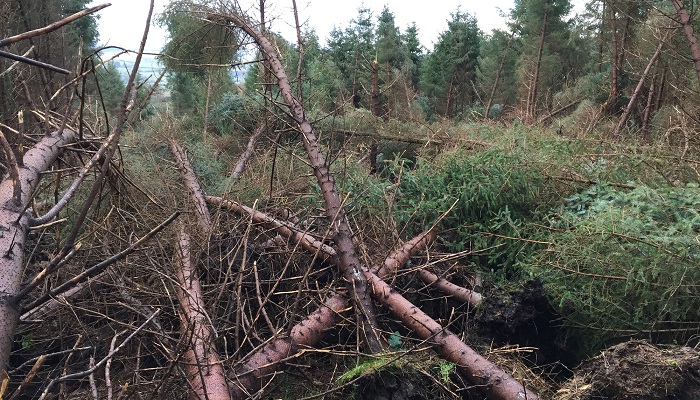
Storm Éowyn, which passed over Ireland on January 24, caused severe impacts on many forests. In the aftermath of this unprecedented weather event, work to quantify the extent of storm damage is progressing and the provision of support to impacted forest owners is a top priority.
Tom Houlihan from Teagasc Forestry Department has a key message; support and advice is available.
Teagasc forestry advisory staff are busy providing guidance and one-to-one supports to forest owners affected by storm damage. By availing of professional advice and developing a step-by-step plan, forest owners will be best placed to address storm damage impacts, minimise risk and recover as much value as possible.
Windblow Task Force
Teagasc is collaborating with forestry stakeholders in a recently-assembled Windblow Task Force. Important issues to address include the potential to accelerate the licencing process, the capacity in the sector to harvest forest material and access to markets for salvaged timber.
Guidance for affected forest owners
Teagasc has issued guidance to forest owners on managing storm damage, with an emphasis on safety and the importance of planning the recovery process and getting advice. This guidance incorporates the following key points:
- Don’t rush in – prioritise safety first
- Check your insurance status
- Seek professional guidance and advice
- Assess the damage in a safe manner
- Ensure a valid felling licence is in place
- Plan access and apply for a road licence, where required
- Selling timber – engage all available markets and secure the best deal
- Keep records and monitor progress
- Prepare an appropriate replanting plan
Assessment of damage extent
Work is ongoing by the Department of Agriculture, Food and the Marine (DAFM) and Coillte to assess the extent of damage nationally. This includes analysis of satellite imagery, which will provide information nationally and at forest level.
Sentinel-2 satellite imagery from the European Commission’s Copernicus Browser is openly accessible to facilitate mapping and damage assessment of forests. DAFM has issued a useful guidance video on wind damage assessment using the Copernicus Browser.
Update on windblow-related licence applications
DAFM have issued a guidance with respect to felling and forest road applications where forests that have been damaged by recent storms.
Under the Forestry Act 2014, DAFM has confirmed that windblown trees require a felling licence, as they still need to be cut harvested and removed. There is a commitment to making the application as efficient and fast as possible and further options are being explored for a simplified approach, with due regard for environmental obligations.
All windblow-related licence applications submitted on or before August 31, 2025 will be prioritised. The same also applies for applications already submitted and notified to DAFM as being impacted by the storms.
This guidance covers:
- New applications not yet submitted
- Applications already in the system
- Amendments for felling licences covering thinning
- Interaction with Reconstitution Ash Scheme
Managing storm damage events
Teagasc will also be organising collaborative events in the coming days and weeks to support forest owners in managing storm-damaged forests. Details of upcoming events, as they are announced, will be available on the Forestry section on the Teagasc website.
Teagasc support is available
Storm damage can be a serious challenge, but with the right plan, expert support, and safety measures, forest owners can manage the impact, protect their forests, and recover as much value as possible. Contact your local Teagasc forestry advisory staff and visit the Forestry section on the Teagasc website.