
22 November 2024
Forestry delivering multiple benefits on Kildare beef farm
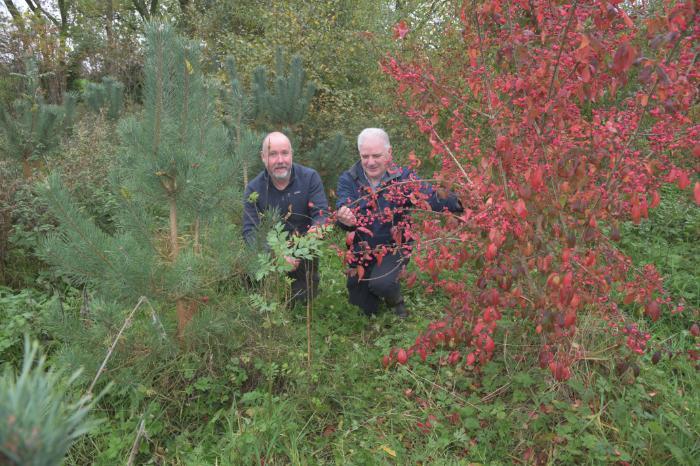
Careful planning and planting is maximising the recreational and biodiversity return from forestry on the Morrison family farm Kildare. Liam Kelly, Teagasc Forestry Development Officer tells us more.
Stephen Morrison, his wife Heidi, and their four children farm at Hartwell Farm, located outside Kill, near Naas. “We’re not far from Dublin, and in my grandfather’s time, cattle would come to the local train station. Once fattened, they would be walked into the center of Dublin,” Stephen recounts.
Stephen studied agriculture in Edinburgh before working on farms across Europe, Australia, and North America. He took over the family farm in 1994. “At that time, we ran a suckler herd that calved in spring and autumn. We finished the progeny and also kept a sheep flock alongside some tillage,” he explains.
Since then, Stephen has streamlined the farm. There are now 55 suckler cows, all spring-calving, and he has added a small Highland cattle herd. He recently converted the farm to organic production.
“Back in 2018, I decided to stop keeping sheep,” says Stephen. “My Teagasc advisor advised me not to make the same mistake of not replacing them with another enterprise, so I decided to plant part of the farm with trees.”
Stephen has always had a deep interest in the farm’s nature, biodiversity, and bird life. The farm has always been rich in hedgerows and trees. Over the years, he has enhanced its biodiversity by fencing off streams and planting suitable areas, including glens.
In 2019, Stephen became an Ambassador for Nature with the Farming for Nature organisation. His family farm has hosted numerous visits, including some organised by Teagasc.
Native Trees
“We always had a small amount of forestry, mainly coniferous,” says Stephen. After researching forestry options, the family decided that a native woodland mix would complement their objectives. These include supporting nature, enhancing farm diversity, improving landscaping, and creating habitats for new and existing bird species. “We also see the farm providing recreational opportunities for both ourselves and groups that may visit.”
Stephen began the project in late 2018, starting with a seven-hectare plot for which a registered forester made a planning application. The application was processed quickly, but part of the site was reserved due to the presence of lapwings—a breeding wader species.
Site preparation began in late autumn 2019. Due to the farm’s location in the foothills of the Wicklow Mountains, a robust deer fence was necessary. The planting, completed in January 2020, included species planted in groups: pedunculated oak (47%), birch (23%), rowan (11%), Scots pine (10%), whitethorn (4%), alder (3%), and spindle (2%).
A meandering path through and around the forest is mowed monthly, allowing easy access.
“I visited the forest recently and was pleasantly surprised by how well the trees are doing,” Stephen says. The carefully planned groupings have enhanced the landscape’s complexity and diversity. The forest path allows visitors to enjoy the beauty of this new woodland.
Stephen is delighted with the forest. “It allows me to enjoy nature, and bird numbers and species have increased tremendously as a result of the new woodlands,” he says. On a recent walk, they heard jays singing, and a buzzard flew overhead.
In spring 2022, a further three hectares of native woodland were planted. This plot was also planted in groups, with a pathway included for accessibility. Teagasc hosted a well-attended forest walk on Stephen’s farm in 2022, showcasing both woodland areas.
Tree Garden
Opposite the farmhouse, a one-acre (0.4 ha) tree garden was planted in 2020 as a family project during COVID-19. “We planted over 150 trees and shrubs, including walnut, Spanish chestnut, willow, hazel, apple, plum, cherry, blackberry, and raspberry,” says Stephen.
Many of the fruit species are thriving and have already started producing. “I really enjoy eating fruit grown on our land,” he adds.
Social Farming
Stephen has recently become involved in the social farming movement, with participants visiting the farm every Friday. The two young forests and the tree garden provide a safe and therapeutic environment for guests to work in a farm setting. A greenhouse and fruit and vegetable garden have also been added, complementing the farm’s social farming initiatives.
Soearth Projects
The Morrison family has launched Soearth projects, which integrate arts and nature to promote mental health and wellness. “We are passionate about nature, and its relationship with psychological well-being,” says Stephen.
A new multifunctional building on the farm provides space for a variety of classes, including yoga and Pilates, catering to individuals, community groups, and businesses.
Among the offerings are eco-activity and wellness classes. These include indoor sessions as well as guided walks through the farm and woodlands, led by Stephen. “this is where the woodlands come into their own; the woodlands are safe, time is not an issue, the beauty of the various tree species is clear to see and the nature provides the beautiful sound, either with the trees blowing in the wind or the beautiful birdsong which can be delightful.” he explains.
Current forest types
Native Forests (FT1)
This forest type supports the creation of new native forests. Areas planted under native forests can be managed for wood production using close to nature forest management.
- Grant/ha: €6,744
- Annual premium/ha: €1,103
- Duration of premiums: 20 years for farmers, 15 years for non-farmers
Agroforestry – Forest Gardening (FT8)
Forest Gardening will be a pilot scheme under Forest Type 8 – Agroforestry and will soon be launched by the Department Of Agriculture, Food and the Marine, Forest Division. The pilot scheme will start with a 1 ha limit per landowner.
- Grant/ha: €6,000
- Annual premium/ha: €829
- Duration of premiums: 10 years
For further details, contact your local Forestry Adviser