
14 June 2024
Your livestock can benefit when you plant trees
It may surprise you but the science is showing that planting trees on your farm is reliable way of keeping your animals more healthy, Paul Butler, Teagasc Forestry Liaison Officer, tells us more.
We know, of course, that planting trees makes financial sense on many farms. The DAFM establishment grants and the annual premia are very generous. Over 23,500 landowners, the majority farmers, have availed of tree planting grants since the late 1980s. Highly attractive new premiums under the DAFM Afforestation Scheme range from €746/ha/year to €1,142/ha/year, depending on the relevant Forest Type chosen (see Figure 1, examples 1 and 2). In addition, qualifying farmers may also avail of the new Basic Income Support Scheme (replacing BPS) with eligible forestry parcels that meet the scheme criteria.
And then there is the timber harvest. The income from this varies from site to site, on the schemes chosen and on management carried out, but generally the outlook for timber demand is very positive.
But what’s this about trees benefitting livestock? Well, quite a bit of work has gone into the investigating the positive effects that trees can have on the overall farm ecosystem.
A form of tree planting where animals and trees share the same parcel of ground is called Agroforestry and is grant aided under Forest Type 8 (see Figure 1, example 3).
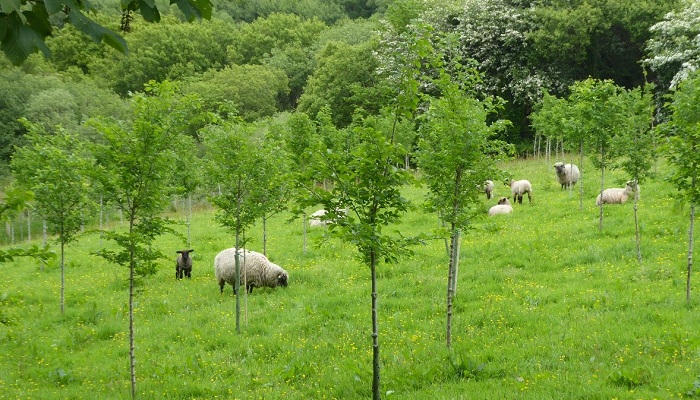
Trials carried out in Loughgall, Co Armagh showed that the use of silvo-pastoral agroforestry, which combined trees with sheep farming on the same land has many excellent benefits (featured image above). It increases the ability of the soil to sustain grazing longer than in fields without trees. This happens in two ways – through enhanced soil trafficability and through increased water permeability.
The trees intercept rain as it falls and some of this is immediately evaporated back. More is absorbed by the tree as it metabolises. Overall, the tree has a drying effect on the soil around it. Secondly, the tree roots penetrate much deeper than grass roots and so open the soil to rainwater penetration. Rainwater goes deeper into the soil and so more can be absorbed by the land. Because of these twin effects, animals can be turned out earlier and left out longer. Research has shown that, in certain locations and as the trees mature, the grazing season can be increased by a number of weeks at both ends of the grazing season.
It has also been shown that there is limited or no significant loss in overall grazing if trees are planted and managed carefully. If spacing between the trees is made wide enough (7 – 10m) it is also possible to cut silage or hay along the rows between the trees.
In terms of direct effects on livestock, research indicates that the shelter and protection provided by well-placed and widely spaced trees has the potential to reduce lamb losses by up to 30% and increase overall productivity.
Tree leaves also contain a range of minerals that are vital to animal health. For example, willow leaves have high levels of zinc and cobalt, and allowing animal’s access to appropriate forage sources can reduce the need for supplements and licks. Sheep can take in around 20% of their food as tree/shrub leaf forage if they have access to this food source. Cows forage less but still they will naturally include maybe 12% tree/shrub in their diet if they have access to this. Anyone who keeps animals will know that sheep or cattle will enthusiastically consume ivy leaves at certain times of the year.
Trees also offer the capacity for protection of our watercourses. A band of trees planted along a waterway can help to filter out runoff such as sediment and phosphates from surrounding land uses. This contributes positively to the protection and enhancement of water quality in our rivers and streams. The canopy and the roots of the trees can stabilise the soil and lessen the eroding effects of heavy rain and wind. The presence of trees can increase percolation of water into the soil, and so can have a powerful effect on limiting runoff from land. Research in the UK indicates that creating woodland between the field edge and a river can reduce sediment run-off by 90-100%, nutrient losses by 20-80%, and reduce pesticide loss in run-off by 60-100%. In this way, trees can protect and improve water quality in rivers, streams and lakes. This is, of course, vital for the healthy functioning of ecosystems but also positive for the quality of water supplies. There are specific grants available for water protection measures that involve trees.
The Native Tree Area Scheme or NTAS is a new Scheme that is attracting a lot of attention. This scheme is separate from the Afforestation Scheme and supports the creation of small native forests (1 – 2 ha max.) around the farm and/or for water protection (see Figure 1, example 4). The NTAS does not require an afforestation licence and so a decision on an application for this option can be available relatively quickly. The NTAS application includes measures (e.g. online eligibility map) to avoid environmental impacts.
Figure 1: Afforestation funding examples, (Source DAFM, 2023)
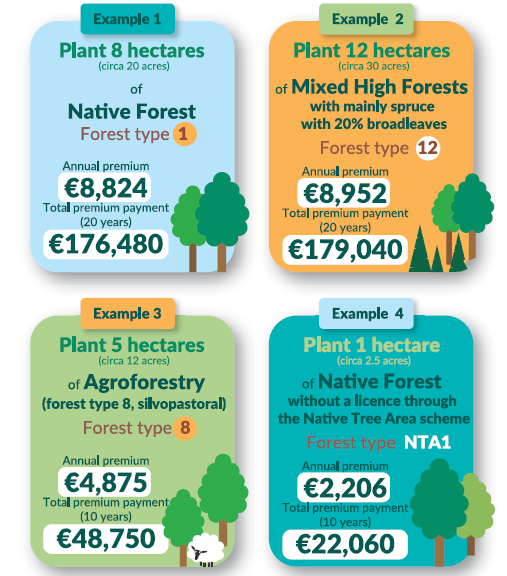
Note: In the examples above, there are additional grants payable for all works associated with establishment of your new forest, e.g. cost of the trees, planting, fencing and maintenance.
Rather than forestry and agriculture being separate enterprises, perhaps the near future holds a picture of a mosaic of fields and woodlands that complement one another. Trees and farming can support one another, offer resilience in the face of climate change, financially support farm families and enhance the environment.
To check on the grants available for tree planting, visit the Teagasc Forestry webpage.