
27 October 2023
Sustainable Timber Transport Solutions – the Scottish experience
A recent study tour saw how technological solutions and a collaborative approach are helping Scotland’s drive for sustainable timber transport. Noel Kennedy, Teagasc Forestry Development Officer reports.
Scotland’s forestry sector is often referenced in Ireland because of the many similarities between the two countries including the importance of Sitka spruce for commercial timber production. With a forest area of 1.4 million hectares, an annual timber harvest of 6.8 million tonnes and forests extensively planted on similar land types in isolated rural communities, Scotland also faces significant challenges for the sustainable transport of timber.
In September, members of the Forest Industry Transport Group travelled to Scotland to explore sustainable timber transport models and technologies being used in timber harvesting operations and to inform their potential application to address similar sustainable timber transport challenges in Ireland.
The Forest Industry Transport Group includes representatives from a range of state and private forestry stakeholders. The objective of the Group is to ensure that Ireland’s timber industry can access and market our timber resource in a sustainable manner with minimal impacts on the public road network, local communities and the environment.
The challenges
Scotland’s timber transport challenges closely mirror those experienced in the transport of timber from Ireland’s forests. These include:
- Hard to access locations
- Sensitive environments
- Fragile public and private roads
- Rural communities
- Large timber volumes
- Forest road network maintenance
Led by Neil Stoddart of Creel Maritime who provide services for the shipping and logistics sectors, specialising in forest products, the FITG group visited a number of working forests on the west coast and in the central highlands to see the timber transport solutions being employed to address these challenges.
Technological solutions
Low Ground Pressure (LGP) systems
Distributing the weight of a timber truck and its timber load over a larger surface area is a proven way to reduce the potential damage to roads.

In forest timber transport using a specialist LGP truck.
In this case a new Renault 8X8 truck fitted with a dolly wheel system to distribute weight more evenly was hauling 120,000 tonnes of timber in 55 tonne loads through the harvest site to a stacking area where it was collected by road going timber lorries. Enabling all weather and all year round forest haulage this in forest transport system reduces road wear and fuel consumption with economic and environmental savings in the longer term.
Central Tyre Inflation (CTI)

This is an established and effective LGP automated tyre pressure system which has been widely adopted by the Scottish timber haulage fleet. We saw a Scania timber truck fitted with the system which allowed the driver to remotely reduce tyre pressure thereby reducing road wear both on the forest road and outside the forest on weaker “fragile” roads. On “better” roads the system automatically re-inflates the tyres to normal road going pressure.
In Ireland’ s new 2023-27 Forestry Programme a CTI grant is included as part of the Innovative Forest Technology Scheme.
Timber transport by water
Many of Scotland’s production forests are located in difficult to access and sensitive locations along the rugged west coast or inland lochs. Scottish Government funding supports projects to facilitate the transportation of timber by sea.
Floating pontoons
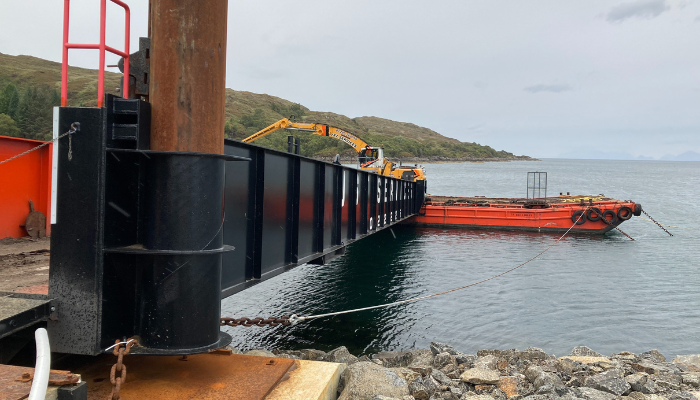
This is the most significant technological and engineering solution being utilised with support through the Scottish Government’s Timberlink project. In the coastal area of Gortenorm we saw a recently constructed floating pontoon which was enabling the loading of a small freight boat with up to 2000 tonnes of timber from the land. The boat was then delivering the timber to local “short” ports for road transport onwards with considerable environmental benefits.
Loading jetties and custom built barge

To facilitate the harvesting of non-native trees for the Loch Arkaig Caledonian pine restoration project and the barging of the timber across the loch, a number of loading jetties were built and a custom built barge assembled on site. This operation will continue on a seasonal basis for the next five years.
Environmentally friendly forwarder – A forestry forwarder is a specialised low ground pressure machine that collects the logs in the forest and brings them to the forest road. In acknowledgement of the high environmental sensitivity of barging a fully loaded forwarder across Loch Arkaig, Creel Maritime in association with John Deere developed the “world’s most environmentally friendly” forwarder which runs on HVO fuel and Bio oil lubricants.
Scottish Government support
Timberlink – is a public service contract, funded by the Scottish Government through Scottish Forestry to support short-sea coastal shipping of roundwood from Argyll to Ayrshire and reduce the environmental impacts of timber transport. Since it began operation on 2000 it has supported the transport of 1.3 million tonnes of roundwood by sea, reducing timber lorry journeys by 9.9 million timber and CO2 savings of 18,500 tonnes.
Timber transport by road
Timber Traffic Improvement Plan – A number of the harvesting sites visited had Timber Traffic Improvement Plans on the agreed timber haulage routes. The improvement works received significant funding though the Scottish Government’s Strategic Timber Transport Fund (STTF).
Pre cast concrete road bridges
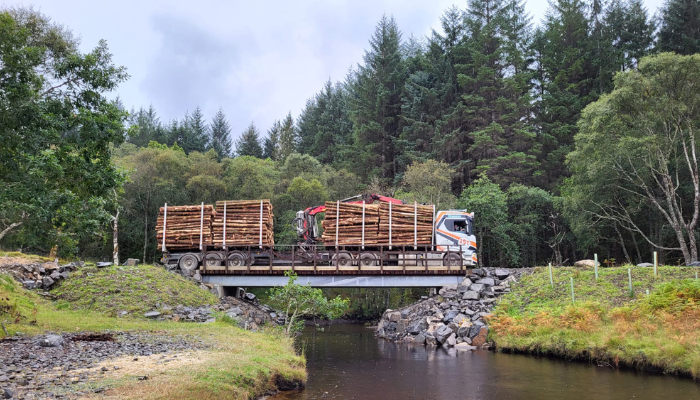
In Gortenorm, we also saw a 15 metre wide single span pre-cast concrete and steel bridge built as a critical element of the forest road infrastructure facilitating timber transport to the pontoon. The use of pre-cast concrete for bridge and other forest construction removes the environmental risk from the use of more traditional poured concrete.
Scottish Government support
The Strategic Timber Transport Fund – Since 2005, the Strategic Timber Transport Fund (STTF) has financed projects that facilitate the sustainable transport of timber in rural areas of Scotland and deliver benefits for local communities and the environment through innovative projects and partnerships. Annual STTF funding ranges £5-7 million per annum and to date has provided £65 million to support 381 projects.
A successful STTF application prompts the development of a local Timber Traffic Improvement Plan with agreed haulage routes, upgrading of local roads and bridges, involvement of Timber Transport Officers to resolve operational issues and clear community benefits.
Learnings and opportunities
As a group we were impressed and inspired by the scale and success of the forestry operations we visited and in particular by the innovation, collaboration and professionalism of the various stakeholders in the face of significant physical and environmental challenges.
The positive attitude of Scottish Forestry and the effectiveness of their STTF and Timberlink projects were recognised as critical in achieving sustainable timber transport and supporting the forest industry and rural communities and this is an area that FITG will be actively exploring in an Irish context.
Sign Up to the Teagasc Forestry Newsletter