
01 September 2023 Genetic conservation of elms in Ireland Since the early 1900s, Dutch Elm Disease (DED), caused by the fungal complex Ophiostoma ulmi Buisman and Ophiostoma novo-ulmi Brasier, has threatened the survival of elms in Ireland and mainland Europe. Karuna Shrestha and Dheeraj Rathore tell us about the efforts being made to conserve […]
01 September 2023
Genetic conservation of elms in Ireland
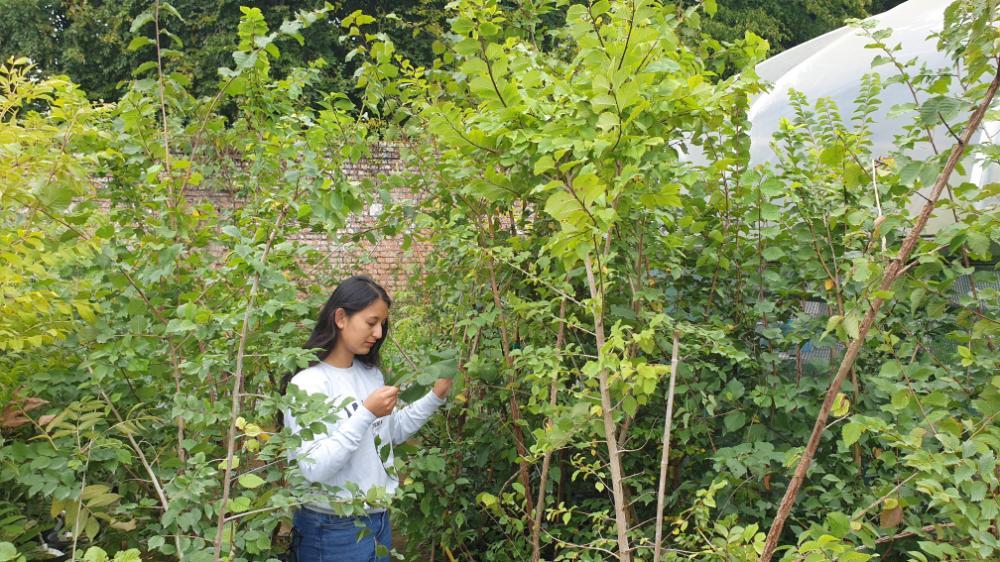
Since the early 1900s, Dutch Elm Disease (DED), caused by the fungal complex Ophiostoma ulmi Buisman and Ophiostoma novo-ulmi Brasier, has threatened the survival of elms in Ireland and mainland Europe. Karuna Shrestha and Dheeraj Rathore tell us about the efforts being made to conserve elms.
Mature elms, once an abundant species of Irish landscape and forests, specifically in urban areas, are a rare find these days. Research shows that it is possible to breed tolerant elms. Teagasc is working to breed DED-tolerant elm trees for restoration in the landscape of Ireland.
The Elm Tree
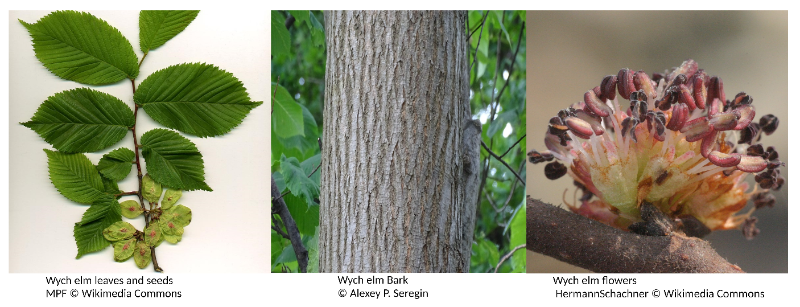
Elm is a broadleaved tree species which can reach a height of 40 m. The leaves are oval with toothed edges, pointed end and visible veins. One half of the elm leaf is shorter than the other side. The elm leaves are up to 16 cm long and 7 cm wide. Elm bark is dark grayish-brown color with deep furrows and rough surface. The flowers are reddish-purple which grows in clusters of 10-20. Flowers are wind pollinated. The flowers develop into small, winged fruits known as samaras. Each elm samara contains a single seed at its center.The seeds mature in late spring; late May to early June and dispersed by wind. Elm trees grow on rich soil with higher moister content. They are usually found on the forest edges, hedgerows, and on the edges of streams.
Importance of Elms
Elms have been historically significant species in the landscape of Ireland, symbolizing the wisdom and resilience of Ireland’s history. Elm trees hold an important cultural, recreational, aesthetic, and ecological values. Elms have always played an important cultural role in the traditional rural landscape. They were used as a firewood, and fodder supplier. Now, they are seen in roadsides and urban landscape as ornamental plants. Elm trees are a source of high quality wood, used for furniture, flooring and firewood. Elms were valued for their toughness in almost all environments and flourish under many condition. They can withstand flood, drought, storm, hail, cold and heat. So, elms can contribute to watershed protection, soil stabilization and to the mitigation of soil erosion. Elm trees also provide shelter for birds, insects and microorganisms creating diverse ecosystems and contributing to biodiversity conservation.
Disease cycle
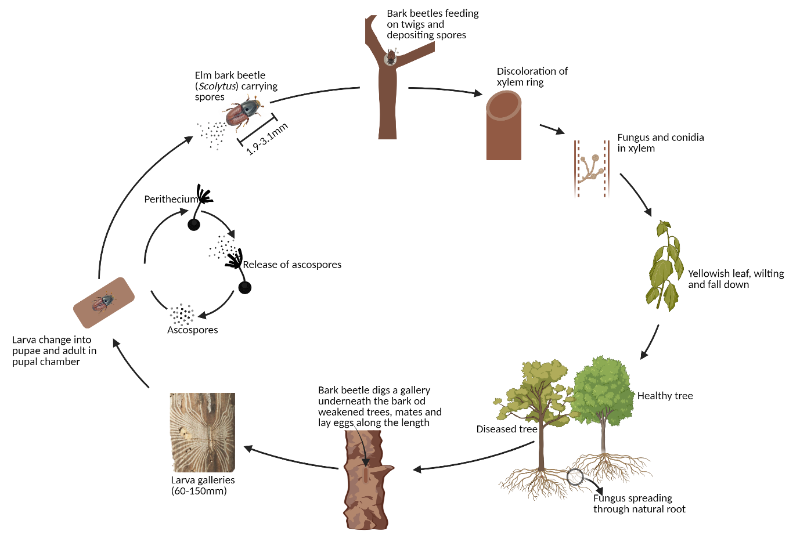
Dutch elm disease (DED) caused by the pathogens O. ulmi and O. novo-ulmi has threaten all three native European elms found in Ireland. Wych elm (Ulmus glabra) and Field elm (U. minor) are more susceptible to DED than European white elm (U. laevis). The insect elm bark beetle (genus Scolytus) plays a significant role in transmitting the disease. The vector carries the spores of the pathogen, spreading them between the trees, and potentially infecting the healthy elm trees. As they feed on the elm trees, the spores of the fungus are introduced into the xylem (channel to transport water and nutrients from roots to the rest of the plants) of the tree, interrupting the water transfer and resulting in vascular wilting, crown defoliation and eventually the death of the tree.
Breeding of DED-tolerant elms
European elms are highly susceptible to DED, however, a number of studies showed that certain European elm are resistant to DED. Limited breeding parents and the prevalence of DED infection has restricted the number of elms that have successfully established. Therefore, seed collection and rearing of these resistant trees contribute in the genetic conservation of elm trees.
Various studies suggested that crossing susceptible and resistant genotypes would result in resistant cultivars. When a moderately resistant genotype of U. minor (Field elm) and susceptible U. minor were crossed a genotype resistant to pathogen Ophiostoma novo-ulmi was produced. The seedling selection of FL 493 x U. minor ‘Tonge Mill’ resulted in production of plant that is either asymptomatic or had 2% or less wilting/damage. Additionally, crossing the susceptible European elms to the highly resistant Asian elm resulted in resistant offspring that were adaptable to a wide range of climatic conditions (Santini et al., 2010). For instance: U. glabra and U. minor (European elm) when crossed as pollen donors with U. pumila and U. japonica (Asian elm), resulted in the production of successful hybrids.
Various elm hybrids resistant to DED, obtained from interspecific crossing (crossing between different species) have been introduced to the market. These include ‘Christine Buisman’, LUTECE® “Nanguen”, ‘Morfeo’, ‘Plinio’, ‘Arno’, etc. In addition to disease resistance, these hybrids are fast-growing and exhibit high aesthetic ornamental characteristics. As a result, breeding and planting these disease-resistant elms in urban areas, not only preserves the genetic diversity but it also conserves the biodiversity associated with the elm.
What is Teagasc doing?
Teagasc has been actively collaborating with public and international organizations towards ex-situ and in-situ conservation of elm trees.
In Ireland, a few elm populations have shown natural resistant to DED, mostly in coastal counties. Teagasc has been actively collecting cuttings and seeds of resistant genotypes, which survived DED and now has a collection of 28 putative resistant genotypes of elm currently under field testing. A breeding program will be carried out using the germplasm collected by selective breeding and seedling rearing method. The clones obtained will be examined for DED and only resistant genotypes will be selected for subsequent breeding. Through cuttings or micro-propagation technique, a sufficient number of disease-resistant cultivar will be produced, and these will be planted in Irelands’ landscape. We will regularly monitor these trees for their adaptability and resistance to the diseases.
How can you help?
If you know any healthy mature elm trees in your surroundings, Teagasc is interested in collecting the samples for the germplasm collection of elm genotype resistant to Dutch elm disease.
Please contact Dr Dheeraj Rathore, Tree Improvement Researcher. Email: dheeraj.rathore@teagasc.ie Telephone: +353 (0)599170218 / +353 (0)871934169
Selection criteria
A healthy elm trees with no or minimal symptoms of infestation caused by the bark beetles may be suitable as a candidate tree for germplasm conservation. The bark beetles are attracted to trees higher than 2m. Therefore, trees in good health taller than 2 m with crown defoliation less than 30% are preferred. These healthy trees should not have leaf discoloration, browning or yellowing and the wilting rate should not be over 30%. Elm trees surviving with no disease symptoms in an area where infected/dead elms with DED exist nearby, could be a sign of resistant, are preferred to ensure the trees are resistant to the disease.