
21 April 2023
How can we decipher the effects of climate change in trees?
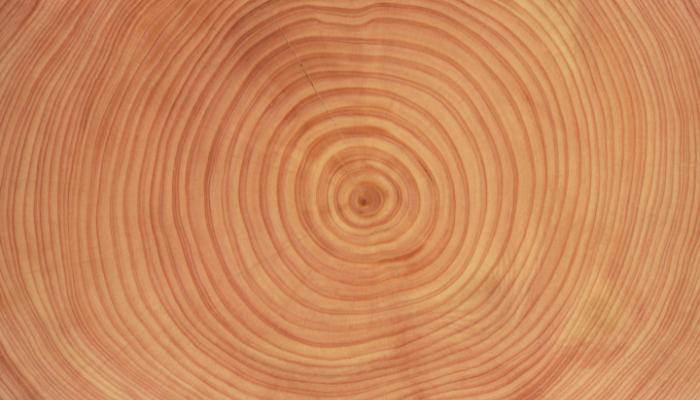
Observing how trees express their reaction to different climate conditions is the starting point for researchers to answer this question.
Here we are talking about phenological events in the establishment phase (such as bud bursting, flushing), but also mortality, and the rate and pattern of growth. However, when phenology is assessed on established, mature trees, it usually means a very long experiment will take place. And as climate is changing rapidly, alternative techniques that provide an insight into how trees reacted to known challenging climate conditions are the most reasonable choice to help us understand and adapt to change. Dendrochronology or tree ring analysis is a technique that provides important information on tree growth and many of its influential factors. Within the FitForests project, Teagasc researchers are analysing tree rings to understand how trees are responding to climate change events. Dr. Bruna Lais Longo provides an overview of this technique.
In order to obtain tree rings, two methods can be used:
- coring to obtain a small sample containing a strip of wood from bark to the pith of the tree. This method is usually used when the tree cannot be harvested, or in structural pieces of old buildings, very common in dendroarchaeology.
- discs can be cut from trees in experimental trials or areas with known site information. This method is often used when harvesting the tree is an option, and is preferred since it provides the entire cross section of the tree, thus more detail is available for analysis.
In the FitForests project discs have been collected in three trial sites in Ireland. One disc is obtained from the stump height, one at breast height (1.3m above ground) and an extra disc from the bottom of each log bucked from the tree. Discs are then brought to the lab, where they are diligently sanded in gradually finer sanding rounds in order to even the surface, eliminating mechanical marks and other imperfections that may hinder the next steps. Annual rings are usually quite clear at this point and can be counted. Additionally, to accurately measure them, a digitalisation is performed with a high resolution scanner. This process generates quality images of each disc, which is now available for measurement using a specialised software, for example WinDENDRO® (the one used in Teagasc).
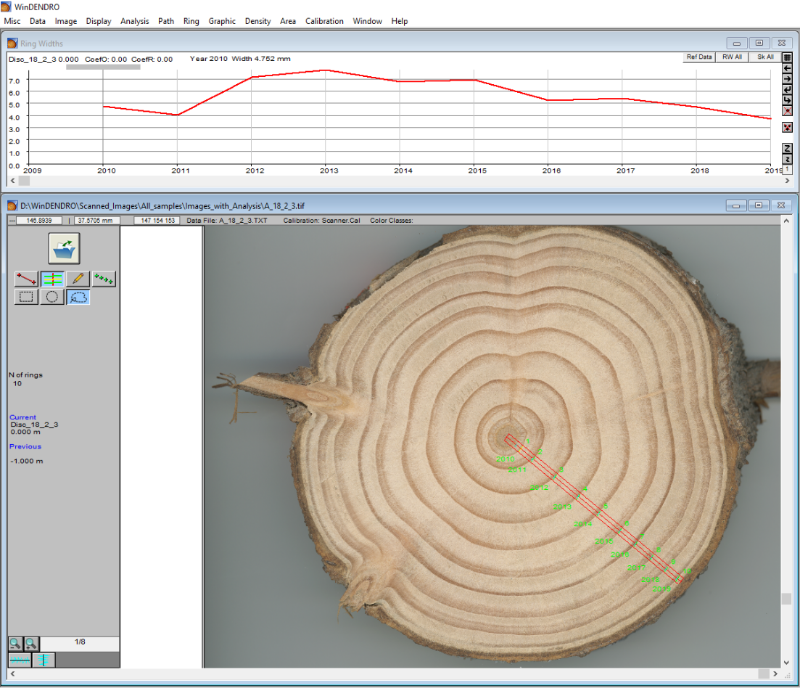
Figure 1. Interface of WinDENDRO software, which is used to measure and analyse tree ring images.
After careful analysis of discs and their images, a couple of questions can be answered:
1. What is the age of the tree?
In temperate areas, the growth of trees is limited to the growing season; the length of which varies depending on the climate conditions in that particular forest site. During the growing season, the tree produces a new layer of wood, a tree ring. Rings can be discerned based on colour, as the wood produced early in the growing season is usually lighter in colour and density, while towards the end of summer, the tree grows a darker and denser wood, characterising the boundary between rings. Thus, there is a variation in certain structural features (i.e. width, wood density, etc.) that can be observed between and within rings. Therefore, because trees produce one ring each year, the age is obtained by counting the number of fully formed rings at the stump disc.
2. When was each annual ring produced?
Knowing the harvest date, it is possible to note which year the tree produced each ring, backtracking from harvest year (most external ring, close to the bark) to year 1 (most internal ring, close to the pith).
A technique called crossdating is key: by matching tree ring characteristics between different discs within the same tree based on appearance and data, it is possible to identify instances (i.e. locally absent, false or micro rings) that would cause errors in the determination of a precise chronology for that tree.
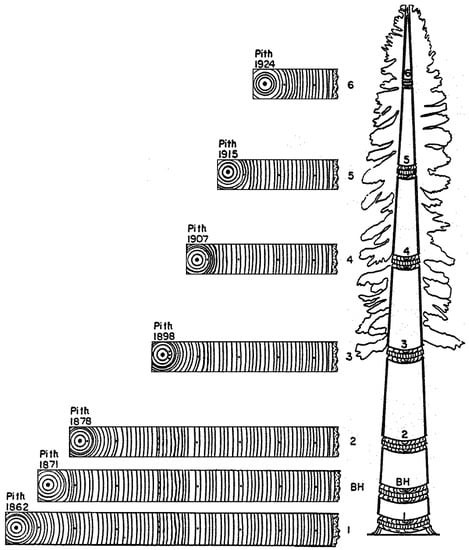
Figure 2. Representation of stem analysis and crossdating. Source: BIONDI, F. 2020. From Dendrochronology to Allometry. Forests, 11, 146.
3. How did the tree grow?
Rapid and slow growth years can be observed based on the width of each annual ring. Further insights can be gathered by measuring the width of the earlywood and latewood within each ring. The ratios between early and latewood, their pattern and relative proportions to the ring itself are measures that help us understand the growth of the tree.
4. How can a climate event be identified in annual rings?
As annual rings can be assigned to the year they were formed, when available, climate (i.e. temperature, precipitation, etc.) and historical records (forest fires, pests, etc.) can be used to relate to each ring’s growth and appearance. This way, it is possible to know how trees react to certain climate events or conditions. For example, tree rings with (unusually light) colour may be related to extreme cold conditions in temperate climates; and that abnormally narrow rings are related to stress due to water deficits in the growing season. In fact, in a few cases the tree’s response to temperature and water availability is similar. Thus, knowing the climate history and the limiting factors in that region for that species helps researchers to correctly interpret the information stored in the rings of a tree.
5. How do we know the scale of such a climate event identified on annual rings?
By comparing discs from different trees locally, regionally and nationally. When comparing the annual rings of the same year between trees, it is possible to establish the scale of a climate event, e.g. an extremely dry year, a local forest fire, etc. For this determination to be valid, the species should be the same, as different species might grow in different patterns when exposed to the same environmental conditions.
6. Is the tree reacting to climate events uniformly along its height?
Simply said, trees grow by extracting nutrients from the soil through roots and pumping it up to the leaves through the bole and branches; while also producing amino acids and sugars through photosynthesis in the leaves, which is piped down to the branches, trunk and roots. These components are used to produce another layer of wood every year, a dynamic that works perfectly in optimal conditions. However, these processes might be affected when the tree is under stress. For example, a drought event affects the growth of the tree, but the extent of this effect might be different towards the top of the tree than at the bottom, depending on the characteristics of the species, the type of soil (and especially its capacity to hold water), the slope, etc. Thus, by comparing annual ring patterns from discs at different heights in the same tree and availing of climate and site data, it is possible to shed light into this question.
This article is an overview of the one of the techniques being applied in work package number 4 of the FitForests project, a study funded by the Department of Agriculture, Food and the Marine (grant number 2019R511).