
03 March 2023
Agroforestry – grass, crops & food forests
Agroforestry is the integration of trees with either crops or livestock on the same land. John Casey, Teagasc forestry development officer, tells us more.
Agroforestry is the integration of trees with either crops or livestock on the same land. It aims to achieve additional benefits in comparison to keeping agriculture and trees separate. Across the world, agroforestry encompasses a wide variety of practices ranging from simple shelterbelts of trees around fields to an intimate integration of food crops and trees.
In Ireland, we may be late coming formally to these practices but the upcoming Forestry Programme 2023- 2027 contains some novel agroforestry measures. Under the new Creation of Agroforestry Systems intervention, it is envisaged that in addition to the reasonably familiar Silvopastoral systems (trees and grass) category, there will also be Silvoarable systems (trees and crops), and Forest Gardening (establishment of small-scale food forests) categories.
The proposed financial support will include 2 instalment grants for the establishment of the forest (total €8,555/ ha). Grant rates have been determined on the basis of the typical cost per hectare of forest establishment, in accordance with current market rates. In addition, annual premiums will be paid to the beneficiary for undertaking management commitments. Premium payments will be made annually per hectare of forest established (€975/ ha for 10 years). In all agroforestry scenarios, a minimum of 400 trees per hectare is required.
Category 1- Silvopastoral Systems
Objective
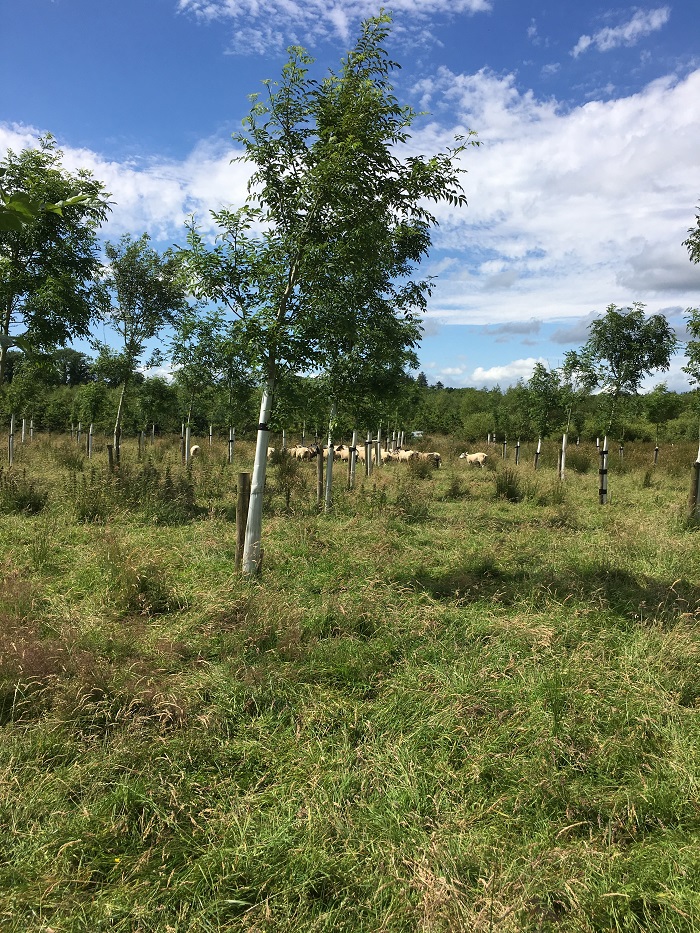
To establish agroforestry silvopastoral systems where trees will be grown at wide spacing with grass grown in between. The grass can be cut as silage/hay or can be grazed by sheep, poultry, cattle and small pigs.
Requirements
The trees will require tree shelters and fencing. Additional funding through the Sustainable Forest Management Intervention will be provided to shape the trees as they emerge from their shelters. The requirement for the removal of shelters and the provision of plastic mesh to protect the trees after the shelters are removed has been factored into the premium payment rates. Fruit and nut trees can comprise 15% the planting. The use of setback areas for grazing the eligibility of both conifers & broadleaf tree species will need to be assessed on a case-by-case basis. It is important to note that once land is converted to agroforestry, it will be classified as forest land and the provisions of forest legislation will apply.
The following agricultural activities will be permitted, so long as such activity is compatible with protecting the trees:
Pasture: Grazing by sheep or young domestic stock is permitted during the spring and summer months in the early years, depending on tree growth, but trees must be protected and tree shelters checked regularly. Thereafter, when tree shelters are replaced with plastic mesh, larger animals may be introduced.
Fodder: Silage and hay production is permitted. It is important that appropriate machinery is used when cutting silage and/or hay so as to ensure that the trees (including stem, roots and crown) are not inadvertently damaged.
Category 2- Silvoarable Systems
Objective
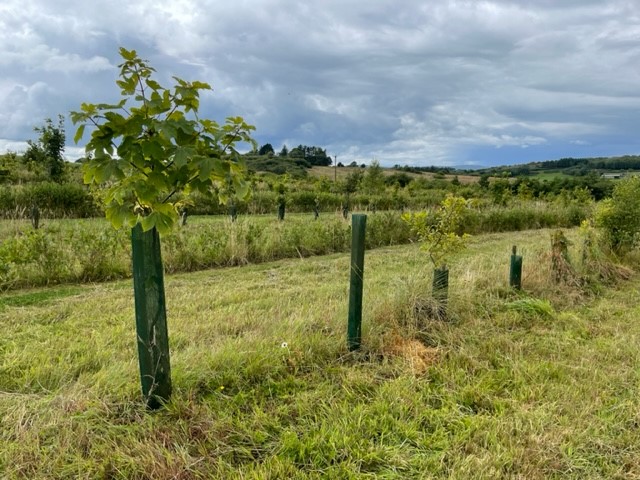
To establish silvoarable agroforestry systems with crops of cereals, fruit and vegetables growing amongst trees. This measure will not require tree shelters as there will be no grazing. The crops will be grown amongst single trees, rows or groups of trees.
Requirements
This measure will need a clear strategic plan taking into consideration a long term vision for the farming enterprise. Headlands for machinery will be required to allow for machines to turn at the end of each row subject to environmental setbacks. Again, eligible tree species include broadleaves and conifers and will be assessed on a site-by-site basis. In this category, fruit and nut trees can account for 20% of species planted. It is proposed to pilot with a maximum of 30 ha per year for 4 projects, with a maximum of 7.5ha per project, under the silvoarable systems category..
Category 3- Forest Gardening
Objective
To establish carefully planned and constructed forest gardens. The objective is to provide robust, small-scale forests that provide a source of organic forest food. Environmental Target People want clean air, clean water and food produced sustainably. The intention is that trees will mitigate the negative effects of climate change, improve animal welfare (most likely poultry), increase biodiversity, produce renewable energy, protect water, and produce quality timber.
Requirements
First off, there will be funding for pilot plantations to establish which designs are most suitable to Irish conditions. Initially, there will be a 1 ha limit per landowner with a national ceiling of 6ha annually. A design plan would need to be submitted with each application. Up to 40% of the trees planted could be fruit and nut trees. It is proposed to a maximum of 6ha per year – 6 projects with a maximum of 1ha each under this Forest Gardening category.
It is anticipated that DAFM will release further details in the near future. In the meantime, why not check out the Teagasc website Forestry – Teagasc | Agriculture and Food Development Authority for any updates?
New Agroforestry project- AF4EU
Agroforestry (AF) can be part of the solution to address sustainability issues, including environmental, economic or social and climate change. Teagasc is looking forward to being a partner in a new EU- funded project beginning in 2023, the Agroforestry Business Model Innovation Network (AF4EU). The aim is to promote agroforestry through the development of networks, based on the sharing of successful cost-effective practical experiences and existing research knowledge, with a special focus on the development and implementation of new business models and extension services.
Co- ordinated Regional AF Innovation Networks (RAINs) will be expanded across Europe, including Ireland – allowing the exchange of knowledge and experience, developing ideas and identifying knowledge gaps. The goal is for the RAIN’s composition to include farmers (livestock, crop and forest sectors), SMEs, extension services, Rural Development EIPs, service providers, farmers’ associations, policy-makers, retailers and consumers.
Further details regarding AF4EU and the networks will made available on the Teagasc forestry website Forestry – Teagasc | Agriculture and Food Development Authority once the project has fully commenced.