
12 February 2023
Part 2: A look at the interim scheme options – Forestry Programme 2023-2027
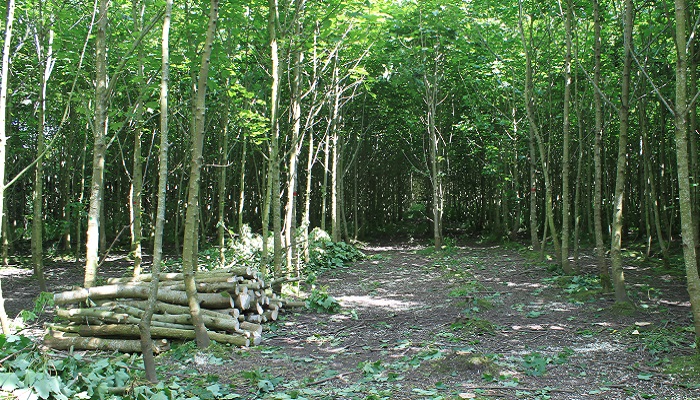
The proposed new Programme is very ambitious and contains a proposed range of forest types to facilitate new forest creation and also interventions to help facilitate sustainable and resilient existing forests.
In part 1, Tom Houlihan, Teagasc Forestry Specialist, explained the proposed new programme and Interim Afforestation Scheme. In this article he takes an initial look at the potential financial returns from two of the forest types in table 1 available under the latter.
Table 1: Eligible forest types and relevant supports under the Interim Afforestation Scheme (Via General De Minimis)
| Forest type | Proposed grant/ha* | Proposed annual premium/ha | Proposed number of premiums for farmers | |
|---|---|---|---|---|
| FT1 | Native woodland | €6,744 | €1,103 | 20 |
| FT2 | Forest on Public Lands** | €10,544 | n/a | n/a |
| FT6 | Broadleaf mainly oak | €6,744 | €1,037 | 20 |
| FT7 | Other Broadleaf | €4,314 | €973 | 20 |
| FT8 | Agroforestry | €8,555 | €975 | 10 |
| FT11 | Mixed High Forest Conifer, 20% Broadleaves | €4,452 | €863 | 20 |
| FT12 | Mixed High Forest Conifer with mainly spruce, 20% Broadleaves | €3,858 | €746 | 20 |
*Additional supports for fencing also apply. **Grant includes Trails, Seats and Signage Facilities payment.
Comparing forest types
The Teagasc Forest Investment Valuation Estimator (FIVE) informs decision making in relation to potential land use and forestry options. FIVE uses discounted cash flow (DCF) analysis to model indicative financial returns for forestry land use options (forest creation) and management options (e.g. forest thinning). It provides financial output for decision support, particularly in relation to reviewing pre-planting options and comparing criteria such as tree species, yield classes and forest rotation lengths according to landowners’ preferences and objectives. In order for landowners to get the optimum benefit from FIVE, Teagasc forestry advisors can facilitate one to one consultations in order to go through the forestry establishment scenarios that may be appropriate for individual circumstances.
Potential timber revenues are generated by FIVE through the selection of forest criteria and management regimes. A range of variables are used as inputs in a typical financial analysis. These include species, site productivity, rotation length, relevant premium payments, establishment and on-going management costs, as well as potential thinning and clearfell timber volumes and revenues. Future cost and revenue streams from forestry are generated by FIVE and are discounted to present day values and presented as net present values (NPVs).
The NPV refers to the net returns to forestry over one (or more) forest rotation(s). In order to compare forestry with other farm enterprise options (at an indicative level), the FIVE tool expresses different forest crop rotations on an annual per hectare basis by generating the Annual Equivalent Value (AEV) for each forest scenario. The AEV expresses the NPV as a series of equal cash flows over the forest rotation.
The following case studies use FIVE analysis to compare the returns for type Forest Types 7 and 12 available under the Interim Afforestation Scheme (via General De Minimis).
Farmer 1
Considering planting 6ha of heavy mineral soil with Forest Type (FT) 12. This Forest Type comprises mixed, high forest with mainly spruce and an inclusion of 20% broadleaves. This planting option is equivalent to Grant and Premium Category 3 (GPC 3) under the previous Forestry Programme (Table 2).
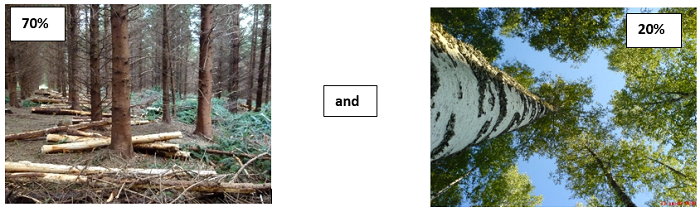
Table 2: Comparision between GPC and new FT
| Prevoius Grant and Premia Category (GPC) | New Forest Type (FT) |
|---|---|
|
GPC 3, Grant Rate: €3,215 (excluding fencing) |
FT 12 Grant Rate: €3,858 (excluding fencing) |
| GPC 3 Premium rate: €510 /annum (15 years) | FT12 Premium rate: €746/annum (20 years) |
Assumptions:
- Establishment type: Afforestation;
- Area planted: 6ha;
- Soil type: Wet mineral;
- Selected species: Sitka Spruce 70%, Birch 20%;
- Retained area for biodiversity enhancement (e.g. open spaces, retained habitat, setbacks): 10%;
- Yield class (productivity indicator): Sitka spruce YC 24, Birch YC 8;
- Forest thinning: Normal;
- Rotation: 35 years;
- Timber prices: 10 year average*;
- Discount rate: 4.5%;
- Grant rate: Covers full cost of establishment / early management.
Table 3: Indicative returns
| Per ha (€) | total (6ha) | |
|---|---|---|
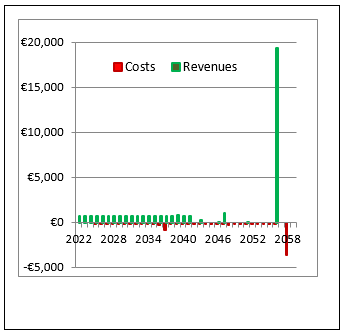
| Total revenues | 35,903 | 215,423 |
| Total costs | 6,980 | 41,880 |
| Balance | 28,923 | 173,543 |
| Net present value** | 12,084 | 72,502 |
| Annual equivalent value*** | 692 | 4,152 |
*10-year timber prices (2011-2021). **Net present value refers to the net returns to the forest enterprise. ***Annual equivalent value expresses the new present value as a series of equal cash flows over the forest rotation. Farmers meeting the required criteria can also be eligible for the Basic Income Support Scheme (BISS) Payment on planted land.
Figure 1: Indicative returns, FT12, 1ha
Farmer 2
Considering planting 6 ha of mineral soil with Forest Type (FT). This Forest Type comprises a fast growing broadleaf forest (e.g. birch or sycamore). This planting option is equivalent to Grant and Premium Category 5 (GPC 5) under the previous Forestry Programme (Table 4).
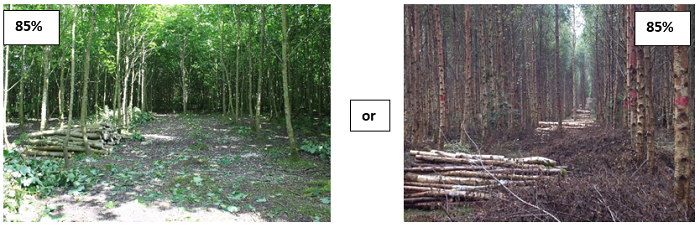
Table 4: Comparision between GPC and new FT
| Previous Grant and Premia Category (GPC) | New Forest Type (FT) |
|---|---|
|
GPC 5, Grant Rate: €3,595 (excluding fencing) |
FT 7 Grant Rate: €4,314 (excluding fencing) |
| GPC 5 Premium rate: €605/annum (15 years) | FT 7 Premium rate: €973 / annum (20 years) |
Assumptions:
- Establishment type: Afforestation;
- Area planted: 6ha;
- Soil type: Mineral;
- Retained area for biodiversity enhancement (e.g. open spaces, retained habitat, setbacks): 15%;
- Yield class (productivity indicator): 8;
- Forest thinning: Normal;
- Rotation: 50 years;
- Timber prices: 10 year average*;
- Discount rate: 4.5%.
Table 5: Indicative returns
| Per ha (€) | total (6ha) | |
|---|---|---|
| Total revenues | 30,168 | 181,009 |
| Total costs | 9,180 | 55,080 |
| Balance | 20,988 | 125,929 |
| Net present value** | 11,643 | 69,858 |
| Annual equivalent value*** | 589 | 3,535 |
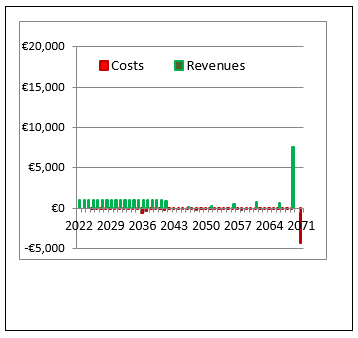
*Timber prices for broadleaf species are based on limited data. **Net present value refers to the net returns to the forest enterprise. ***Annual equivalent value expresses the net present value as a series of equal cash flows over the forest rotation. Farmers meeting the required criteria can also be eligible for the Basic Income Support Scheme (BISS) Payment on planted land.
Figure 2: Indicative returns, FT7, 1ha
Farm forestry offering highly-competitive options
If all costs and revenues associated with forestry land use are compared with all costs and revenues associated with agricultural land use (after adjusting to present values and the one-year cycle per annum basis), then the forestry AEV per ha and family farm income can be considered conceptually equivalent. In this regard, forestry returns can be highly competitive when compared to many agricultural enterprises. It should be borne in mind that this analysis compares observed agricultural incomes with projected future forestry income flows discounted to today’s values and converted to annual equivalent. This allows indicative rather than absolute comparison.
FIVE analysis does not take into account the capacity for eligible forestry parcels to draw down the new Basic Income Support Scheme (BISS) payment as well as the forestry premiums. It also does not factor in the potential income tax free returns and relative efficiencies in terms of labour inputs when compared to other enterprises. FIVE cannot account for uncertainties such as potential subsidies that agricultural and forestry land will attract in the future or what new values may emerge for the services produced by agricultural and forestry land uses.
Further information
The forest options considered here clearly have many benefits, but it is important that farmers and landowners are fully aware of all implications in advance of informed decision making. Teagasc provides comprehensive supports and the best information available to help inform good decision-making while supporting landowners in meeting their objectives. See the Teagasc Forestry webpage or contact your local Teagasc forestry staff.