
06 January 2023
Jobs to do in your forest over winter
Winter tends to be a bit more quiet on the farm. It is a great time to get jobs done in your forest. So, dependent on the age of your forest, here are some suggestions to work off all those Christmas puddings!
Winter management tasks – check list
- Go for a walk
- Maintain good access to and through your forest
- Check tree stocking and replace dead trees where necessary
- Check for nutrient deficiencies and take foliar samples if required
- Check drainage and improve where necessary
- Check fences and repair where necessary
- Carry out formative shaping on broadleaves, especially oak
- Mark potential crop trees
- Carry out high pruning if/when appropriate
- Cut inspection paths in your conifer plantation
- Review your insurance cover
Go for a walk
Access makes management happen. No access, no management. Simple as that.
So, take your dog for a walk through your forest. By doing so, you’ll discover what needs to be done. The sooner an issue is spotted, the easier it will be to sort it out. And if you’re not too sure, ask your local Forestry Adviser. He or she will be more than happy to help.
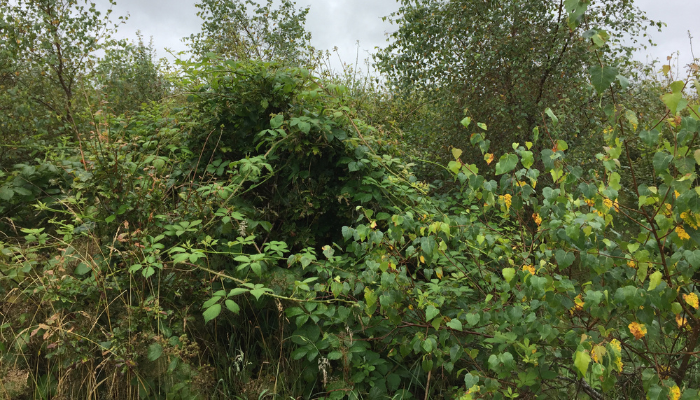
Top your pathways once a year to prevent your access from getting overgrown with briars and whins.
Replace dead trees
Future tree selection and quality timber production depend on many trees to choose from. Make sure to keep your tree stocking density as close to 100pc as possible.
You can estimate this by using circular plots. Place a stake in the ground and tie an eight-metre tape or string to the stake. Tighten the tape and walk around in a circle, while counting all live trees within this circle. Multiply the result by 50 to find the stocking density per hectare.
For instance, you should count 66 live oak trees within the circle, while Sitka spruce should have 50 live trees.
Check for nutrient deficiencies
Healthy trees will grow strongly so make sure that the trees have access to satisfactory nutrient levels. Levels and requirements vary according to the soil type and tree species planted.
Keep in mind that other factors such as poor drainage or lack of adequate vegetation control may also produce deficiency-like symptoms. That’s why it is important to identify the issue before attempting to rectify it. For instance, there is no point in applying fertiliser if the site is poorly drained. Fix the drainage issue, monitor the trees’ response and then reassess fertiliser requirements.
Where symptoms occur, foliar analysis is recommended to determine the nature and the extent of a possible nutrient problem. Evergreen conifers should be sampled (ideally) in December.
Have a look at www.teagasc.ie/forestry how to take foliar samples and where to send them to for analysis.
Check drains
It is very important to ensure good drainage. A high water table leads to difficulties in nutrient uptake while limited tree rooting space affects (future) tree stability.
So on your walk, keep a close eye on the drainage system and keep it effective at all times.
Check fences and gates
Keep browsing animals (e.g. sheep, deer, etc.) out of your forest. They damage (or kill) trees by bark stripping, eating of shoots or trampling on tree roots. Trees browsed by animals will lose their commercial value very quickly.
Animals may also cause drains to collapse initiating water logging. This will result in an increased windthrow risk.
Carry out formative shaping
Formative shaping of broadleaf trees is important as it will create longer straight lengths of quality timber. By removing forks or very large competing side branches, you ‘extend’ sawlog length.
This can be carried out in summer or winter but not in spring or autumn. This process should start early once trees are growing vigorously. Don’t remove too much of the foliage, the tree needs its leaves to grow strongly.
See www.teagasc.ie/forestry for details how to go about this.
Mark Potential Crop Trees (PCTs)
Winter is a good time to select the best trees (or Potential Crop Trees) in your broadleaf forest. Some of these trees will go on to produce the final and intermediate sawlog timber.
PCTs should have good, straight stem form, have good vigour, be disease-free and are evenly distributed. Aim for 300 to 500 PCTs per hectare.
Select your future PCTs before the first thinning operation is carried out. The other trees you can regard as ‘fill’ and will gradually be removed providing growing space for the PCTs.
Carry out high pruning
Once the final ‘sawlog length’ has been achieved by regular formative shaping (see above) then it’s time for high pruning.
The purpose of high pruning is to avoid knots in the timber. Start by removing the lowest side branches, gradually removing branches up the tree as the tree develops. Only PCTs are high pruned. High pruning tends to be initiated after a first thin operation has been carried out.
Cut inspection paths
When a conifer forest is about ten years old, inspection paths are required. This allows access into and through the forest so that the suitability for thinning (and timber quality) can be assessed. It is also a great opportunity to check if any other issues need to be addressed, maybe a blocked drain for instance.
There is a short, handy video on www.teagasc.ie/forestry explaining this process.
Review your insurance cover
Brexit has contributed to a drastic increase in the cost of forest insurance. Having said that, it is still advisable to insure your forest.
Make sure that you understand what you are insuring. For instance, policies may cover
- Loss of timber value due to fire and/or wind damage
- Cost of replanting
- Fire brigade charges
- Public liability and employer’s liability.