
23 December 2022
95% of the hardwoods used in the Irish furniture and woodworking industries are imported
There are 200,000 ha of broadleaf plantation, of which more than half is 30-years old or younger. Thinnings from such plantations is currently directed to the firewood market, negating any added-value potential which could be realised through markets for better material.
There is potential to reduce reliance on imported hardwoods through advances made in the processing of small diameter hardwood logs and in the development of innovative uses for small-sized sawn hardwoods. Common alder (Alnus glutinosa) is a native Irish species which has been widely planted across the country over the last 30 years. Small diameter thinnings can be harvested from these plantations. However, due to a lack of research and innovation in the area of utilisation of small diameter thinnings, there is currently very low value for these logs. A recently completed Walsh Scholarship project investigated the potential to add value to such logs.
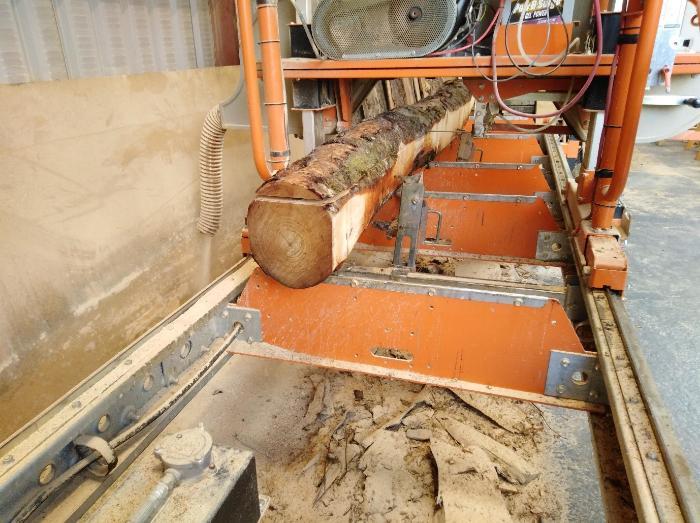
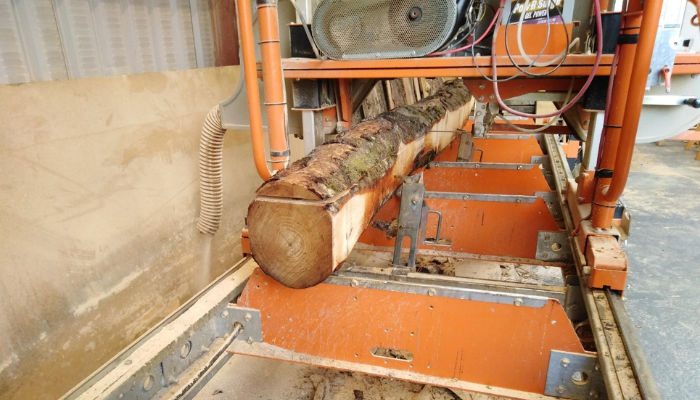
Small diameter alder log being processed into planks on ATUs mill
Walsh Scholar Colin Marren graduated from Atlantic Technological University (ATU) in November after completing his MSc by research at the Letterfrack Campus. His Teagasc-funded project, “Exploitation of the working properties and utilisation of small-diameter Irish-grown alder (Alnus glutinosa)” was a collaboration between ATU Connemara and Teagasc, and was supervised by Dr Ian Short (Teagasc), Mr Seán Garvey (ATU) and Dr Dermot O’Donovan (ATU). A broader research advisory panel included Prof. Robert Bush, Virginia Tech University, Mr. Kevin Maye (ATU) and Dr. Kate Dunne (ATU).
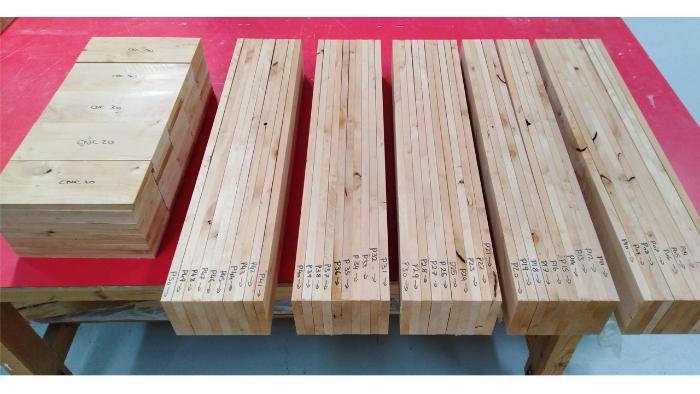
Alder samples prior to testing
Colin’s project investigated the potential for, and development of, value-added end-uses, novel products and alternative markets, for small diameter Irish grown alder. This involved scientific testing and analysis of the wood properties and, based upon those results, examining potential applications and utilisation. The testing was broken into three sections:
- mechanical testing
- machinability testing; and
- product development/testing.
Testing of the alder’s mechanical properties was done at ATU Connemara materials laboratory, primarily using the 30KN Instron test rig which can conduct tests according to the BS 373 (1957), the Standard for testing mechanical properties of small clear specimens of wood. The working properties and aesthetic value of the specimens was assessed with reference to the properties specified by Knaggs and Xenopoulou (2004), i.e., machining, nailing, screwing, bonding, and finishing, all which are aligned with the EN942 (2007) Standard. Due to a lack of comparable data using these Standards this research employed the ASTM D1666-11 testing Standard for which comparable data exists for alder and other similar species. See the two YouTube videos linked below for some visual examples of the testing processes. Results from the above were used to direct choice of potential market to be evaluated using qualitative comments, quantitative metrics, and professional opinion/ expert analysis.
The results from the mechanical testing showed the small diameter alder to perform similarly, but slightly lower than, mature common alder and American red alder (Alnus rubra) and that it would not be suitable for load bearing applications. Machinability tests showed excellent results across all test methods and presented very high levels of machinability in sanding, planing and CNC routing. The research indicated that the material tested can be dried aggressively, without pre air-drying, with little to no degrade to the quality of the material.
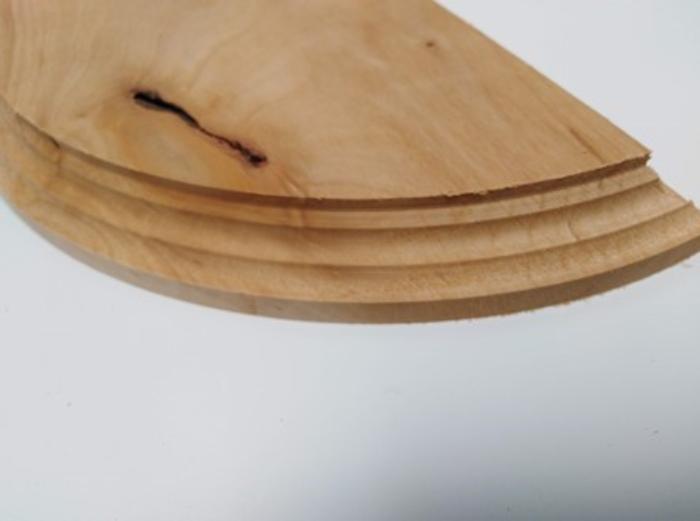
Example of result from CNC testing
The product testing gathered qualitative and quantitative data from industry professionals through practical experience and a questionnaire. The material showed some promise for use in the skirting and architrave market. Testing in post primary education settings resulted in encouraging feedback from teachers. Participants found the material to be more suitable than some imported material they currently use. A recent change in the junior cycle curriculum includes learning outcomes on sustainability and understanding the impact of where their material comes from – using locally sourced material has a lesser impact on the climate when compared with imported materials and could be a good example to students. Participants considered that the alder could replace some imported timber species they currently use and that they would buy this material for their classes if it was available.
The research also found that the alder could go straight to kiln drying without the need for prior air drying, without causing negative impacts on mechanical performance. It also showed that the alder could be dried at more aggressive levels than the industry standard Schedule J recommends, again without negative impacts on mechanical performance. This could lead to cost savings if the material is to be used by industry.
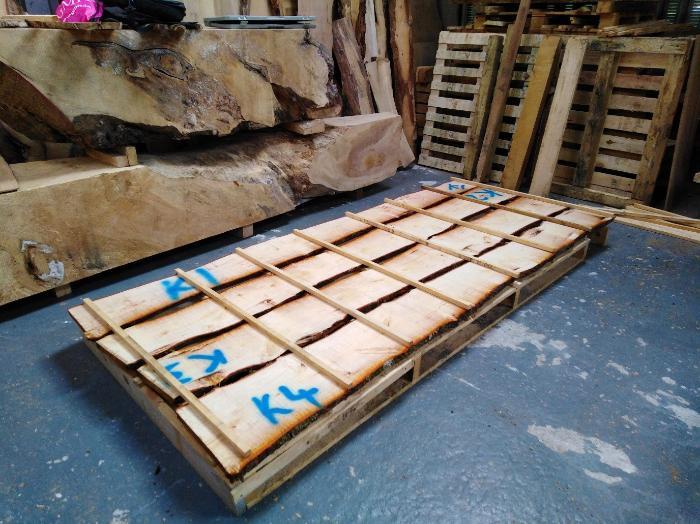
Some of the alder planks prior to drying in ATUs kiln
The source material for this project came from one site only and, therefore, it would be beneficial to replicate the work with material sourced from a number of sites to ensure robustness of the results. Similar research could also be replicated with other species for which there are currently few markets of small diameter thinnings. However, the results of the project indicate that small diameter Irish grown alder does have potential to be utilised for more value-added end-uses than it is currently being employed.
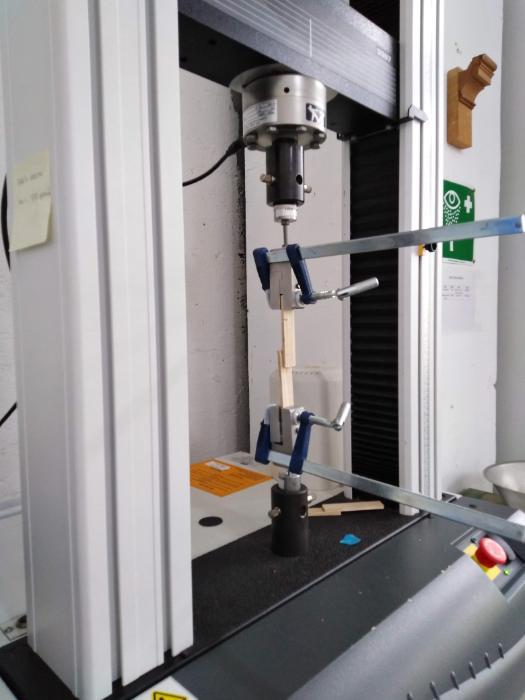
Effectiveness of gluing being tested on ATUs Instron
Related Resources
Articles
Spazzi, J., Garvey, S. and Short, I. 2019. Developing new hardwood markets for Irish timber. Irish Forestry 76 (1&2): 60-72.
Spazzi, J., O’Connell, J., Sykes, J., Short, I. and Garvey, S. 2020. The Hardwood Focus Group: Exploring utilisation potential of Irish broadleaf forests. Forestry & Energy Review 10(1): 24-29.
Llana, D.F., Short, I. and Harte, A.M. 2020. Use of non-destructive test methods on Irish hardwood standing trees and small-diameter round timber for prediction of mechanical properties. Annals of Forest Science 77, 62.
YouTube videos
https://www.youtube.com/watch?v=1JxKnW9Wmbw&t=39s
https://www.youtube.com/watch?v=NZ72VqzZGfw