
13 December 2024
Pig farm energy costs – analysing your bills
While energy prices have gradually reduced in the last two years, Pig Development Officer at Teagasc, Emer McCrum explains why now is an opportune time to for pig farmers to review their individual situation and plan measures to reduce this cost.
Energy costs, including electricity and liquid fuel, on average account for the third largest non-feed input after labour and healthcare costs. The graph below details the national average Heat, Power & Light cost per pig produced in recent years.
Figure 1: Heat, power and light cost per pig 2017-2023
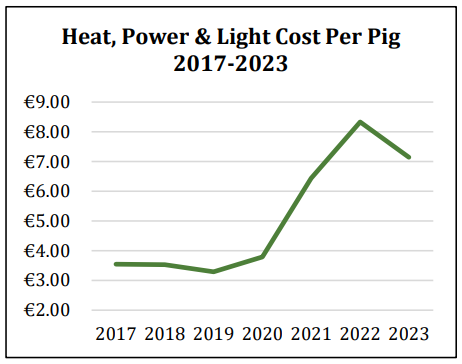
Source: Teagasc National Herd Report 2017-2023
The rapid escalation in costs from 2021 was part of the broader industry crisis at the time and because of this, producers were limited in financial terms to act on reducing energy usage and improving efficiency at farm level.
Now is an opportune time to review your individual situation and plan measures to reduce this cost and in the process, improve the sustainability of your business.
In this article we will look more closely at your electricity bill, in particular the ‘other items’ tucked away on page two. Many producers are currently locked into medium to longer-term contacts at competitive rates. Double check, however, when your contract is due to expire as suppliers may not always give you advanced warning or notify you once a contract has expired.
Shopping around can be time consuming so employing the services of a broker might be a more suitable option as pig farms generally have good purchasing power. Before doing so, gather up a selection of recent bills to give the broker an idea of your annual usage.
When was the last time you sat down and studied your energy bill? With direct debit payments and many service providers having moved to paperless billing, it may be some time since you last went through the additional charges on your bill. A competitive unit price is hugely important but remember to review the second page of your bill at least annually.
Maximum Import Capacity (MIC) / Capacity Charge
The annual charge per kVA is divided by 365 and charged pro-rated based on the number of days in the billing period. For example, at present a 90kVA allowance costs in the region of 12c per kVA per day or almost €330 per month. If the MIC is too low for your current requirements, you may be incurring excess charges. In the event that peak demand exceeds the MIC, a surcharge of up to six times the capacity charge per kVA will apply.
Conversely if the MIC is too high for your requirements, you will be charged for more capacity than you actually require on an ongoing basis. As a general guideline, the MIC should be set at 5% above your highest electrical load in the past year. If you are incurring excess costs, analyse a number of recent bills with your electrical contractor to check your recorded use and establish whether a new MIC is required.
Demand charge
Demand charges are a feature of certain price plans. It is designed to reflect the high cost of producing electricity during the hours when there is most demand on the electricity network. The charge is applied per kW used above a threshold of 30kW during the hours of 5pm to 7pm from Monday to Friday across the winter months (01/11 to 28/02 inclusive). Outside of these hours and time period there is no demand charge and this item will appear as €0.00 on your bill.
If you are incurring excess charges here, explore options to reduce the electricity demand during these hours. Move to using energy intensive equipment at alternate hours, avoid having large loads operating at the same time and reschedule tasks outside maximum demand periods.
Wattless charges
Certain equipment such as motors or fluorescent lights require reactive power or wattless units in order to operate. Wattless energy is measured separately from your general units and if your consumption of wattless units increases above one-third of your general units per bill, the excess wattless units will incur a charge. If you are consistently incurring excessive wattless charges, contact your electrical contractor to fit power factor correction equipment. This will reduce the amount of reactive power you consume and help to avoid wattless charges on your bills. If you have had a consistent wattless charge on every bill, the payback period for this work is less than four years.
Public Service Obligation (PSO) levy
You may have noticed the PSO Levy returning to your bills since October. The levy was reduced to zero in 2023 to September 2024 due to the extremely high wholesale prices at the time. The PSO for all business customers is based on the MIC. The new rates for businesses from 1st of October to 30th September 2025 are as follows:
- MIC < 30kVA : €12.91/kVA/Month
- MIC => 30kVA:€1.57/ kVA/Month
It is advisable to carry out a review of your billing items at regular intervals particularly if there has been a change to the core energy use on your holding. In the next article we will review longer term options in the area of improving energy sustainability but in the meantime, some homework.
This article first appeared in the Teagasc Pigs Advisory Newsletter for November. For more insights and to access the full publication, click here.