
08 March 2024
Space to grow: Reducing stocking density has benefits for pig welfare and performance
Keelin O’Driscoll & Melissa Cupido, tell us that in recent years, there has been increasing emphasis placed by national and EU regulators when it comes to adapting pig management strategies to improve welfare.
One strategy which is encouraged is provision of ‘a sufficient quantity of material to enable proper investigation and manipulation activities’ (Council directive 2008/120/EC). The material should be edible or feed like, chewable, investigable and/or manipulable (Commission Recommendation (EU) 2016/336). Straw is generally considered the gold standard in this regard, and it can be provided to pigs via a rack attached to the side of the pen. However, less than 5% of Irish producers reported providing pigs with such material, and a further complication in Ireland is that there is a low availability of straw. Besides provision of enrichment, provision of more space than the legal minimum is also recommended, as a high stocking density is a known trigger for tail biting, and enrichment alone will not eliminate this. Indeed countries where docking is completely prohibited have a higher legally required space allowance than stipulated by the EU directive. We have recently finished an experiment in Moorepark to address the question of whether alternatives to straw provide the same benefits, and whether additional space can improve pig welfare and performance.
Experimental set up
We used 47 pens containing 468 post-weaning pigs for the study, which were not tail docked, and weaned into pens along with their littermates. We provided four different loose materials as enrichment, one type per pen; Hay, Haylage, and Straw in 12 pens, and Grass in 11 pens. We also varied the stocking density, by assigning either 8 pigs, 10 pigs, or 12 pigs to each pen. This provided a space allowance of 0.62m2, 0.49m2 and 0.41m2 per pig in the weaner pens, and 1.24m2, 1.00 m2, and 0.83 m2 per pig in the finisher pens. The lowest stocking density is the one typically used in Moorepark, and most aligned to the legal limit.
What we measured
We measured both animal behaviour and performance. The number of tail biting outbreaks was recorded, as well as the performance of aggression, tail, ear and other biting behaviour, and interaction with the enrichment. We also weighed the pigs at weaning, transfer to finisher stage, mid finisher stage, and at 22 weeks of age (directly before the first pigs were sent to the factory). We also had records of feed delivered to the pens, so were able to calculate feed intake and FCR.
Results
Although there was no effect of enrichment material on damaging or aggressive behaviour, the pigs differed in the amount of time they spent interacting with them; they interacted more with Grass than Hay or Haylage. Moreover, when it came to tail biting outbreaks, most occurred in Haylage (38.14%) and Hay (31.96%) pens, Straw was intermediate (22.68%), and there were fewest in Grass (7.22%).
Stocking density had a much greater impact on pig behaviour; pigs in pens of 8 and 10 performed less aggressive and damaging behaviour than those in pens of 12 pigs (Figure 1a and 1b).
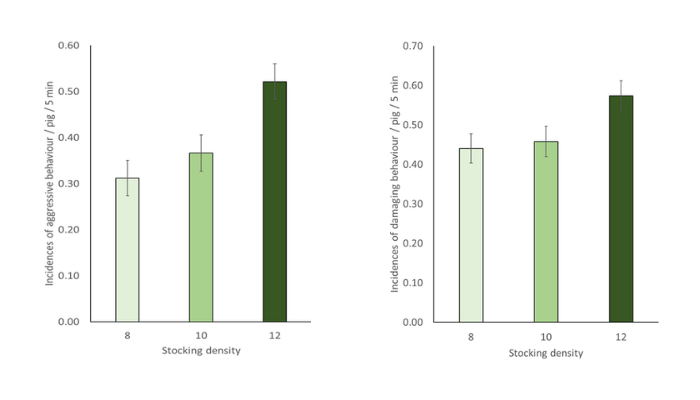
Figure 1. Effect of the different stocking density treatments on aggressive and damaging behaviours.
These behaviours also translated into the incidence of tail biting outbreaks; most outbreaks occurred in pens of 12 (67%), followed by pens of 10 (22%) and 8 (11%).
With regard to performance, the type of enrichment material used did not affect any measurement. However by week 22 we found a significant effect of stocking level on pig weight, with pigs kept in pens of 12 lighter at this time than those in pens of 10 or 8 (Figure 2).
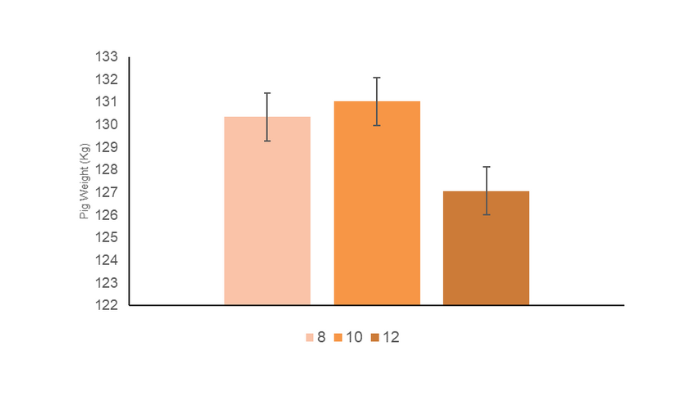
Figure 2. Pig weight at 22 weeks of age.
We also found that in the weaner stage ADG of pigs kept in pens of 8 (0.613g/day) was higher than those kept in pens of 12 (0.530g/day), and tended to be higher than those in pens of 10 (0.556g/day;). Transition to weaner accommodation can be highly stressful for piglets, so it is positive that the lower stocking density improved ability to grow.
When considering the FCR, in the finisher stage there was a tendency for an effect of stocking level, with pigs in pens of 12 having a numerically lower FCR than those in pens of 8 or 10.
What does this mean?
The most significant finding was that keeping pigs at lower stocking levels seemed to have a positive impact on both their behaviour, and their productive performance. Furthermore, pens stocked at the highest stocking level performed poorer on average than lower stocked pens when comparing the ADG and ADFI, indicating that lower stocked pens may reach slaughter weight sooner than higher stocked pens. When it comes to enrichment, it seems clear that materials that pigs interact with more, are likely to be more effective in reducing the risk of severe tail biting outbreaks. The use of material can be measured by the amount of times you have to top up racks, or the weight provided.
Acknowledgements
The authors thank Teagasc farm staff and visiting students for their assistance. Siobhan Mullan and Laura Boyle are also collaborators on this project and supervisors of the PhD studentship. For any further questions on the OneWelPig project you can contact Keelin at keelin.odriscoll@teagasc.ie