
27 October 2023
Moorepark weighs in on farrowing room feeding
Aisling Holmes & Kieran Keane presented recently at the Teagasc Pig Farmers’ Conference 2023. They spoke about how productivity on Irish pig farms is always improving, and some practices in the farrowing house in Moorepark that help sustain and enhance these production improvements.
Productivity on Irish pig farms is constantly improving, with data from the Teagasc Profit Monitor (PM) recording system showing a 36% increase in average born alive between 2000 and 2022 (10.85 to 14.81). The Teagasc Pig Research Facility at Moorepark is seeing similar gains to those on commercial farms (Table 1) and we thought it was worth focusing in on some practices within the farrowing house to see how we can help sustain and hopefully enhance these production improvements. The data represented in Table 1 is based on production values in Moorepark obtained over a two year timeframe, and highlights the increased production currently being achieved in that relatively short time span.
Table 1. Comparative production figures in the Moorepark unit and the Teagasc PM system.
| Moorepark | Teagasc PM system | |||
| 2021 | 2022 | 2021 | 2022 | |
| Number Born alive per litter | 15.5 | 15.8 | 14.69 | 14.81 |
| Average piglet birth weight (kg) | 1.3 | 1.5 | ||
| Average weaning weight (kg) | 8.1 | 8.7 | 7.1 | 7.2 |
As outlined in table 1 our average piglet birth weight increased by 15%, and our average piglet weaning weight by 7.4% in the space of a year. Cleary there are many factors at play with regard to these increases namely genetics, weaning age, sow diet, management, creep intake etc. For this paper we will mainly focus on sow feeding and creep feeding within the farrowing room in the Moorepark Pig Research Facility.
Sow Feeding
Pregnant sows in Moorepark enter the farrowing room on day 108 of gestation and remain on the dry sow diet until the day after farrowing. The dry sow diet is composed mainly of barley, soya and soya hulls. These ingredients contribute to a diet high in fibre (CF =8.5%), as feeding a fibrous diet during gestation can help to increase intake during lactation. The digestible energy of the diet is 13.2MJ/kg (N.E.=9MJ/kg). The sows progress well on the feed curve when they start getting the lactation diet, which can be seen in Figure 1. It is composed mainly of wheat, barley, soya and soya oil. A lot of the energy and fat in the diet is derived from a high inclusion of soya oil (4.9%). It has a digestible energy is 15MJ/kg (N.E.=10.8MJ/kg), with a fat content at 6.4% and total lysine content of 1.15%.
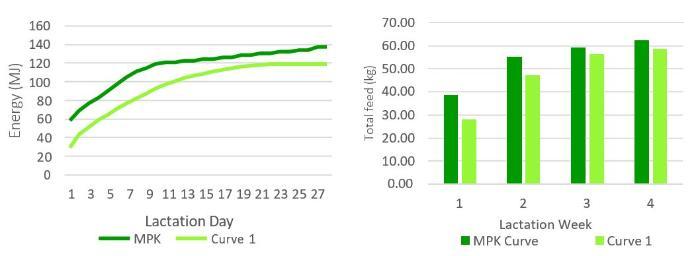
Figure 1. Comparison of energy and amount of feed offered between Moorepark lactation curve (MPK) and typical lactation curve (curve 1). Note: Moorepark curve based on D.E. of 15Mj/kg & Curve 1 @ 14.2Mj/kg.
Figure 1 demonstrates the difference between the Moorepark lactation curve and a typical lactation curve. The Moorepark lactating sow curve increases quickly and the sows are eating over 8kg per day from day 11. This feed is delivered in dry form through three equal portions over the normal working day to ensure sows are getting up and to check trough state prior to feeding. Our goal is to get as much energy into the sows as they need to provide enough for their litter without having to draw too much on their own body reserves. We increase and decrease the sows feed as needed based on trough inspections and review their feed curve regularly. Given that both the energy level of the diet and our curve are quite high, the sows in Moorepark don’t tend to lose much bodyweight during lactation. Excessive bodyweight loss during lactation can adversely affect subsequent reproductive performance such as follicle development for instance. This is important as this early follicle development is a major factor in determining the viability and size of the sow’s subsequent litter.
Creep Feeding
In Moorepark we give the piglets access to creep feed from day 13 up until weaning at 28 days of age. We treat the first week as an introductory phase, allowing the pigs to investigate their new diet by playing, chewing and understanding its form, function etc. Creep diet is given out by hand into creep feeders, approx. 75-100 grams at a time, about 2-3 times per day for the first few days. Through this method we see the average consumption of creep per litter in the first week to be in the region of 500 grams, although we estimated that an additional 200 grams of feed is also wasted during this phase. By day 20 from birth the creep amount being given out has increased to approximately 1 kg per litter in divisions of 200grams about 4/5 times per day. By day 23, we found that some litters were eating such high volumes of creep that we could not keep up to demand with our regular feeders. We started introducing larger creep feeders from day 21 for those litters eating higher volumes, to avoid inadvertently limiting their ability to consume creep in this peak phase of intake. This feeder helps maintain the freshness of the creep while also providing it on an ad-lib basis.
The Moorepark creep diet is high in energy, protein and fat. It has a DE of 16.2MJ/kg (N.E.=10.8MJ/kg), crude protein of 19.9%, total lysine content of 1.6% and fat is 11.4%.The energy and fat in the diet is mainly derived from soya oil and full fat soya. There is a high skimmed milk and whey powder content, hence most of the protein in the diet is coming from milk products. Having a high milk powder content in creep can increase intake on both a piglet and per litter basis, by increasing the number of eaters within that litter. Piglets find it easier to digest proteins from milk than from other sources such as soya or fishmeal. In fact the digestibility and absorption of milk protein in piglets at 24 days is around 93%, which is at the peak of pre-weaning creep intake. Conversely for diets relying on soya for protein content, its digestibility is only 78% at the same age. Milk proteins have also been shown to have a better effect than soya proteins on gut morphology in young pigs, which has a positive impact post weaning.
From a manufacturing viewpoint however the levels of milk and fat within the diet do come with certain drawbacks– flowability of the diet in meal form can be quite poor and the durability of the resulting pellets is quite low. When these factors are managed correctly this can create a nice soft palatable pellet which is easy for small piglets to consume.
Creep intake data
We looked at data taken from a sample population of 248 litters from Moorepark (trial and non-trial) and analysed their creep intake and weights, so that we could estimate the impact that creep intake has on performance (Figure 2). The data was broken down based on the average amount of creep eaten per litter and divided into groups. Within this data 40 litters (16%) were denied creep access pre-weaning due to the experimental design of the trial they were on. As is evident from Figure 2. The largest proportion of litters (38%) were found to be within the 4kg – 8kg creep intake group, with the average creep intake per litter for this group being 5.7kg. Similarly the overall average creep intake across all groups, was 5.6kg based on 12.5 pigs at weaning. Prior to analysing the data we were reasonably confident that a high proportion of litters were able to outperform the rest in creep intake but we were surprised by the figures that emerged. From the 8 kg – 12kg creep intake group almost 20% of the litters observed consumed on average 10.4kg of creep. Based on the above results, if we were to provide all of our litters in Moorepark with only the average amount of feed, we would be limiting 88 litters on an annual basis by up to 50% of their intake ability. Multiplying this up to a typical 700 sow unit, this would correspond to almost 300 litters per year being restricted in their creep provision.
Following on from this we took the same data as discussed above and super imposed the average piglet birth and weaned weights to each of the creep intake groups (Figure 3). We saw the average weaning weight increased across the groups as creep intake increased, ranging from 8-8.4kg. Although this difference across the groups is minimal, (ranging from 2.5% – 5%), we know the amount of creep eaten pre-weaning has a positive long-term effect on pig growth and lifetime performance.
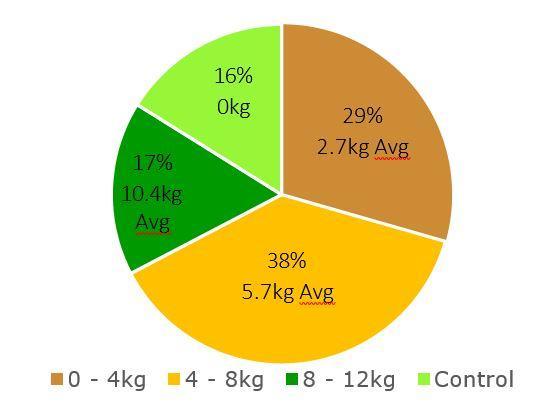
Figure 2. Creep intake per litter from sample population of litters in Moorepark unit.
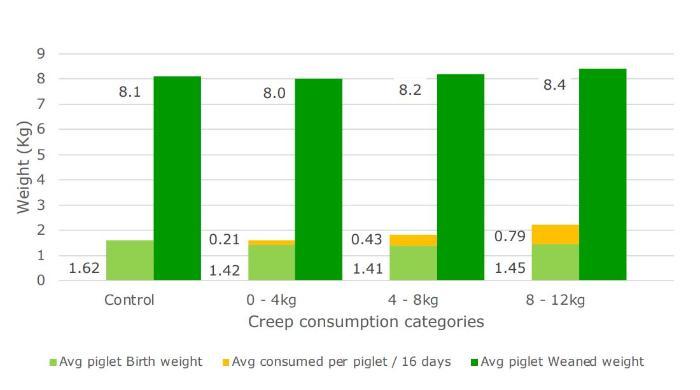
Figure 3. Average birthweight, weaning weight and creep consumed per group.
We see in Moorepark that our litters perform quite well in the post weaning phase. We are lucky to often be able to wean our litters intact and this helps greatly in reducing the lag effect in the initial post weaning period. We know by reducing this lag effect at this stage we are increasing our pig’s growth performance in the early weaner stage and throughout its life. Our pigs are eating approximately 1400- 1500 grams of creep diet within the first week post weaning, with a similar level of growth attained. Our average daily gain (ADG) in our weaner for 2022 was 570 grams/day (47 days).
Read more from the Teagasc Pig Farmers’ Conference 2023