
04 November 2024
Women’s perspectives, ideas and skills vital for farming innovation and sustainability
There is a solid business case for greater recognition and development of the roles of women in agriculture, Áine Macken-Walsh, Sociologist at Teagasc, told a recent Women in Agri National Dialogue event.
The series of events, jointly hosted by the Women in Agriculture Stakeholder Group (WASG) and the Women in Agriculture Working Group (WAWG) at the Department of Agriculture, Food and the Marine (DAFM), created a platform for women to share their experiences in agriculture, learn from others and engage directly with industry leaders.
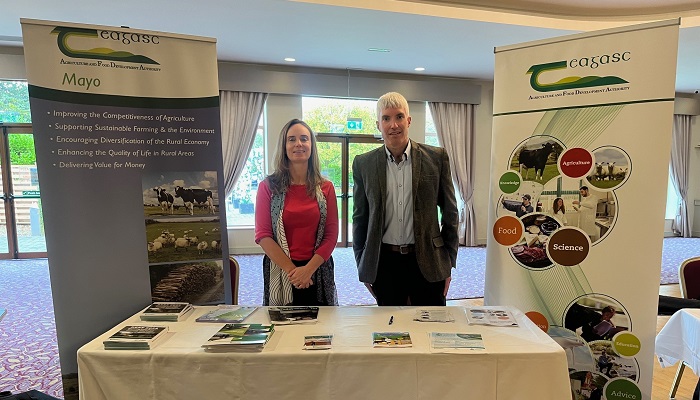
Pictured at the recent Women in Agri National Dialogue event were Áine Macken-Walsh and Brendan Garry
Representing Teagasc at the National Dialogue event in Claremorris, Co. Mayo, Áine Macken-Walsh discussed findings of the HERSELF project, funded by DAFM, and shared how national and international evidence shows that women’s perspectives, ideas and skills are vital for innovation and to make farming more sustainable.
Over the course of the event, two key points were raised. Firstly, the definition of ‘farmer’ should not be confined only to the person who owns the land.
“The full spectrum of different careers and jobs on farms needs to be recognised like in other sectors: administrator, business development, innovation manager etc. Lots of different people who work and could be attracted to work in agriculture need to be recognised, valued and their roles supported,” Áine Macken-Walsh explained.
On the reasoning behind this, delegates heard that the inclusion of their ideas, skills and perspectives can aid fuel the future development of agriculture, while failing to diversify farming careers and to recognise existing workers will confine the pool of knowledge available to agriculture.
Positive and distinctive impacts
Secondly, the positive and distinctive impacts that women’s involvement in agriculture and farming – particularly in supporting farm diversification, organics, and innovation, where they often have leadership roles – was also highlighted.
Áine Macken-Walsh noted: “Supporting the contributions of women and other underrepresented groups in agriculture needs to go beyond assisting them to be ‘included’ or ‘fit in’ to existing ways of doing things. Called ‘integrative feminisation’, this leads to little or no change.
“Instead, the particular, unique and different contributions of women and other groups should be actively supported, to challenge existing approaches and to discuss and negotiate new pathways for development and innovation. This is a collaborative process, involving men, women and diverse people of all ages across skills and career types.”
Also speaking at the event, Education Officer in Teagasc Ballinrobe, Brendan Garry outlined the various advisory services that are offered to clients. The courses and many ways of completing the Green Cert were also showcased, with Brendan remarking that a large proportion of current students are female, and a large increase in the percentage of females completing such courses has been witnessed over the last few years.