
16 July 2023
Equines on an organic farm
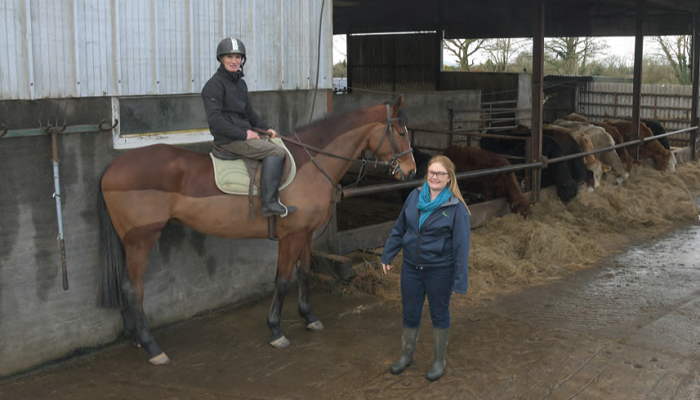
Robert and Maura McCabe, who farm 45ha in Corbally, Enniscorthy, Co. Wexford, joined the Department of Agriculture, Food and the Marine’s Organic Farming Scheme in January 2023.
They farm suckler cows and horses, keeping all bovine weanlings for one winter and selling them at 18 months off grass. The equine enterprise includes thoroughbred broodmares and their offspring, along with some sport horses and Irish Draughts.
Robert and Maura ran young horse, Irish Blaze, in his first Point to Point in 2021 to place joint first; he won again on his first track race in Navan and was subsequently sold. He is in training with Gordon Elliot.
On the farming enterprise, Robert said: “We believe cattle and horses can fit in very well on an organic farm. They complement each other in terms of grazing. Horses generally don’t require a high nitrogen input for grazing, so an organic system suits. Horses also love grasses mixed with herbs and clovers, which is typical of organic swards.”
Clover can be a valuable nutrient for the horse. It is important to remain vigilant where the percentage of clover increases above 20% in pasture or forage. Watch out for any contamination with a fungus or other toxins, particularly in conserved clover.
“The cows follow the horses and graze out whatever the horses will not, leading to good clean grazing and providing high-quality re-growths,” Robert explained.
“I found over the years that spreading nitrogen to force rapid grass growth did not suit the horses. They often left lots of this heavily-fertilised grass behind. I was spending money to grow the pasture, the horses didn’t eat it and I ended up topping the fields. I hope now that without artificial fertiliser and a different mix of grasses and herbs that there will be more efficient grazing by the horses,” Robert said.
The equine enterprise is not part of the organic conversion and as such they can be fed non-organic feed. Under the ‘Organic Food and Farming Standards in Ireland’, the horses can graze for 180 days as non-organic animals on the organic holding.
Robert said: “Breeding a racehorse is very rewarding and this allowance has enabled us to convert to organic farming and still run our successful equine enterprise.”
There are two approaches possible to combine an equine enterprise and an organic enterprise:
Separate the organic and equine enterprises as the McCabes have opted to do
The equine housing and other facilities and pasture used for equines (horses or donkeys) must be clearly separate from those used to manage the organic livestock. Equines in this scenario can be managed conventionally with non-organic feed, veterinary treatments and parasite control providing the following are adhered to:
- Physical boundaries– a dedicated non-organic area (stables/ other facilities and paddocks) with physical boundaries must be clearly identified for use by the non-organic equines. Physical separation means geographically distinct blocks of land with separate LPIS (land parcel identification system) numbers on BISS (previously BPS) declared as non-organic parcels. The two holdings can be adjoining, provided fields are separated by stock proof hedging or fencing.
- Stocking levels must be nitrates compliant (not exceeding 170kg N/ha).
- Financial and operational separation is required – separate accounts with invoices clearly identifiable for the two holdings independently of each other and must be able to demonstrate separate procedures and record keeping for both.
- Grazing of organic/in-conversion land is possible by non-organic equines once the period does not exceed 180 days per calendar year. However, the non-organic equines cannot be on the pasture at the same time as any organic animals. Equines grazing organic/in-conversion land may not be fed any feedstuffs possibly containing genetically modified organisms or derivatives whilst grazing the organic land.
Farm all enterprises organically
Any equines on the holding in this situation must be managed according to the organic regulations. Equines in this scenario have unlimited access to the organic grazing on the holding, and must be kept on certified organic pasture. A health plan is a requirement for all holdings, developed in conjunction with the farm veterinary surgeon and setting out a plan for health care and nutritional supplementation. However, all equines also have to be managed according to organic regulations including in relation to, for example:
- Feeding – all concentrate and forage feed inputs must be of organic origin. Sourcing organic concentrate feed suitable for equines is challenging. Equines may not be fed any feedstuffs possibly containing genetically modified organisms or derivatives thereof. Trace elements and minerals may be given where justified by known farm deficiencies and specified in the health plan. In addition to use as a feed additive, trace elements and minerals may also be given by injection where identified in the health plan by a vet.
- Bedding – conventional straw is permitted. Untreated wood chip/shavings are also permitted.
- Parasite control – treatment of internal/external parasites is permissible under veterinary guidance and the health plan. However, to minimise the requirement for anthelmintics, high-quality pasture management is of critical importance to minimise worm burdens. The following practices contribute to managing parasite burdens:
- Appropriate stocking density (1.5horses/hectare) is a good general guideline.
- A rotational/mixed grazing system providing periods of rest for pasture.
- Grazing younger/more vulnerable stock on ‘clean’ pasture.
- Removing dung from pasture is probably one of the most effective practices in breaking parasite life cycles, particularly if cross grazing is not employed.
- Monitoring stock using faecal egg count testing and blood sampling to ascertain the parasitic status of the herd (discuss with your vet). All of the above practices are equally advisable for non-organic enterprises to conserve the use of anthelmintics and preserve their effectiveness for the future.
- Vaccination is permitted in cases where there is a known disease risk which cannot be controlled by any other means and which has been confirmed and specified in the health plan with the vet.
- Chemicals – synthetic chemicals, fertilisers, pesticides and herbicides are all prohibited under organic farming irrespective of livestock category.
- Adding new equines – for breeding purposes up to a maximum of 10% of the number of adult animals on the holding may be introduced with prior permission granted by the organic certification bodies. For units with fewer than 10 equines, the introduction of new animals is limited to a maximum of one per year. For most, the first scenario where the equines are farmed non-organically as a separate enterprise to the organic enterprise will be the simplest choice, but this depends on the farm infrastructure being conducive to the clear separation.
This article by Marianne Mulhall, Teagasc Organic Advisor, Elaine Leavy, Teagasc Organic Specialist, and Wendy Conlon, Teagasc Equine Specialist, was first published in Today’s Farm. For further information on organic farming, click here.