
As discussed at the Crops and Technology Open Day in Oak Park yesterday, June 25, researchers in Teagasc are investigating fast-growing bean varieties as a potential solution to this challenge.
Speaking at the event organised in partnership with the Irish Farmers Journal, Dr. Sheila Alves highlighted early findings from Teagasc trials on fast-growing beans. She also informed the attending growers and agronomists of the latest findings on inter-cropping research which has been expanded from a research farm setting to commercial farms.
Dr. Alves explained. “Fast-growing beans, sown on the same date as standard faba bean varieties, can be harvested three to four weeks earlier due to their shorter life cycle. They tend to have a smaller canopy and seed size, which influences sowing rates – ~60 seeds/m2 for fast-growing beans versus 40 seeds/m2 for conventional faba bean varieties.”
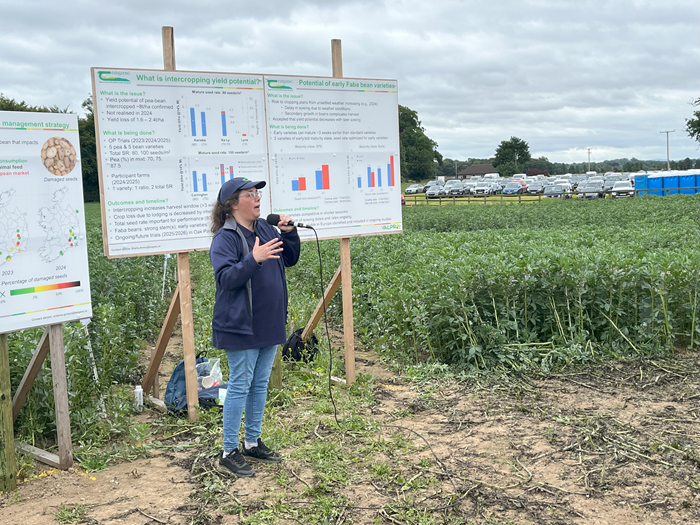
Dr. Sheila Alves, pictured above, discussed fast-growing faba bean research ongoing at Oak Park as part of Crops and Technology 2025.
When standardised to 14% moisture content, Oak Park trials have demonstrated promising early results. Standard faba bean varieties like Lynx yielded 2.4t/ha and Victus 3.1t/ha when sown at 40 seeds/m2 on April 17, 2024, and harvested on September 18, 2024. When sown on the same date at a seeding rate of 80 seeds/m2, fast-growing bean varieties Louhi and Vire yielded 3.1t/ha and 4.2t/ha, respectively, when harvested on August 24, 2024.
“While fast-growing beans may not outperform standard varieties under optimal conditions, they offer valuable alternatives when weather conditions are less than ideal. The fast-growing bean varieties grown at our trials on a sandy soil in Oak Park were ready to harvest approximately three weeks earlier than the standard varieties,” Dr. Alves noted.
Although early days in this research, Dr. Alves explained that studies will continue to optimise sowing dates and rates, while varieties available in Europe have been identified and will be trialled at Oak Park in the coming seasons.
Dr. Alves also gave a brief overview of Teagasc’s research in the area of intercropping, noting that the trials in Oak Park have been expanded to commercial farm level. Over the 2024 cropping season, a number of farmers grew intercropped mixes of field pea and faba bean, beside a sole pea crop. Although research from Oak Park had pointed to potential yields of ~8t/ha for the mix crop at a total seed rate of 100 seeds/m2, differing results were witnessed at commercial farm level.
“Average yields on the mix crop in the commercial farms were closer to 5.5t/ha, comparable to the sole pea crop sown at 80 seeds/m2. Why? On these farms, the pea tended to dominate, growing taller and outperforming the beans, which struggled to form pods despite flowering. For this season, we have revised our seeding rates, moving to 80 seeds/m2, while maintaining the same ratio of pea:bean”.
Battling the Bruchid beetle
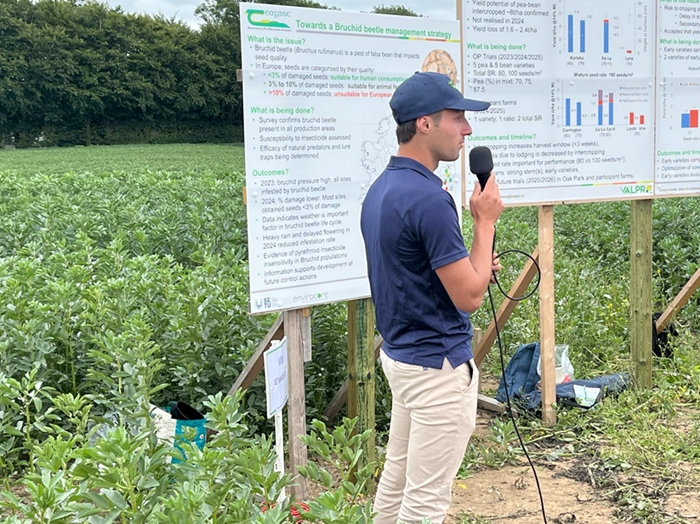
Also speaking at the Crops and Technology Open Day, Antoine Pichon, pictured above, a PhD candidate collaborating with Teagasc and SETU, detailed his research in the area of the Bruchid beetle, a pest that significantly impacts faba bean grain quality and marketability.
“In continental Europe, faba bean seeds are graded by damage: under 3% damage qualifies for human consumption; 3-10% for animal feed; and above 10% makes them unsuitable for market,” he said.
“Our surveys in 2023 and 2024 found widespread Bruchid beetle populations. The 2023 season had high infestation levels, but damage rates were generally lower in 2024.”
Pichon’s research aims to develop new control methods, monitor insecticide effectiveness and study natural predators of the beetle.
Farmers interested in participating in the bruchid beetle study can contact Antoine Pichon at antoine.pichon@teagasc.ie.
More from Teagasc Daily: Calculating the carbon footprint of your crops
More from Teagasc Daily: Handle pesticides safely