
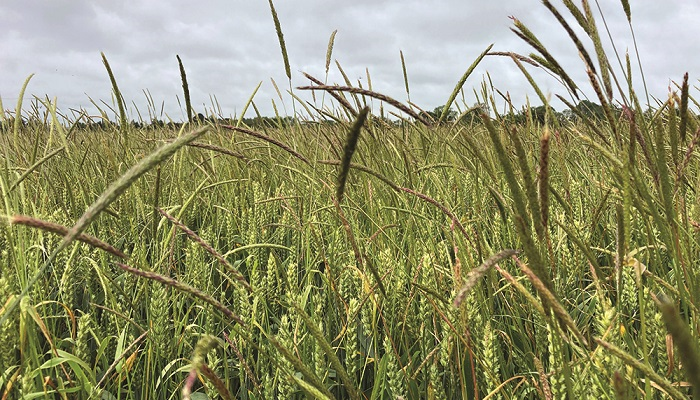
As the end of the season for most cereal and break crops approaches, Crops Specialist at Teagasc, Shay Phelan reminds us that there is still one very important chore to complete over the coming weeks – walking crops to identify problem weeds.
Walking your crops and identifying problem weeds such as wild oats, blackgrass, Italian ryegrass, or resistant chickweed, poppy speedwell etc. might seem like a tedious chore, but it is vitally important for protecting your farm into the future. Doing this now, before the harvest, and taking some notes or indeed taking action could save you money in the long run.
Significant developments in grass weeds
This has been an important spring in terms of grass weed development in Ireland, with the positive identification of a sample of Italian Ryegrass that has triple stacked resistance. This means that it is resistant to glyphosate, als herbicides e.g. Pacifica Plus and ACCase herbicides e.g. Falcon. This has the potential to become the dominant grass weed in tillage systems and so needs to be carefully monitored.
The other significant development is the listing of Blackgrass as a noxious weed, joining ragwort and other weeds. While this will not cure the problem itself, it does mean it is now an offence under the 1936 Noxious weed act and the Department of Agriculture, Food and the Marine has powers to issue ‘Notices to Destroy’ letters in all instances where it becomes aware of the presence of noxious weeds, either from inspections or as a result of reports made by the public.
While this might seem extreme, controlling the problem early is beneficial; a recent case study on a farm who had blackgrass estimated that eradicating the problem after it had become a significant problem cost almost €1,900/ha over four years when loss of crop yield, fallow, stale seed beds, machinery costs etc. were taken into account. This doesn’t take into account the cost of putting measures in place to prevent the spread of the weed to other fields or farms. These costs, incurred in that case study, show the importance of walking your crops now and identifying any problems early. This allows you to put in place early control measures, saving a lot of money in the long run.
Beans
Crops are flowering at this stage but reports of chocolate spot have been low so far, although there have been some isolated reports. Black bean aphid has also been reported in a few crops but, as of yet, it doesn’t seem to warrant control (5% of crops infected). Disease control time is against most crops now as they are generally too tall for normal machinery to drive through without doing any damage. For those with high ground clearance sprayers, you can still apply Elatus Era 0.66l/ha or Signum 0.5-0.75 kg/ha.
Crops and Technology Open day
All involved in the tillage and horticultural sectors are invited to the highly anticipated Crops and Technology Open Day.
Organised in partnership with the Irish Farmers Journal, the Crops and Technology Open Day will take place in the Teagasc Crops Research Centre, Oak Park on Wednesday, June 25 from 10am.
The open day, which is held every two years, brings the Oak Park Crop Research Programme and other elements from across the broader Teagasc Research programme to the public, supported by researchers, PhD students and advisors. At the event, the latest innovations, research findings on all the main tillage crops and horticultural field crops, and advice will be displayed and discussed.
Find out more and plan your visit to the Crops and Technology Open Day here.