
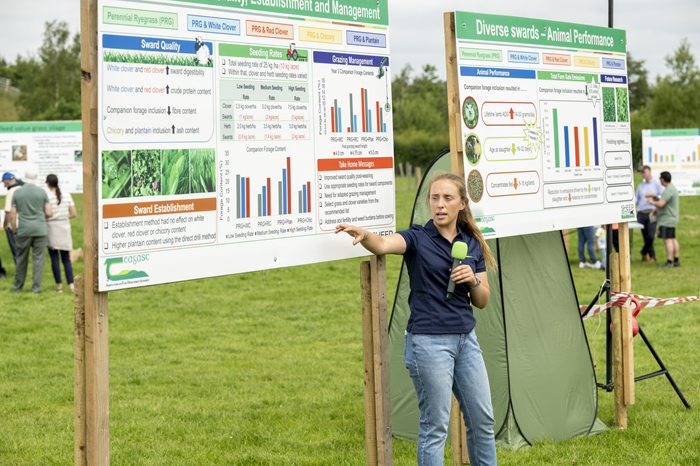
Results of a major research project, which investigated the impact on lamb performance of adding companion forages (legumes and herbs) into perennial ryegrass swards, were discussed at Sheep 2025, Saturday, June 21.
Through the inclusion of companion forages, such as white clover, red clover, chicory or plantain, Research Officer at Teagasc, Sarah Woodmartin explained: “We have seen the potential to increase intakes, animal performance, improve sward quality in the latter half of the grazing season, and there are also potential environmental benefits from their inclusion.”
Most of these benefits, she noted, occur in the second half of the grazing season when the proportion of legumes and herbs present within the sward increases. Some of the key findings detailed by Sarah Woodmartin at Sheep 2025 were:
- In the post weaning period, average daily gains were higher from the perennial ryegrass + white clover (PRG+WC) (+33g/day), perennial ryegrass + red clover (PRG+RC) (+41g/day), perennial ryegrass + chicory (PRG+Chic) (+40g/day) and perennial ryegrass + plantain (PRG+Plan) (+25g/day) lambs, when compared to those grazing the perennial ryegrass only treatment.
- The additional performance achieved over the post-weaning period had a positive impact on lifetime ADG. PRG+WC (+27g/day), PRG+RC (+33g/day), PRG+Chic (+28g/day) and PRG+Plan (+14g/day) lambs all had higher lifetime average daily gains when compared to lambs grazing the perennial ryegrass only treatment.
- This increase in performance resulted in a younger age to finish. On average, lambs on the perennial ryegrass only treatment took 231 days to reach the point of sale; this was significantly reduced for the PRG+WC (-26 days), PRG+RC (-32 days), PRG+Chic (-27 days) and the PRG+Plan (-16 days) lambs.
- As a consequence, meal required to bring the lambs to finish was also reduced when grazed on pastures containing either of the four companion forages.
- Using average costs from the 2018-2022 period, perennial ryegrass only lambs required, on average, €4/head of concentrates, whereas this reduced for the lambs grazed on either the PRG+WC (€2.20/head), PRG+RC (€0.37/head), PRG+Chic (€0.74/head) and PRG+Plan (€1.85/head) swards.
- Although not a central focus of the study, the number of dosing events also reduced for the lambs grazed on swards containing companion forages, as a result of the reduced days to slaughter.
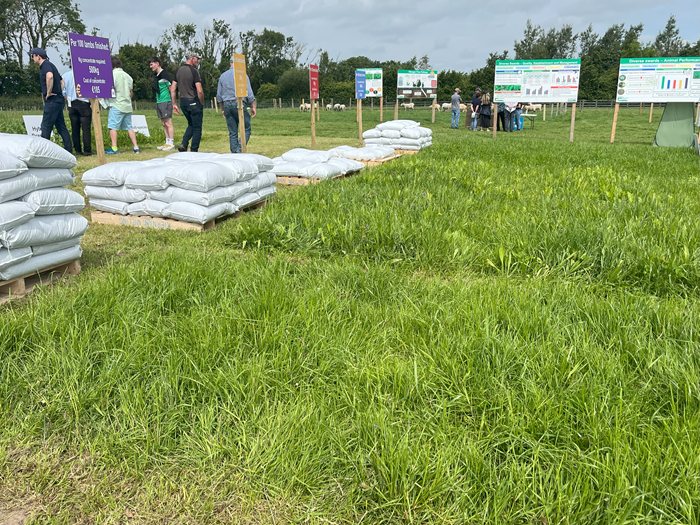
The Athenry companion forages study also examined the impact of diverse swards enteric methane emissions, with Sarah Woodmartin adding: “We found that the inclusion of white clover (-5%), red clover (-13%) or plantain (-8%) reduced methane output. It is very positive to see that we can achieve increased intakes and performance, while there is potential to reduce the methane coming from the lambs grazing these swards.”
Sheep 2025 is a joint industry collaboration between Teagasc, Bord Bia, the Department of Agriculture, Food and the Marine (DAFM), Irish Farmers Journal, and Sheep Ireland. Irish Country Meats are the main sponsor for this event, in addition to support from major sponsors FBD Insurance, MSD Animal Health, and Elanco.
More from Teagasc Daily: Forage crops: An option for finishing hill lambs?
More from Teagasc Daily: Deepening the understanding of hill sheep grazing patterns
Photo caption: Sarah Woodmartin discussed the performance of diverse swards at Sheep2025. Photo: Andrew Downes