
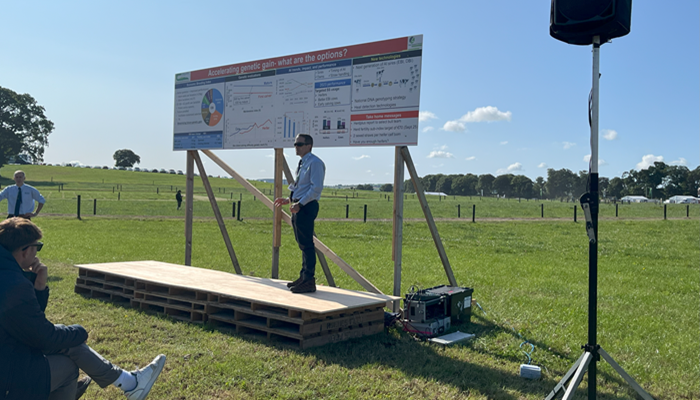
The practical advice and synchronisation programmes for effective use of sexed semen on commercial dairy farms were developed and refined by Professor Stephen Butler and his team at Teagasc Moorepark. Few technologies have delivered as much for the Irish dairy and beef industries.
As part of today’s Moorepark Open Day, Professor Butler reminded farmers of the progress to date: “In 2021, there was no sex-sorting lab in Ireland, and approximately 85,000 sexed semen straws were used on Irish dairy farms.
“Today, we have two labs operating in Ireland. The use of sexed semen has increased to more than 350,000 straws this year and is expected to increase further in the years ahead. Because of increasing use of sexed semen during the period from 2021 to 2024, the use of conventional dairy semen almost halved, and the use of beef semen almost doubled.
“We’ve witnessed a year-on-year decrease in the number of male dairy calves born, as farmers increase the use of beef genetics in their dairy breeding programmes. In 2021, 49.1% (417,852) of all dairy registered calves were male. As a sexed semen uptake has increased, this proportion has declined to 42.6% (295,162) in 2024, and it’s projected to be less than 40% (276,000) of the total male dairy origin calf crop in 2025 and less than 37% (250,000 calves) in 2026.”
Professor Butler highlighted some of the reasons for this increased uptake:
- The use of sexed semen in dairy production allows predetermination of calf sex with ~90% confidence,
- Large teams of high Economic Breeding Index (EBI) bulls are now available sexed,
- Acceptable pregnancy rates are being achieved across thousands of herds,
- Using high EBI sexed semen on the best EBI dams accelerates herd genetic gain,
- Using sexed semen to generate replacement heifers at the start of the breeding season ensures that all replacements are born at the start of the calving season the following year,
- Sexed semen facilitates a marked increase in the use of high DairyBeef Index (DBI) beef semen to generate all non-replacement calves, which could account for over 70% of the total calf crop. These beef-cross calves are more saleable compared with male dairy calves.
New strategies
Although the use of sexed semen to generate replacements is having the intended consequence of reducing the number of male dairy births, Professor Butler noted that new strategies will be required to generate high EBI male calves suitable for breeding the next generation. Work is ongoing in Moorepark on reproductive technologies to assist with this and to accelerate genetic gain.
“Identifying elite genetic merit dams to be oocyte donors and fertilising the oocytes with semen from elite genetic merit sires can facilitate generation of multiple offspring annually per dam-sire combination.
“Intense selection using this approach increases the likelihood of generating elite genetic merit offspring and can be applied to both dairy and beef breeds,” Professor Butler added.
Strategies for the successful use of sexed semen were also discussed at Moorepark 2025. Read Professor Stephen Butler’s and Professor Donagh Butler’s paper titled ‘Accelerating genetic gain’ here for more information.
A recording of Professor Stephen Butler’s and Professor Donagh Berry’s presentation from the Moorepark Open Day is available to watch below (embed video link once available).
More from Moorepark 2025: EBI values to be revised
More from Moorepark 2025: 20% more grass growth achievable on dairy farms
More from Moorepark: Moorepark: Opportunities exist, but cost control essential
More from Moorepark: EBI values to be revised