
Farmers attending Teagasc’s flagship dairy event, Moorepark 2025, today, July 2, were presented with a clear pathway to increase grassland productivity, with Teagasc researchers sharing a strategy to increase grass growth by 20%.
Addressing the thousands of dairy farmers gathered, Professor Michael O’Donovan and Dr. Michael Egan urged dairy farmers to realign their grassland management efforts, highlighting key actions to undertake over the short, medium and long term.
Professor O’Donovan started by quantifying the variation in grass dry matter production witnessed on dairy farms nationally, noting:
“Data from the Teagasc National Farm Survey shows that the average dairy farmer grows approximately 9.5t DM/ha of grass, whereas the average farmer measuring and recording grass covers through PastureBase Ireland grew 13.2t over 2014-2024, and the top 100 of these farms grew 15.2t DM/ha.
“Bridging the gap between these top performing farms and the average will be key going forward and our key message from today is many dairy farmers can increase the quantity of grass grown on their farms by 20%.”
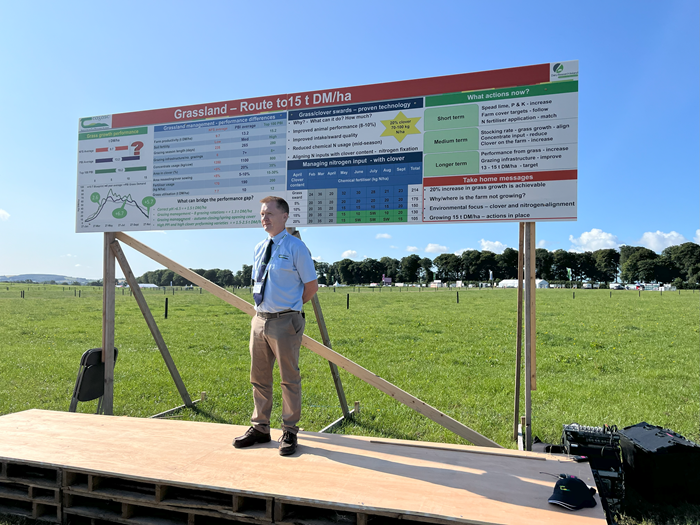
Dr. Michael O’Donovan pictured at the Moorepark Open Day 2025
What sets these farms apart?
The performance differences, available to view in table 1 below, that set these higher achieving farmers apart from the average were also discussed, pinpointed to their focus on soil fertility, extending the grazing season at both shoulders of the year, investing in infrastructure to make additional grazings possible, additional sward rejuvenation and the incorporation of clover.
“All-in-all, the top 100 PastureBase Ireland dairy farmers are growing and utilising more grass, achieving more grazing days and are feeding less meal. This isn’t just based on farm location, we are seeing these differences of farms right across the country,” Professor O’Donovan commented.
Table 1: Grassland management performance differences
| Farm productivity (t/ha) | 9.5 | 13.2 | 15.2 |
| Soil fertility | Low | Medium | High |
| Grazing season length (days) | 235 | 265 | 280 |
| Grazing infrastructure / number of grazings | 6 | 7+ | 8+ |
| Concentrate usage (kg/cow) | 1,350 | 1,100 | 800 |
| Area in clover (%) | <5% | 20% | 35% |
| Area reseeding / over sowing | <5% | 5-10% | 15-30% |
| Fertiliser usage (kg N/ha) | 170 | 190 | 200 |
| Grass utilisation (t/ha) | 7.5 | 10 | 12 |
Bridging the grass performance gap
Acknowledging the performance gap is one thing, but implementing measures to bridge it is another, and the Teagasc researchers detailed how.
The starting point to this is correcting soil fertility through liming acidic mineral soils. Although soil pH is improving on dairy farms, 76% of soil samples tested from these are suboptimal for lime. If corrected to a pH >6.5, it would facilitate the incorporation of white clover along with delivering an additional 1.5t DM/ha of grass production, mainly stemming from improved nutrient use efficiency and the release of the soil’s locked up nitrogen and phosphorus reserves.
Additionally, by achieving 8 grazing rotations, an additional 1.3t DM/ha of grass can be produced. Reaching this target, however, will require a major focus on spring and autumn grazing strategies.
“We are seeing it all too much, farmers aren’t focused enough on their autumn closing targets and this is having knock-on effects on spring grass availability and potentially grass production for the remainder of the grazing season,” Professor O’Donovan noted.
The levels of reseeding nationally were also discussed and although challenging conditions over 2024 curtailed reseeding, Professor O’Donovan noted that it needs to be prioritised on many dairy farms.
“Once soil fertility has been corrected, reseeding is the next step and research from Moorepark has shown that rejuvenating swards with high performing perennial ryegrass and white clover varieties selected from the Pasture Profit Index (PPI) can boost dry matter yield by 1.5-2.5t DM/ha annually, while also making better use of the nutrients supplied,” Professor O’Donovan said.
Build clover into your grassland system
Farmers, if not already doing so, were also encouraged to incorporate white clover into their perennial ryegrass swards, with Dr. Egan commenting: “Grass-clover swards are now a proven technology and swards with 20% clover content in April are capable of supplying 70-100kg of nitrogen per hectare through the process of biological nitrogen fixation.
“Along with the potential for savings on chemical nitrogen, our research has shown improved animal performance, stemming from higher intakes and sward quality characteristics.”
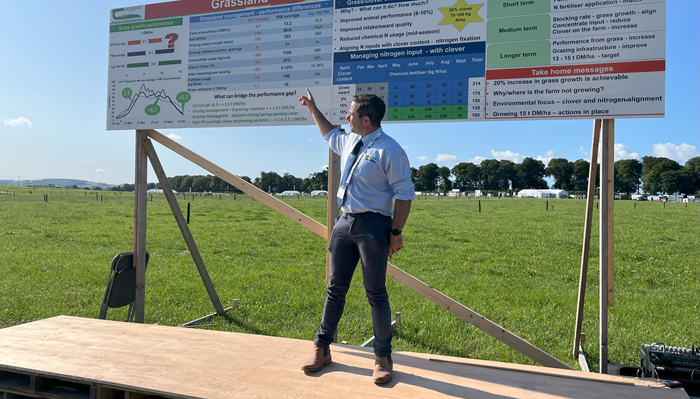
Although the key selling point of white clover swards is the reduced requirement for chemical nitrogen, Dr. Egan stressed the need for farmers to align nitrogen inputs with sward clover content and the clover plant’s ability to fix nitrogen. To do so, he encouraged farmers to follow the Teagasc fertiliser blueprint for clover swards, available to view in table 2 below.
Table 2: Managing nitrogen input with clover
| April clover content (%) | Feb | March | April | May | June
(2 rot) |
July
(2 rot) |
August | September | Total |
| Chemical fertiliser (kg N/ha) | |||||||||
| Grass sward | 24 | 36 | 20 | 32 | 30 | 28 | 21 | 23 | 214 |
| 5% | 20 | 35 | 20 | 20 | 20 | 20 | 20 | 20 | 175 |
| 10% | 20 | 35 | 20 | 15 | 15 | 10 | 15 | 20 | 150 |
| 15% | 20 | 35 | 20 | 15 | 10 | Soiled water | 10 | 20 | 130 |
| 20% | 20 | 35 | 20 | 15 | Soiled water | Soiled water | Soiled water | 15 | 105 |
For more insights, view Professor O’Donovan’s and Dr. Mike Egan’s presentation to the Moorepark Open Day below: