
Some 25 years since its launch, the Economic Breeding Index (EBI) has become the envy of dairy breeding programmes globally, allowing Irish dairy farmers to select and breed for more profitable and efficient dairy cows for a grass-based system.
Developed by Teagasc and the Irish Cattle Breeding Federation (ICBF), the beauty of the EBI has been its ability to evolve, incorporating traits of importance whether from a production, fertility, cow maintenance or carbon point of view, all the time making farmers incorporating the EBI into their breeding programmes better off financially.
However, in order to keep this breeding index in check with future market trends and projected costs, Professor Donagh Berry told the gathered crowd at Moorepark 2025 today, July 2, that the relative emphasis on individual traits and the genetic base on which the EBI is based will be updated this year.
“The economic values in the EBI were last updated at the end of 2022 and they will be undergoing a review in 2025. The economic value on each trait in the EBI is defined as the expected change in profit per unit change in that trait, holding all other traits in the EBI constant,” Professor Berry noted.
Based on informed estimates of future market costs and prices, each trait within the EBI is weighted according to its relative monetary value.
“The EBI must be designed with future resilience in mind. Global and national markets for feed, fertiliser and energy significantly affect milk revenue and herd management and, thus, the relative importance of these traits in a breeding index,” Professor Berry commented when explaining why this review was occurring.
Base animal change
Genetic evaluations such as the EBI use a ‘base’ animal to keep results consistent over time. Ireland last changed its base for dairy cows in 2016-2017, which caused a drop of €71 in the EBI of all animals.
“The old base for production and fertility was 2005 born cows, calved and milk recorded in 2007, and milk recorded in at least two of the next five years,” Professor Berry said, before adding: “This is due to be updated to a more recent base for milk, fertility, health and management traits later in 2025.”
It is expected the new base will be updated to 2015-born cows, calved and milk recorded in the 2017-2019 period. As to the consequences of the base change, Professor Berry noted: “The most important thing to know about a base change is that it has zero effect on the ranking of animals.
“Using an old base can make current animals appear better than they are, which can be misleading. Changing the base affects all animals’ PTAs, often lowering them but updating the base is more about making the results clear and easy to interpret,” Professor Berry concluded.
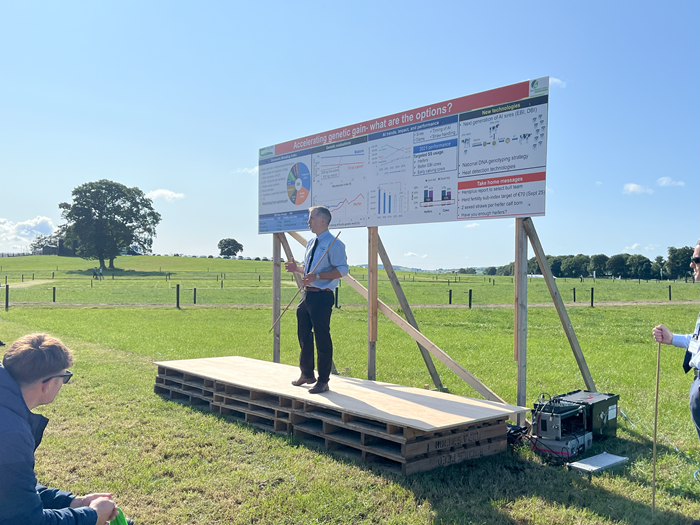
Professor Berry was joined by Professor Stephen Butler at board 3 at the Moorepark Open Day, where they discussed Accelerating genetic gain. For more information, a recording of their presentation is available to view below:
For more insights, their full paper from the Moorepark 2025 Open Day is available to read here.
More from Moorepark: 20% more grass growth achievable on dairy farms
More from Moorepark: Moorepark: Opportunities exist, but cost control essential
More from Moorepark: Fewer male dairy calves and more beef from the dairy herd
More from Moorepark: Making dairy farms more attractive places to work