
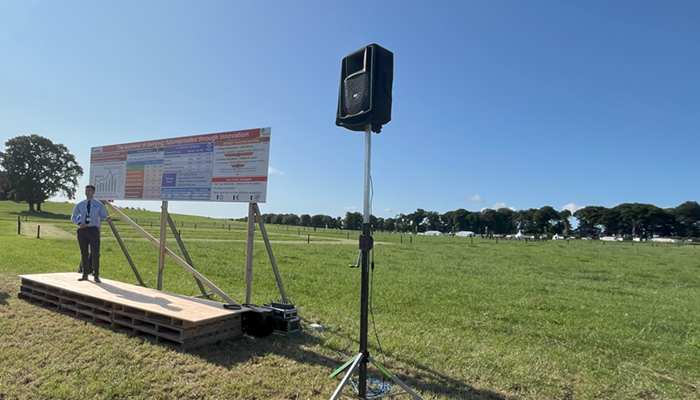
As less than 5% of dairy farmers are under 35, farmers attending the Moorepark Open Day, today, July 2 were reminded that the future of Irish dairying depends not just on productivity, but also on people.
Addressing delegates at board 2 – the Business of Dairying, Dr. Conor Hogan, a Research Officer on the People in Dairy Programme, explained: “The lack of young people entering the dairy sector represents a key structural challenge.
“Given the evolving expectations of both current and future farmers, it is increasingly apparent that improving working conditions and enhancing the attractiveness of dairy farming as a career are critical for both generational renewal and making farms better workplaces for all involved.”
To make this possible, Dr. Hogan detailed four foundational practices, as detailed in table 1 below, that must be embedded on all farms. These include:
- 1). A 16:8 hour milking interval – to shorten working day length,
- 2). Proactive workforce planning – to build a farm team,
- 3). System specialisation and outsourcing to contractors – to maximise the amount of time spent on productive tasks,
- 4). An efficient calf rearing system – to reduce the spring workload.
Table 1: Work organisation effectiveness benchmarks and targets for farms from the 1st February to 30th June
| Average | Top 25%1 | Target | |
| Start time | 06.48 | 06.47 | 07.00 |
| Finish time | 19.08 | 18.25 | <18.00 |
| Farmer workday length (hour) | 12.3 | 11.4 | <11.0 |
| Farmer work (hours/week) | 61.1 | 51.2 | <48 |
| Farmer days off per year (holidays and weekend days) | 19 | 33 | >602 |
1Selected based on the farms ranking for work organisation effectiveness. 2Allowing on average on day per week off and a two-week holiday.
Making it happen – the skills that will shape future success
To realise these opportunities, Dr. Hogan explained, the next phase of development for dairy farms must be underpinned by robust skills and planning.
“Financial benchmarking and sound business planning will be essential for guiding smart investments and managing volatility. Equally, people management and leadership, including how work is organised and how people are supported, will determine the attractiveness of farms as workplaces.”
Work on the basics
As costs on dairy farms have increased by +50% since 2020, Dr. Padraig French also reminded those in attendance that a refocus on the basics is required, whether that be through better cows, pasture management or work practices.
“Dairy farmers need to invest in things that are going to improve profitability or reduce costs,” he explained, “and investing in soil fertility is the starting point.”
As evident in table 1, Dr. French also spoke on key performance indicators, tracking the progress from 2013/2014 to today, while also setting targets for the future.
Table 2: Moorepark’s key performance indicator (KPI) targets for dairy farms
| KPIs | 2013/2014 | 2023/2024 | Target |
| EBI (€) | 84 | 198 | >240 |
| 6 week calving rate (%) | 57 | 68 | >90 |
| Optimum soil fertility (% area) | 12 | 24 | >90 |
| Labour efficiency (hours/c0w) | 42 | 35 | <18 |
| Pasture utilised (t DM/ha) | 7.0 | 8.0 | >12.0 |
| Grazed pasture in diet (%) | 61 | 55 | >65 |
| Concentrate fed (t/cow) | 1.1 | 1.3 | <0.5 |
| Total costs (€/kg MS) | 3.70 | 5.65 | 3.80 |
For more insights, a recording of Board 2 from the Moorepark Open Day is available to view below:
More from Moorepark: Moorepark: Opportunities exist, but cost control essential
More from Moorepark: Fewer male dairy calves and more beef from the dairy herd
More from Moorepark: EBI values to be revised
More from Moorepark: 20% more grass growth achievable on dairy farms