
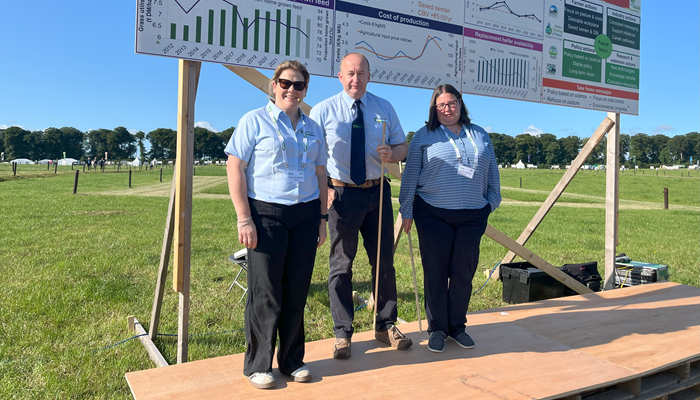
Farmers attending the Moorepark Open Day today, July 2, were shown a blueprint for a more profitable and sustainable dairy farming future.
Addressing the gathered masses, Head of the Animal & Grassland Research and Innovation Programme at Teagasc, Professor Laurance Shalloo said: “There has been a 50% increase in costs of production since 2020. That increase has resulted from input cost inflation, weather effects, higher input systems and investment at farm level.”
Although dairy continues to be Ireland’s most profitable farming enterprise, Professor Shalloo noted that substantial profit differences exist between farms and there are opportunities for a refocus on costs of production across all farms.
Cost control is essential every year, he advised, and improving grass utilisation while reducing purchased feeds has shown consistently that it increases profits.
“Increased volatility in input costs and milk prices highlight the need to further build resilience into Irish dairy systems,” Professor Shalloo noted.
Grass, breeding and future focuses
Joining Professor Shalloo at board one at the Moorepark Open Day, Dairy Enterprise Leader with Teagasc, Dr. Emer Kennedy highlighted the need to refocus on grass, be that production and utilisation.
“The most profitable dairy systems in Ireland are those that maximise grass in the cow’s diet. In 2023, home-grown forage accounted for just 78% of dairy cow diets in Ireland,” Dr. Emer Kennedy explained, before adding: “Increasing the proportion of home-grown forage in the cow’s diet to over 90% will be a key target going forward.
“We know this is possible; National Farm Survey data from 2023 shows that the average Irish dairy farmer produced 10.4t DM/ha. In contrast, top-performing farms measuring through PastureBase Ireland (PBI) consistently exceed this, suggesting considerable room for improvement.
“Grass silage and concentrates are three to four times more expensive than grazed grass and by prioritising pasture utilisation, farmers can significantly reduce feed costs and boost margins,” Dr. Kennedy explained.
Genetics and breeding targets are also important, with Dr. Kennedy adding: “The Economic Breeding Index (EBI) is constantly updated to help farmers select cows best suited to grass-based systems. Highly fertile cows, achieving a 90% six-week calving rate, breeding replacements through sexed semen and producing high Commercial Beef Value (CBV) non-replacement stock all contribute to higher productivity at lower costs.”
Additionally, Dr Deirdre Hennessy detailed future focus areas. She noted that farmers must focus on pasture and costs, making farms a desirable workplace and continuing to use sexed semen and high Dairy Beef Index sires. For future policy, she explained, it must be based on science, while research and extension must serve to develop new technologies and promote their use of farms through knowledge transfer actions and consistent messaging.
For more insights, a recording of board one from the Moorepark Open Day is available to view below:
A positive outlook at Moorepark
There is a positive outlook for dairying at the moment and there are good opportunities for young people to consider a career as a dairy farmer. Teagasc has a range of educational options to equip young people to meet the challenges facing the sector and to flourish. Those were the views of Professor Frank O’ Mara, Director of Teagasc who spoke at Moorepark today.
Professor O Mara said: “Ireland’s grass-based milk production system ensures milk production in Ireland is competitive internationally. Grazed grass is the cheapest feed for cows and systems built on that are key to the sector being sustainable and resilient to both climate change and economic shocks.”
In the ‘business of farming’ village at the Teagasc Dairy Open Day in Moorepark, it is highlighted that there is a large variability in costs on Irish farmers as measured by both the Teagasc National Farm Survey and the Teagasc Profit Monitor results.
Additionally, the research currently underway to address the challenges faced by the dairy sector is being displayed at the open day. The technologies available, and those being researched to reduce Greenhouse gas emissions in terms of both methane and Nitrous oxide are being highlighted and discussed with the farmers and industry personnel attending the open day.
There is also a major focus on nutrient management to reduce the potential load on the environment. The measures being promoted as part of the Teagasc ‘Better Farming for Water, 8-Actions for Change campaign are on display.
The forum in the afternoon today will be opened by the Minister for Agriculture, Food and the Marine, Martin Heydon TD.
More from the Moorepark Open Day: Making dairy farms more attractive places to work
More from the Moorepark Open Day: Fewer male dairy calves and more beef from the dairy herd
More from the Moorepark Open Day: EBI values to be revised
More from the Moorepark Open Day: 20% more grass growth achievable on dairy farms