
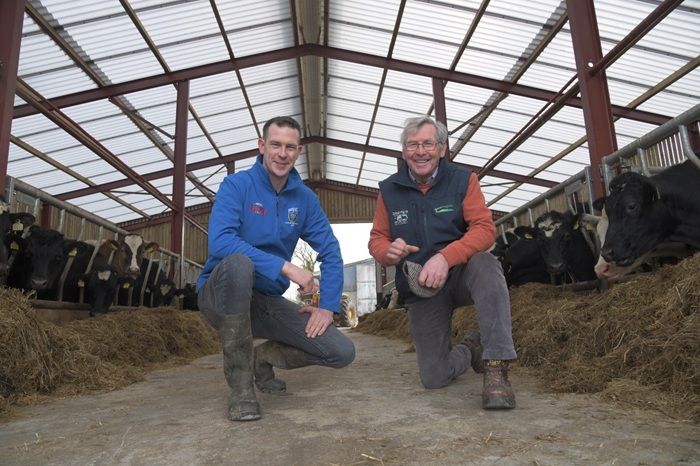
In advance of a major farm walk this week, DairyBeef 500 Advisor, Fergal Maguire talks us through Charlie Smyth’s dairy beef system in Co. Cavan, identifying five key changes that have improved farm profitability and sustainability.
In April 2021, Charlie Smyth joined the Teagasc DairyBeef 500 Campaign. As a demonstration farmer, his role is to promote and showcase a dairy calf-to-beef system that is socially, environmentally and financially sustainable. While Charlie’s system was already operating at a good level of efficiency, a new farm plan was designed to focus on five key areas where improvements could significantly enhance both profitability and long-term sustainability.
1). Reducing age at slaughter
One of the primary focus areas was to reduce the age at slaughter. In 2021, steers were finished at an average age of 27 months. By 2024, that had been reduced to exactly 24 months – a three-month improvement. This reduction came with only a minor decrease of 4kg in carcass weight, while delivering significant savings on feed and housing costs by shortening the finishing period.
2). Buying better beef genetics
Finishing steers at less than 24 months required better beef genetics on farm. Prior to joining the DairyBeef 500 Campaign, purchased calves often had poor beef traits, which affected performance at finishing. Today, whether buying Friesian or beef-sired calves, Charlie prioritises animals with strong beef genetics and high Commercial Beef Values (CBV), with a firm emphasis on quality over price.
3). Improving grass utilisation
Grass utilisation has also been a major focus. A new paddock system has been installed, complete with centralised water troughs and temporary fencing, enabling a flexible rotational grazing system. Cattle are now typically moved every three days. Previously, cattle could remain in the same paddock for over a week, negatively impacting both animal performance and grass regrowth.
Charlie’s goal is to have animals close to 500kg by October 1st. Achieving this liveweight target pre-housing reduces the need for concentrates during the winter finishing period.
4). Adjusting the system to suit housing capacity
As overall efficiency improved, Charlie increased calf numbers. However, this put pressure on winter housing, especially within a 24-month Friesian system. Without a standalone calf shed, calves were reared in the weanling shed – a system that became limiting as numbers grew.
To address this, 50% of the calves purchased now are early-maturing heifers, which can be finished and sold by the end of November. This change frees up valuable housing space and allowed calf numbers to increase without the need for new housing infrastructure.
5). Disease prevention through vaccination
With more calves on the farm, the risk of respiratory disease also increased. To address this, a robust pneumonia vaccination programme was introduced. Calves receive an injectable pneumonia vaccine and an intranasal IBR dose two days after arrival, followed by a booster a month later, and a final booster one month prior to housing in autumn. As a result, calf mortality has remained below 1% for the past three years.
For further insights, listen into the Beef Edge podcast below, where Charlie Smyth joined podcast host, Catherine Egan to give an overview of his system:
See the system in action
Charlie and his father Charles Smyth will host a Teagasc DairyBeef 500 Farm Walk on their farm near Virginia, Co. Cavan (Eircode A82 DA00) on Thursday evening, 10th July at 7:00 PM. The event offers a valuable opportunity for anyone involved or interested in dairy calf-to-beef systems to see firsthand how a simple, streamlined approach – from calf rearing to beef finishing – can be labour-efficient and highly profitable.
Find out more about Charlie Smyth’s DairyBeef 500 Farm Walk here.