
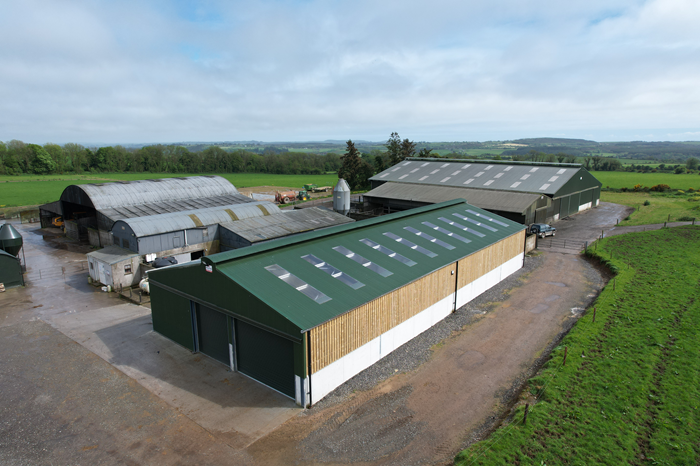
As infrastructure investment costs have increased dramatically, Dairy Specialist, Patrick Gowing reminds us of the importance of proper yard planning to future proof your investments.
Over the last number of years, the cost of investing in farm buildings has increased dramatically. In 2017, for example, we typically would have said a slatted cubicle shed would cost ~ €1,700/cow space ex VAT. In 2025, the cost of the same development has increased to €3,500/cow space ex VAT.
Given the level of capital it requires, if you are planning on any investment on your farm, it is very important to plan the yard properly and future proof it going forward.
Designing your farmyard
Most farmyards have developed over time, with a new feature added typically every other year. Often times these are added without consideration for the overall flow and design of the yard.
Now is the time to step back and have a hard look at your yard, as there are many aspects we have to take into consideration. However, if you design it right, it will minimise soiled water issues, reduce labour and improve lameness in the herd.
Your farmyard should always be designed with a larger herd in mind. It doesn’t cost anything to leave space behind a shed for potential future development – even if the herd never grows.
Based on this, Teagasc has developed some design principles you should consider when planning your yard. Teagasc will also be holding a series of farmyard design events across the country, starting in July this year, highlighting best practice in farmyard design.
Figure 1: Flows within the farmyard

Design principles:
- Main movements on a dairy farm are milk lorry, cow movement and machinery. They should not cross over – allow each to operate individually.
- Allow for future expansion. Develop the farm in streets rather than courtyards.
- Locate silage and other feed storage facilities close to the feeding area.
- Do not locate silage pits or drystock housing between cow wintering unit and milking shed.
- Locate the exit from the main housing in close proximity to the holding yard entry (5-10m) to reduce movements across open yards.
- Separation of soiled water, clean water and slurry.
- Calving boxes associated with cubicle shed and close proximity to the milking parlour.
- Minimise turns from paddock to holding yard entry. Plan for 3 turns maximum and use bends rather than 90 degree turns on farm roadways.
- Face open-sided sheds towards sheltered side, as 70% of wind/rain comes from southwest.
- Locate cattle crush and holding pen adjacent to the milking parlour and winter accommodation.
- Have an appropriately sized handling facility with good animal access.
- Allow for expansion of milking facilities, winter accommodation and slurry storage.
- Divert surface runoff from higher ground and divert roof water to clean drains.
Details of the Teagasc Farmyard design events will be available here shortly.