For the last 160 years, the reference method for measuring protein in foods has involved measuring a food’s nitrogen content and multiplying it by a conversion factor.
Despite being used in food labelling, nutritional assessments, global trade and the food sciences, many currently accepted conversion factors still originate from the 19th century.
Recalculating the conversion factor for dairy protein
A few years ago, the United Nations (FAO / WHO) summoned a group of international experts to recalculate the conversion factor for dairy protein. This could only be done with a low – medium level of confidence.
“Milk is probably the most studied food product in the world, so the lack of confidence surprised us. This reflects the lack of certain specific analytical methods, and the associated published data, which we are working to resolve,” Andre Brodkorb, who represented Teagasc on this panel, reflects.
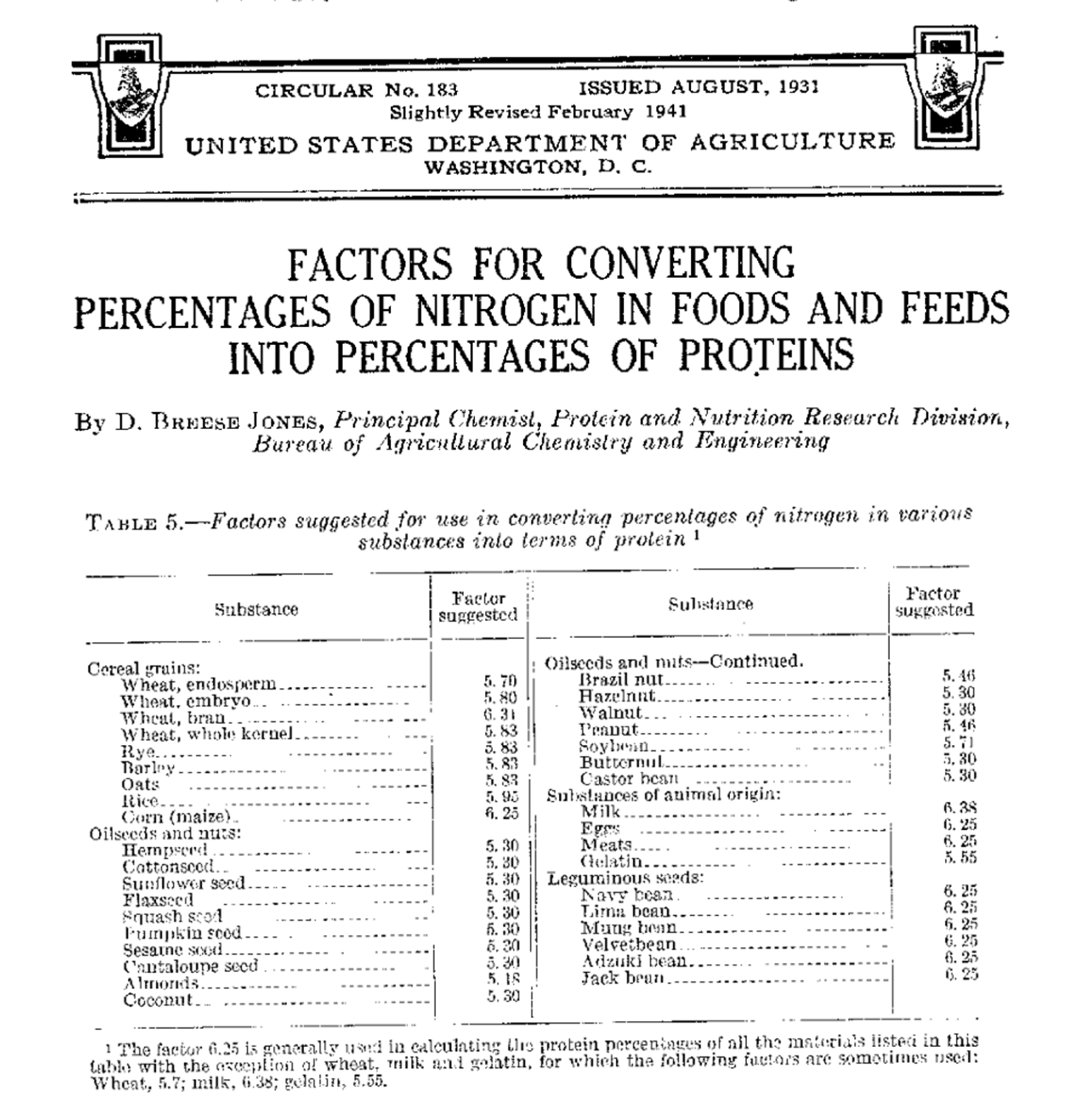
While the knowledge of food composition has improved over the years, it may be surprising to know that the actual definition of protein has also changed. Currently, used factors assume protein is the mass of purified, coagulating, nitrogenous substances, which correlates to the only method available to 19th century food scientists.
“The accuracy achieved by Olof Hammarsten or Thomas Osborne, using a bunsen burner, filter paper and various salt solutions, is a surprisingly high bar to attain. However, contemporary definitions of protein have changed, requiring these otherwise excellent analyses to be updated,” Tim Hoekstra, a Teagasc Walsh Scholar PhD student working on this issue, notes.
Figure 1: “Jones 1931”: the source of modern-day conversion factors
Milk
The nutritional sciences typically define protein as the mass of amino acids (i.e. the building blocks of protein), or sometimes the mass of dietary nitrogen. However, many proteins also contain carbohydrate portions as a fundamental part of their structure, whilst dairy proteins are unique by also containing phosphate – modified amino acids, which greatly enhance milk’s nutrition by binding calcium in a bioavailable “micelle” structure.
Figure 2: Nitrogen – fractions in milk products, depicting amino acids in varying forms (polypeptide chains, peptides and free amino acids), as well as protein’s post translational modifications (i.e. phosphorylation, glycosylation), and “non-protein” nitrogen compounds
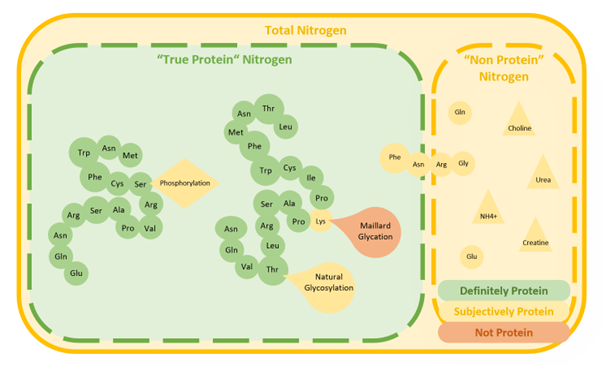
The researchers were also surprised to learn roughly a quarter of the nitrogen in milk that has been historically termed “non-protein nitrogen”, when considered under contemporary nutritional definitions, is actually protein.
Noel McCarthy, the Teagasc Research Officer overseeing this project, explains: “The relative mass fractions in milk change dramatically between different protein ingredients. By logic, we can appreciate that if we include or exclude different mass fractions into the definition of protein, the resultant mass of protein changes, requiring different conversion factors.”
Accounting for all this will require a set of conversion factors, specific to the context and product they are being used for. This will be published once the researchers have validated their analytical methods and built up a larger dataset.
John Tobin, Head of the Food Chemistry Department at our Moorepark site, points out: “Conducting this important research at Teagasc makes sense, given our resident expertise and capability in determining the nitrogen fractions in milk, within our accredited laboratories, which support the production of certified reference samples, distributed across milk testing sites in Ireland.”
This research is funded by Dairy Research Ireland in collaboration with University College Cork.