As part of this Signpost update, tillage farmer Tom Tierney ponders where does the volumes of rain that fall on his farm end up, while highlighting some of the key actions he’s taking to protect water quality.
Every spring, as a tillage farmer, I find myself waiting impatiently for the rain to stop and the land to dry so we can begin planting. But it often makes me wonder – where does all that water go?
Our farm has the required buffer zones along watercourses to protect water quality, but there’s always room to do better. Each year, we rotationally grow winter cover crops on at least 25% of the land, chop straw on the maximum payable 40 hectares under the Straw Incorporation Measure (SIM) and use no-till establishment methods. These actions improve soil health and, by extension, water quality.
‘Farming for Water’ EIP actions
Last October, as weather conditions became wet, a farm visit was organised by Signpost with my ASSAP sustainability advisor Fiona. We walked the land, discussing how to take part in the new ‘Farming for Water’ EIP (European Innovation Partnership) and identifying additional enhancements we could make.
The EIP offers a flexible suite of options to improve water quality, tailored to each farm’s needs. One idea was to build another pond, a plan I welcomed. We already have a pond I built in the ’90s while repairing a land drain. I decided to let the water collect instead, and today it’s a peaceful, wildlife-rich area in our forestry I love to visit and reflect.
Here are some of the EIP options we chose:
- Cover crops: I am expanding the area grown on the farm. Cover crops mop up excess soil nitrogen over winter, reduce leaching, enhance soil structure and boost fertility.
- Riparian buffer zones: Strategically placed in compacted field corner areas where there were risks of direct water runoff to drains.
- 3m and 6m margins: Arable grass margins offer greater ease of management to compulsory Nitrates Directive buffers, protecting small and large drains, especially where the land slopes. Since regulations already prohibit me from applying fertiliser and spraying within 3m of watercourses, cultivating that area is unnecessary and counterproductive. The grass margin also offers protection from encroaching weeds from the field margins.
- Water bars and gateway resurfacing: Water bars redirect flow from roadways into fields rather than drains. Resurfacing gateways helps prevent pooling and directs water away from drains, keeping the area cleaner.
- Small-scale wetland pond: Ponds are highly effective for attracting wildlife and boosting biodiversity. The range of species that thrive around them makes them a valuable and exciting addition to any farm.
- Critical Source Area (CSA) management: We included a wet, unfarmed area at the bottom of a hill in the EIP plan. Such areas often deliver high levels of pollutants and managing this in the EIP can now offer some assistance payment.
Elsewhere on the farm, while the extended dry spell earlier this year was initially welcome, it may have harmed our spring barley. However, the dry period helped reduce our spray programme for winter wheat to two fungicides. Most crops are doing well, though spring barley is thin and suffered a second flush of weeds after late rains. Winter beans are looking good, albeit with some chocolate spot due to recent wet weather. We now wait for the summer weather to do its magic before harvest commences at some stage in July.
Recently, I received a letter from Kildare County Council, notifying me of their intention to inspect our buffer zones. Hopefully, they’ll see the effort we’re putting in and respond with encouragement which will help others in the area to play their part too.
Tom Tierney is a tillage farmer participant in the Teagasc Signpost Programme. The above article was first published in the Farming Independent.
Climate Actions for July
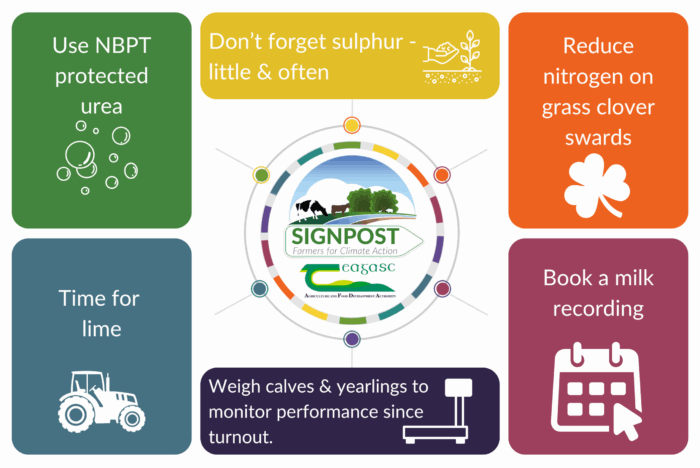
Each month, the Teagasc Signpost Programme promotes six key actions for each months. This month’s actions are:
- Use NBPT protected urea,
- Don’t forget sulphur – little and often,
- Reduce nitrogen on grass clover swards,
- Book a milk recording,
- Weigh calves and yearlings to monitor performance since turnout,
- Apply lime.