
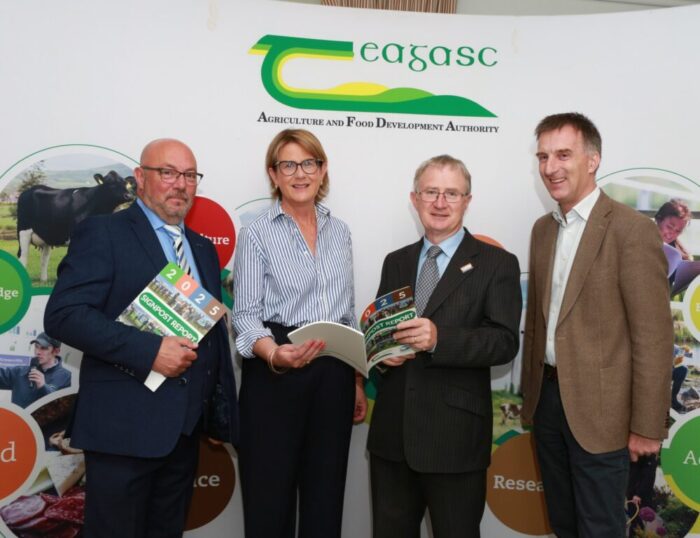
Since its inception in 2021, the Teagasc Signpost Programme has led climate action on Irish farms through the promotion of science-based solutions, tailored advisory support and strong farmer engagement.
A collaborative effort with 62 industry partners and 120 Signpost Demonstration farms, today, July 16, 2025, seen the launch of the Signpost Report 2025. This marked the fourth year of the national programme which aims to support Irish farmers improve environmental sustainability, particularly to reduce greenhouse gas emissions, while maintaining profitability and production.
Speaking at the launch of the report, Teagasc Director, Professor Frank O’Mara noted that farmers are not just willing but are already taking action on climate change.
As highlighted in the Signpost Report 2025, some of the key actions from the Signpost Programme include:
- More than 5,000 soil samples were analysed from participating farms, showing substantial improvements in soil fertility with, for example, 70% of soils on dairy farms being optimum for pH, P and K in 2024.
- A major deep-soil carbon campaign covering 91 farms confirmed that Irish grasslands, particularly those on clay-rich soils, have strong potential to act as carbon sinks.
- Improved nutrient use efficiency has contributed to a decline in overall fertiliser nitrogen (N) use, aided by greater incorporation of clover in swards, precision slurry application, and enhanced nutrient planning.
- Use of protected urea fertiliser has increased dramatically among Signpost farmers, with 76%, 58% and 69% of the chemical N applied on dairy, suckler beef and dairy beef farms respectively, applied as protected urea, compared to a national average of less than 30%.
- Over 90% of cattle farmers in the programme now use low-emission slurry spreading (LESS) methods, which significantly reduce ammonia losses and improve nutrient retention.
- In tillage systems, practices such as cover cropping, reduced fertiliser use, and incorporation of organic manures have all seen increased usage across the programme.
The programme also prioritised farmer engagement and knowledge exchange through the launch of the Signpost Advisory Programme and the organisation of 260 on-farm events. Extensive communication and training activities further supported the dissemination of information on sustainable practices to farmers.
“The whole of industry approach has been invaluable, and by combining scientific research with practical, on-farm demonstrations, the Signpost Programme is delivering results that matter, for farmers, for the environment, and for Ireland’s climate goals, Professor O’Mara noted.
Overall, the programme represents a comprehensive effort to advance environmental stewardship in Irish agriculture, and this is reflected in agricultural emissions having decreased by 1.0 MtCO2e (4.6%) since 2018.
“We’ve shown that climate action on farms is not only achievable but scalable,” said Dr. Tom O’Dwyer, Head of the Signpost Programme. “The enthusiasm of farmers to engage, adapt, and lead is driving change across the country. These are practical steps with measurable impact, supported by evidence and collaboration.”
Farmer behaviour is also shifting. Surveys from 2024 revealed that over 90% of Signpost Demonstration Farmers understand their farm’s emissions profile, and 77% of farmers attending Signpost events have implemented at least one emissions-reducing practice after attending Signpost events.
For full insights, the Signpost Report 2025 (PDF) is available to download here.