
Energy companies are actively looking for land to install solar panels, have you been approached? If so, here are some answers to the key questions you may have.
Through the recently published Solar Energy Guide for Dairy Farmers, produced by John Upton, Barry Caslin, Francis Quigley, Teagasc, and Michael D. Murphy, Munster Technological University, the key considerations of leasing land for solar projects were outlined.
The Option period gives developers time to establish the basics of a project, which include:
- Obtaining planning permission,
- Setting up grid connection,
- Conducting surveys,
- Bidding into a Renewable Electricity Support Scheme (RESS) auction.
A successful auction bid guarantees financial support for the project. If the developer exercises the option, you will lease your land to them for 25 years or more with potential rents between €2,200 and €3,500 per hectare per year.
Professional advice is essential. If you are considering leasing your land to a solar company, seek professional tax advice especially if succession or transfer of the land to a child or family member is part of your long-term plan. The tax implications can be complex and could significantly affect your finances.
Key questions to ask
Before deciding whether to let your land for solar projects consider the following:
- What type of “developer” are they?
- What’s their track record? How many sites have they built? Where? When? Testimonials from other landowners?
- What is their financial backing – where is the project funding coming from?
- Who will own and operate the project, or will it be sold to another party?
- What’s the ethos of the company?
- Where else do they operate?
Large solar sites
Development is now shifting towards larger schemes of 40 MW or more, to benefit from economies of scale. Typically, 1 MW of installed capacity requires about two hectares (ha) of land; so many new sites require at least 80 hectares, depending on the project design.
What makes a suitable site?
Developers look for sites with the following characteristics:
- Proximity to a suitable power supply: Sites near a 33 kV distribution line or substation are ideal. Smaller 10 kV lines are usually unsuitable, and 110 kV transmission lines (carried on steel pylons) are often too large to connect to.
- Minimal third-party land requirements: Sites should ideally avoid the need to cross third-party land, as this adds costs and complications.
- Flat or south-facing slopes: These provide the best orientation for solar panels.
- Seclusion from residential areas: This helps minimise potential objections from local communities.
Grid restrictions remain
Spare capacity on electricity grids remains limited in many parts of Ireland, potentially restricting new developments. If grid capacity is available, act quickly as it may only be sufficient for one scheme in the area.
What returns can be expected?
Rents typically range from €2,200 – €3,500 per hectare per year, with some developers offering an additional payment linked to the site’s turnover. However, developers are increasingly opportunistic and €2,200 to €3,000 per hectare is more common.
Key factors influencing returns:
- Location and sunlight levels,
- Scale of the project, and
- Grid connection costs
Other considerations
- Battery storage: If battery storage is added to the site, negotiate an additional payment
- Inflation-linked income: Rental income is typically linked to inflation, with agreements often lasting 30 years or more
- Land use: Ensure clarity on the total area being rented, as security fences may create narrow, uneconomical strips of land around field boundaries.
Additional considerations
There are several other important factors to weigh before proceeding. Aside from the likely returns and whether the development is right for the business long-term, there are many other issues to consider, including:
- Ensure the developer covers all costs, including legal/professional fees, planning and grid applications, regardless of whether the project is completed.
- Developers handle the planning application, but landowners may need to engage with the local community to build support.
- Avoid exclusivity agreements until the full Heads of Terms have been agreed upon.
- Ensure provision is made for decommissioning and site reinstatement – for example, a clean-up/security bond or insurance policy.
- Verify that the developer has sufficient indemnity insurance during both the option agreement and lease periods.
- Address practicalities during/after construction, such as timing and duration of construction, access requirements, impact on drainage/soil structure, postconstruction clean-up and fault correcting – it is very important to provide for these as some landowners have been left with significant damage after lengthy and messy construction.
What are the tax implications?
Key points to note:
- Lease Income Tax: Income from solar farm leases do not qualify for traditional farming tax relief. All lease and option income is fully taxed, with no opportunity to offset expenses.
- Capital Gains Tax (CGT): Farmers over 55 years old who have owned and farmed the land for at least 10 years can transfer land with solar panels tax-free to a child, provided less than 50% of the area is covered by panels. If the land value exceeds €3 million, the excess may be subject to CGT.
- Keeping Farm Status: Leasing less than 50% of the land for solar panels, allows the farm to retain its status as a working farm for tax purposes.
- Agricultural Relief: Land used by solar panels does not qualify for agricultural relief unless less than 50% of the total farm area is covered by panels.
Example: Tax and Income breakdown
Lease example
- A 20-year lease at €2,200 per hectare generates €44,000 per hectare over 20 years.
- After income tax at 40%, the net income is €26,400 per hectare.
- Always seek professional advice to understand the tax implications fully and make an informed decision.
BISS eligibility and solar panels
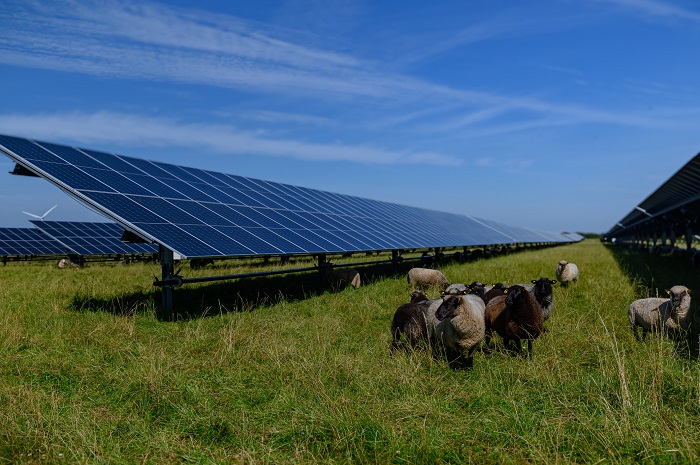
While parcels with solar panels will be considered on a case-by-case basis, in general, they will be considered eligible for the purposes of claiming payments under the BISS and other area-based schemes, with the solar panels being considered as ineligible features within the parcel. A key requirement for land to be deemed eligible is that there must be an agricultural activity in the parcel. In the case of areas with solar panels, grazing with sheep is a suitable agricultural activity. Other requirements to make land eligible, as set out in the terms and conditions for the various area-based schemes, must also be respected.
The solar panels will be addressed in the same way as any other ineligible feature within the parcel, e.g. rock, hardcore or a roadway, as set out in the 2023 Guide to Land Eligibility booklet published by the Department of Agriculture. Therefore, the eligible area of the parcel will have to be reduced to take account of the impact of the solar panels, including the supporting structures on forage availability along with any other ineligible features in the parcel. If the reduction is greater than 70%, the area will be considered ineligible. If the impact on the eligible area is less than 70% an appropriate percentage reduction must be made by applying a reduction co-efficient, as set out in the 2023 land eligibility booklet.
Ways a parcel can be ineligible:
- No agricultural activity on the land.
- Applicant doesn’t own, lease, or rent the land.
- No written agreement to access the land.
Potential eligibility:
- If ineligible features (e.g. solar panels and their structures) cover less than 70% of the parcel, the land may be eligible for BISS, subject to a proportional reduction.
- If ineligible features are under 50%, the parcel is fully eligible, provided agricultural activity continues (e.g. grazing).
- Agricultural use must not be impeded by the solar infrastructure
Know whom you are dealing with
There are three main types of solar developer, and it is crucial to know who you are dealing with,
- Site finders – offer terms to landowner and conduct grid application/ planning but then sell the project on to a developer to build.
- Developer with financial backing (for example, from pension fund or other investor) to build projects that they may then sell on.
- Funded developer in it for the long-term – developer takes on full planning, construction and operation of the site for the long-term.
While leasing land for solar projects can offer attractive returns, the decision requires careful consideration. Always seek professional tax and legal advice and understand both the short-term and long-term implications before proceeding.
For more information, read the publication: ‘A Solar Energy Guide for Dairy Farms’ here (PDF).