
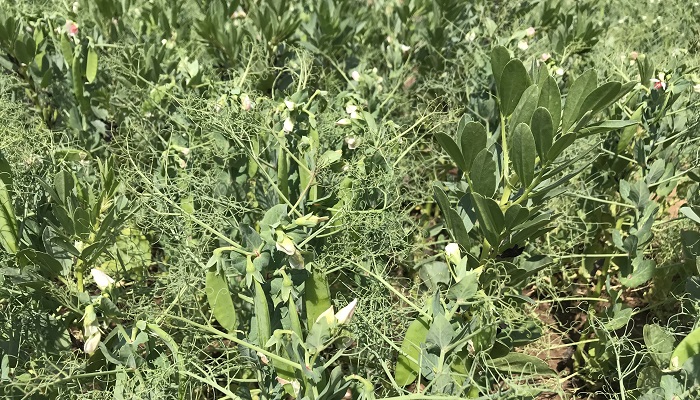
The renewed interest in plant-based proteins and sustainable farming is making pea crops in tillage rotations more appealing, writes Teagasc Crops Specialist, Ciaran Collins.
As part of a recent Today’s Farm article, Ciaran Collins wrote: Once a common crop on Irish farms, peas have largely disappeared from tillage rotations due to high risks, especially from pre-harvest lodging. But with a renewed interest in plant-based proteins and sustainable farming, researchers at Teagasc are taking a fresh look at the crop. And the results are encouraging – particularly for those willing to try intercropping of pea and bean.
Factors driving renewed interest in peas
- Demand for home-produced native protein sources for the animal feed sector.
- Rising demand for plant-based proteins for the food sector like pea flour and protein isolate.
- Environmental benefits, including improved soil health, biodiversity and reduced greenhouse gas emissions.
- Support from the EU Farm to Fork strategy, which prioritises local protein production to reduce reliance on imports.
Our climate is well suited to pea production. Irish yields are amongst the highest in Europe, but despite this, only about 650 hectares of peas are grown here each year. This is a fraction of what could be grown.
A key advantage of including peas in an Irish arable rotation is their suitability for lighter soils, whereas faba beans can struggle – particularly in dry years. Additionally, peas benefit from a later sowing date in the spring and an earlier harvest than faba beans. But for Irish farmers in Ireland to embrace peas again, we must address the biggest challenge which is lodging.
The pea lodging problem
Peas are very prone to lodging, where plants fall over before harvest. This leads to significant yield loss and difficulties with combining. Teagasc researchers at Oak Park, led by Dr Sheila Alves, have tackled the problem by intercropping peas with faba beans.
It is a simple idea where the stronger stems of faba beans support the lodging-prone pea plants. The beans act as a scaffold for the peas. Starting with plot trials in Teagasc Oak Park and expanding to six commercial farms across Laois, Tipperary, Cork, and Wicklow in 2024, the trials compared sole pea plots with intercropped plots using a 70:30 pea-to-bean ratio (Carrington peas and Louhi beans).
Key outcomes from the 2024 trials
- Reduced lodging: Faba beans help support the pea canopy, resulting in taller, more upright pea plants.
- Extended harvest window: Intercropping delayed maturity slightly, giving farmers more flexibility at harvest without compromising yield.
- Yield stability: Across trials, there was no significant yield loss from intercropping compared to sole pea crops.
- Faba beans with strong stems and early maturity (e.g. Louhi) are the most effective partners for peas.
- Results to date suggest that intercropping peas with beans does not eliminate the lodging risk and the crop will eventually lodge but it can delay lodging and reduce risk of crop deterioration.
Recommendations for growers based on 2024 experiments
- Sow in April. Plant 80 seeds/m² using a 70:30 pea-to-bean ratio.
- Select early-maturing faba bean with good stem strength to maximise support. Variety Louhi used in 2024.
- Pre-emerge herbicide essential, e.g. Nirvana 4.0L/ha.
- Two fungicides three weeks apart from early flowering, similar to faba beans.
- No specialist machinery required, sow and harvest both crops together for ease of management.
More from Teagasc Daily: Fast-growing faba beans – a runner in shorter growing seasons?