
Teagasc data shows that farms that are positive to PRRS have an extra cost of 4-7c/kg deadweight. This is not only because of the effects of the PRRS virus itself but because the virus opens the door to other secondary pathogens like Pasteurella or Streptococcus, increasing labour costs, medicine use, mortality and reducing growth.
As part of a recent update from the Teagasc Pigs newsletter, Emer McCrum and Edgar Garcia Manzanilla, Teagasc, and Emma O’Connor and Carla Gomes, AHI, tells us more on the PRRS Control Programme in the Republic of Ireland.
Due to this cost, Pig Regen and DAERA identified PRRS as a priority for disease control and started a PRRS Regional Control Programme that has been ongoing in Northern Ireland for the last five years. The programme was an Operational Group (funded by European Innovation Partnership, EIP) and started as a pilot in a 5km radius area around Cookstown.
The pilot programme resulted in benefits in productive performance (increased in born alive and weights), reductions in factory lesions (reduced pericarditis and pleurisy) and, most important, it was a great social experience showing the benefit of collaboration between stakeholders. The programme is now being rolled out across Northern Ireland.
The programme’s main actions
The programme is very simple and is designed to bother farmers and veterinarians as little as possible. The four main actions are:
- Test farms regularly to study type and evolution of the virus,
- Create a pig health mapping tool with the location and PRRS status of the farms,
- Synchronise PRRS vaccination in all the farms in the area,
- Implement biosecurity actions to reduce PRRS virus circulation within and between farms.
Extending the programme into the Republic of Ireland
It makes sense to extend the programme to the whole island of Ireland and, for this reason, IFA approached Teagasc to develop a similar approach in the Republic of Ireland. Teagasc and AHI have secured funding (EIP Operational Group, similar to NI) to pilot the programme in a group of farms in Cavan, Monaghan and Donegal.
The first farms of interest are the ones in the border regions because those are the ones that are in proximity to Northern Irish farms and can infect them. The actions in these farms will be the same as in Northern Ireland: test farms regularly, map the farms and their PRRS status, synchronise the vaccination on the same dates as in Northern Ireland and implement biosecurity actions.
The team
The implementation of the programme is a very intensive exercise and some key figures in the success of the Northern Ireland programme are Gary Anderson, Chair of Pig Regen, Violet Wylie, Pig Regen Innovation Broker, who ensures coordination among the stakeholders on a daily basis, and Mark Hawe, DAERA Advisor, who supports the implementation within the farmer network.
These roles will be developed in the Republic of Ireland by Emma O’Connor, AHI Innovation Broker, and Emer McCrum, Teagasc Advisor. If you are interested in knowing more about this programme please contact them directly eoconnor@animalhealthireland.ie and emer.mccrum@teagasc.ie.
Testing farms and mapping their PRRS status
Collaboration and openness are key for the success of such a programme (as is confidentiality within the group) and the first step is to identify the location of all the involved farms, their PRRS status and their vaccination practices. This knowledge helps to decide which are the areas with more risk and the main actions needed at an area level to reduce the circulation of virus.
AHI developed a survey, and 92 farms were identified in the borders region of which 66.3% were confirmed or suspected positive, 28.3% confirmed negative and 5.4% don’t know their status. Of those, most of the farms confirmed positive are vaccinating, mostly in sows but very few in piglets too.
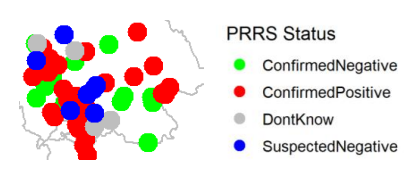
As an example of the need for mapping, you can see the figure below which represents a sample radius of around 20km in the Cavan area with some farms included. The size of the point has been increased, and the actual status of some farms have been changed for confidentiality. The first step in this map would be to confirm the status of those farms that are suspected or whose status we do not know. Once we know the status of all the farms, we need to discuss how to control the risk of negative farms becoming positive and how we can minimise circulation of the virus in positive farms to avoid clinical disease to improve health and reduce costs.
Synchronising vaccination and implementing biosecurity actions
The farms participating in the programme do not need to change their vaccine. Those that are on a blanket vaccination programme will need to synchronise the timing of vaccination among them and with NI. Those on a 6 and 60 protocol can continue with the same protocol.
Once the vaccination is synchronised, the veterinarians will assess the biosecurity practices in the farm using some sections of the Biocheck.UGent tool and they will identify the easiest and most impactful actions to improve biosecurity in the farm and reduce the load of virus. Biosecurity actions can be as simple as changing needles more often or using colour coded materials for different stages.
The programme will run for the next two years, and the situation will be reassessed annually (more often if needed) for performance, circulation of virus and lung lesions in the factory. One of the advantages of this programme is that it will not only affect the clinical effects of PRRS but also the general health and welfare of the animals. Teagasc and AHI are in the process of obtaining extra funding to add analysis of flu in the same farms to have a more complete picture of the pathogens.
Read the full Teagasc Pigs newsletter (PDF) here.
More from Teagasc Daily: WelFarmers – Good Practices Evaluation Underway
More from Teagasc Daily: If crude protein is down, what’s up?